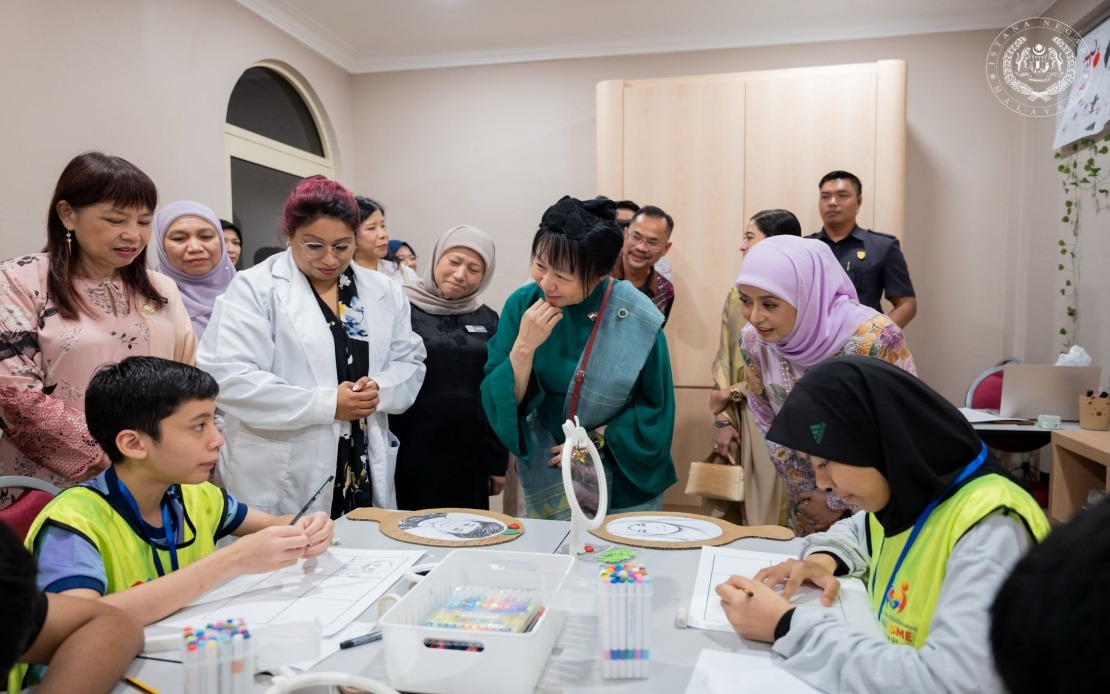
Her Majesty Raja Zarith Sofiah, Queen of Malaysia, hosted Singapore First Lady Jane Ittogi Shanmugaratnam at the Bangi Autism Service Centre (PPA) near Kuala Lumpur on July 14, a visit that demonstrated the strengthening social services dialogue between Southeast Asia's two most developed economies. The engagement formed part of a broader state visit programme by Singapore President Tharman Shanmugaratnam, marking the kind of high-level diplomatic engagement that increasingly extends beyond conventional bilateral ceremonies into substantive areas of public policy and social development.
Upon arrival, Jane Ittogi was received by Raja Zarith Sofiah alongside Tunku Tun Aminah Sultan Ibrahim, setting a formal yet accessible tone for the facility tour. The delegation encompassed Malaysia's highest-ranking officials responsible for social welfare, including Prime Minister's wife Datuk Seri Dr Wan Azizah Wan Ismail and Women, Family and Community Development Minister Datuk Seri Nancy Shukri. This breadth of representation underscored the Malaysian government's commitment to positioning autism support as a priority development issue rather than a marginal concern, a signal particularly important for families navigating the Malaysian social services ecosystem.
The visiting party toured core operational spaces within the centre, inspecting the Activities of Daily Living (ADL) Room, Occupational Therapy Room, and gymnasium facilities. These visits allowed Singapore's First Lady direct observation of Malaysia's hands-on approach to autism intervention, where individuals receive training in essential daily skills and therapeutic support within a community-based framework. For Malaysian stakeholders, such international scrutiny validates local innovation and encourages continued investment in what remains a resource-constrained sector relative to demand.
Minister Nancy Shukri disclosed during welcoming remarks that 93,199 individuals with autism had been registered with the Social Welfare Department (JKM) as of June 2024. This figure carries significant implications for policy planning across the region, particularly as Malaysia grapples with the dual challenge of rising diagnosis rates and the need to scale appropriate services. Shukri attributed the upward trajectory not merely to genuine prevalence increases but also to improved public awareness campaigns and enhanced access to diagnostic services—a distinction that matters greatly for resource allocation decisions.
The expected continued growth in registered cases reflects a broader Southeast Asian pattern whereby developmental economies are progressively identifying conditions previously underdiagnosed or entirely unrecognized. Malaysia's trajectory mirrors similar increases in neighbouring countries as healthcare systems mature and awareness spreads beyond urban centres. However, this expansion of the diagnostic net creates acute pressures on intervention capacity, making centres like Bangi critical nodes within the national support infrastructure.
The Bangi Autism Service Centre operates through a carefully structured public-private partnership involving the Social Welfare Department alongside two established non-governmental organisations: the National Autism Society of Malaysia (NASOM) and the Damansara Damai Community-Based Rehabilitation Centre (PDK). This model represents a pragmatic Malaysian response to service delivery constraints, leveraging NGO expertise and community networks while maintaining government oversight and resource contribution. Such partnerships have become increasingly common across Southeast Asia as governments seek to stretch limited budgets whilst preserving quality standards.
From Singapore's vantage point, Malaysia's centre-based approach complements the city-state's own social services architecture. Singapore, with vastly smaller geography and population, has developed more concentrated, highly systematized autism services; observing Malaysia's distributed community model offers valuable comparative insights into scaling interventions across larger territorial and demographic spaces. The bilateral exchange implicit in such visits facilitates learning transfer that can benefit both nations' policy development.
The visit concluded at approximately 11:30 am, providing a focused but substantive engagement rather than a ceremonial quick pass. This duration allowed meaningful conversation about operational challenges, evidence-based practices, and resource constraints—the genuine substance of social services cooperation. For Malaysian officials, such engagements with peers from a developed regional neighbour offer valuable opportunities to benchmark progress and identify best practices adaptable to local contexts.
These high-profile visits carry symbolic weight beyond their immediate diplomatic function. By elevating autism services to the level of state visit programming, Malaysia's government signals that disability support constitutes legitimate state business worthy of senior leadership attention. This messaging matters substantially for families struggling to access services and for NGOs competing for government support and public donations. International validation, particularly from a developed neighbouring state, indirectly strengthens domestic constituencies advocating for expanded autism funding and services.
The strengthened Malaysia-Singapore relationship reflected through this engagement extends into a broader regional context where social development increasingly features alongside traditional economic and security cooperation. Both nations face ageing populations, rising non-communicable disease burdens, and evolving family structures that strain conventional support systems. Collaborative approaches to identifying innovations and scaling effective interventions represent a practical dimension of ASEAN cooperation that directly touches citizens' lives, complementing the trade and diplomatic dimensions that dominate headline coverage.

