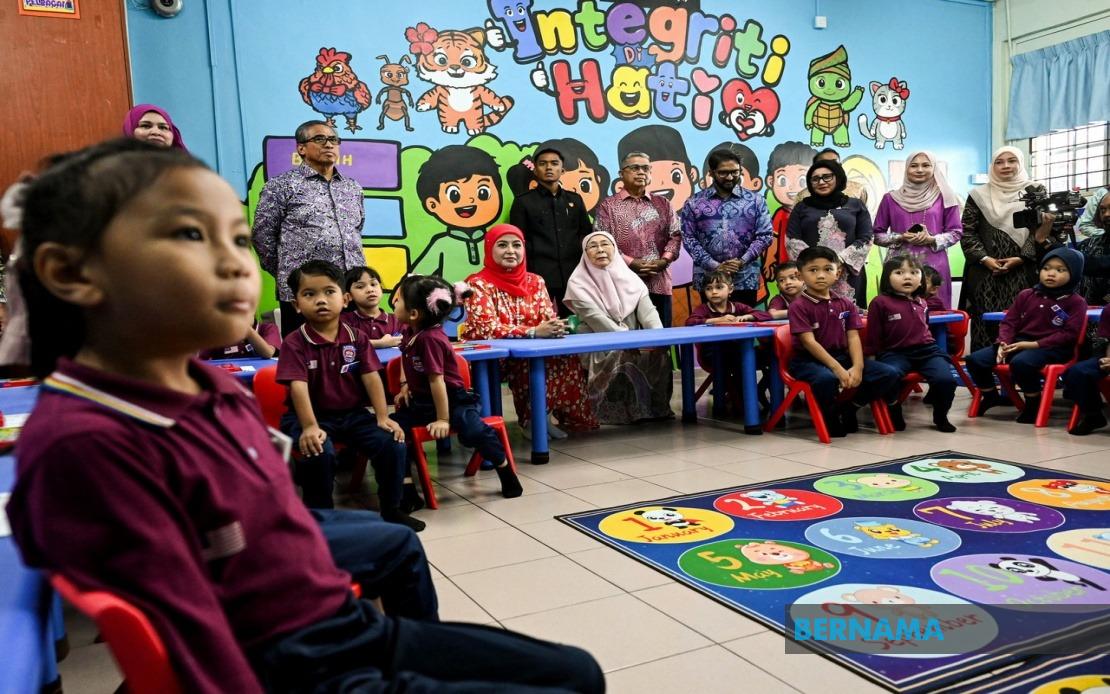
Queen Raja Zarith Sofiah officially inaugurated the Children's Integrity Module (MIKa) at Tabika Perpaduan Taman Bukit Cheras in Kuala Lumpur on Tuesday, signalling the start of an ambitious long-term effort to cultivate ethical principles among Malaysian children from their earliest years. The royal endorsement underscores the government's commitment to character formation as a foundation for national development, with the programme targeting young learners aged between two and six years old.
The ceremony drew a distinguished gathering of government officials, including National Unity Minister Datuk Aaron Ago Dagang, Chief Secretary to the Government Tan Sri Shamsul Azri Abu Bakar, and Bandar Tun Razak Member of Parliament Datuk Seri Dr Wan Azizah Wan Ismail. After receiving the Queen upon her 9.45 am arrival, officials conducted her through the venue, where she observed an interactive learning simulation in the classroom and engaged directly with the young pupils participating in the module's activities.
The MIKa initiative represents a deliberate policy shift toward preventive ethics education, premised on the conviction that integrity cannot be legislated into existence but must be cultivated as habit and practice during formative years. Tan Sri Shamsul Azri elaborated on this philosophy in his remarks, contending that integrity rooted in genuine personal conviction proves far more durable than compliance driven by external rules. This approach aligns with emerging international research in early childhood development, which emphasises that moral reasoning and ethical behaviours develop substantially before formal schooling begins.
Development of MIKa commenced in 2024 with input from 35 early childhood education specialists who constructed the curriculum framework and learning materials. The collaborative effort drew support from multiple government ministries, statutory agencies, and higher education institutions, reflecting a whole-of-ecosystem approach to implementation. This multi-stakeholder engagement strategy indicates recognition that embedding integrity across Malaysia's diverse early childhood sector requires coordination among diverse actors operating under varying governance structures.
The scope of ambition embedded in MIKa proves remarkable when considering Malaysia's fragmented early childhood landscape. The government targets reaching more than 31,000 childcare centres, kindergartens, and preschools by 2030, encompassing the vast majority of children entering the formal education system. Such comprehensive penetration would represent a significant undertaking in curriculum harmonisation and teacher training across both urban and rural settings, and would require substantial investment in materials, professional development, and monitoring mechanisms.
Tan Sri Shamsul Azri's articulation of the philosophical underpinning stressed that institutional frameworks alone cannot generate the trustworthiness and principled behaviour that Malaysia requires for its development trajectory. Instead, the argument proceeds, durably ethical citizenship emerges when individuals internalise integrity as a guiding value rather than observing it from fear of penalty. This perspective finds resonance in Malaysia's broader nation-building agenda, particularly as policymakers grapple with recurring concerns about governance standards and institutional trust.
Parental involvement stands highlighted as essential to MIKa's success, with officials acknowledging that early childhood educators cannot bear sole responsibility for character formation. The initiative thus implicitly calls upon families to model integrity in their daily conduct and to reinforce the values that MIKa introduces in educational settings. This recognition that integrity education operates most effectively within ecosystems encompassing home, school, and community suggests a more nuanced approach than purely curriculum-based interventions.
For Malaysia's regional position, the MIKa launch signals an attempt to address perceived deficits in institutional integrity that periodically surface in public discourse. By beginning integrity education during the preschool years, policymakers evidently calculate that generations entering the workforce in the 2030s and beyond will embody higher standards of personal and professional ethics. This long-term perspective reflects confidence that systematic investment in early value formation can yield measurable social returns through improved governance and institutional performance decades hence.
The programme's emphasis on teaching integrity to children aged two to six carries particular resonance for Southeast Asian nations confronting similar governance challenges. Malaysia's neighbouring countries face comparable pressures to strengthen institutional trust and ethical standards, suggesting that MIKa's model could offer insights applicable across the region. The willingness of Malaysia's government to position integrity education as a strategic national priority, worthy of royal patronage and multi-agency coordination, potentially influences how other Southeast Asian policymakers conceptualise early childhood development's role in governance improvement.
Implementing such an ambitious curriculum across diverse institutional settings presents considerable practical challenges that will test government commitment beyond the launch event. Ensuring consistent quality in teacher training, maintaining curriculum fidelity across urban childcare chains and rural community-run facilities, and measuring the long-term impact of early integrity education all demand sustained attention and resource allocation. The success of MIKa ultimately depends less on the eloquence of its philosophical foundations than on the rigour with which implementation unfolds across Malaysia's complex early childhood ecosystem.
The initiative also reflects Malaysia's attempt to address integrity concerns proactively through institutional design rather than reactive enforcement. Rather than awaiting behavioural problems to emerge and then applying corrective measures, MIKa seeks to establish ethical foundations before problematic patterns crystallise. This preventive orientation, if executed effectively, could substantially reduce the social and economic costs associated with corruption, fraud, and institutional dysfunction that periodically plague Malaysian governance.
As the Queen's involvement signals governmental seriousness about MIKa, implementation momentum will now depend upon whether resource commitments match rhetorical support and whether government agencies coordinate effectively in deploying materials and training across the targeted 31,000 institutions. The coming years will reveal whether MIKa becomes a signature programme that meaningfully transforms integrity culture among Malaysian youth, or whether it remains a well-intentioned initiative that struggles against practical constraints and competing priorities.

