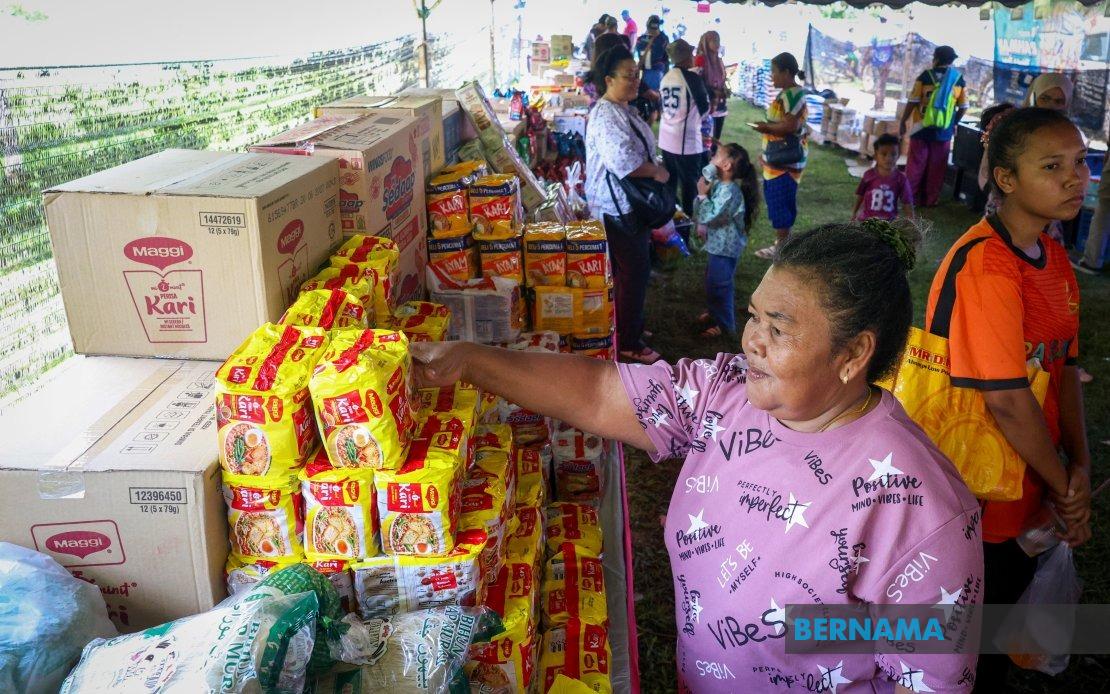
A mobile subsidy initiative has reached one of Kelantan's most isolated Orang Asli settlements, removing a significant burden on indigenous families who previously endured gruelling journeys to access government-subsidised groceries. The Rahmah MADANI Sales Programme (PJRM) now operates at Pasik Resettlement Scheme in Gua Musang, serving more than 1,000 Temiar residents who were previously forced to travel approximately two and a half hours to Kampung Jerek to purchase discounted rice, cooking oil, and other staples through their SARA credit allocation.
The arrival of the programme addresses a persistent hardship for rural Orang Asli communities struggling with elevated living expenses and limited commercial infrastructure. For residents like Ramli Chimbong, a 51-year-old from Kampung Ayong, the previous arrangement meant spending at least RM600 per trip on vehicle rental, meals, and incidental costs just to access prices that government intended to be affordable. The calculation becomes starkly unfavourable when the savings on subsidised goods barely offset the transportation expenses incurred to reach them, effectively negating the poverty-relief intent of the subsidy itself.
The price differential illustrates why the programme's local deployment matters profoundly for household budgets in remote areas. A nine-kilogramme bag of rice retails for approximately RM40 in village shops but through PJRM costs only RM29, representing a 27.5 percent saving on a dietary staple. When multiplied across multiple monthly purchases and extended to cooking oil, sugar, and other essentials, such discounts accumulate into meaningful relief for families living substantially below national income averages. Transportation costs previously consumed any economic benefit the subsidy offered, leaving residents financially worse off despite nominally having access to cheaper goods.
The operational deployment reflects careful supply planning and grassroots understanding of community needs. SMS Maju Solution, the private operator managing the Pasik RPS point, mobilised 100 categories of goods including 300 bags of rice, 300 trays of eggs, and 300 live chickens, attracting residents to begin queuing from 9 am onwards. The breadth of stock suggests organisers recognised that isolated communities require comprehensive provisioning rather than token symbolic gestures, and the early morning crowds indicate genuine demand and community awareness of the initiative.
A particularly telling detail emerges regarding SARA credit balances held in residents' MyKad digital accounts. Operator Sabariah Mohamed Sayuti observed that most participants retained between RM300 and RM800 in unused government assistance credits, with very few individuals showing balances below RM100. This finding suggests previous barriers to accessing the PJRM system—principally the insurmountable travel burden—prevented Orang Asli populations from fully utilising entitlements already allocated to them. The programme essentially converts dormant government assistance into actual household purchasing power by eliminating the geographical friction that previously rendered those credits inaccessible.
Logistical challenges accompanying the initiative underscore the infrastructure deficits facing remote Orang Asli settlements. SMS Maju Solution's supply vehicles encountered significant difficulties navigating roads to Pos Pasik, with a tyre bursting on the rocky and muddy terrain. These obstacles, whilst surmountable for a coordinated programme launch, highlight why permanent commercial retail infrastructure never developed in such locations—the cost structures are fundamentally uneconomical for private operators. Government intervention through mobile subsidy schemes represents a pragmatic accommodation to geographical realities rather than a comprehensive solution to economic marginalisation.
Statewide political figures recognised the programme's significance for rural policy implementation. Nenggiri assemblyman Mohd Azmawi Fikri Abdul Ghani characterised the PJRM deployment as a government mechanism enabling rural communities to withstand inflationary pressures eroding purchasing power. His statement reflects broader recognition that while macroeconomic policies address national inflation trajectories, isolated populations require targeted interventions that physically bring assistance to where people live rather than requiring them to undertake expensive journeys to access it. The assemblyman explicitly advocated expanding identical schemes to all Orang Asli settlements, suggesting the Pasik model represents a replicable template rather than a one-off pilot.
The initiative carries particular relevance for Malaysia's indigenous minority, whose socioeconomic indicators consistently underperform national averages across income, education, and health metrics. Orang Asli communities experience both lower baseline incomes and geographic isolation that multiplies effective costs of accessing government services and commercial goods. The PJRM's arrival at Pasik demonstrates that even modest interventions addressing accessibility can significantly improve welfare outcomes when tailored to community circumstances. Whether such programmes represent sustainable policy or temporary relief measures remains an ongoing question for policymakers considering indigenous affairs strategy.
From a regional Southeast Asian perspective, the Pasik initiative illustrates how densely forested terrain and dispersed indigenous populations throughout mainland Southeast Asia create persistent development challenges that traditional market mechanisms cannot resolve. Thailand, Myanmar, Laos, and Cambodia all contain analogous Orang Asli-equivalent populations facing comparable isolation and poverty. Malaysia's approach of deploying mobile subsidy schemes offers a scalable model that other nations might adapt, particularly as indigenous rights movements increasingly demand that government assistance actually reach intended beneficiaries rather than remaining theoretically available but practically inaccessible. The Rahmah MADANI programme, in reaching Pasik, demonstrates that political will and logistical coordination can bridge geographical divides that poverty alone cannot overcome.

