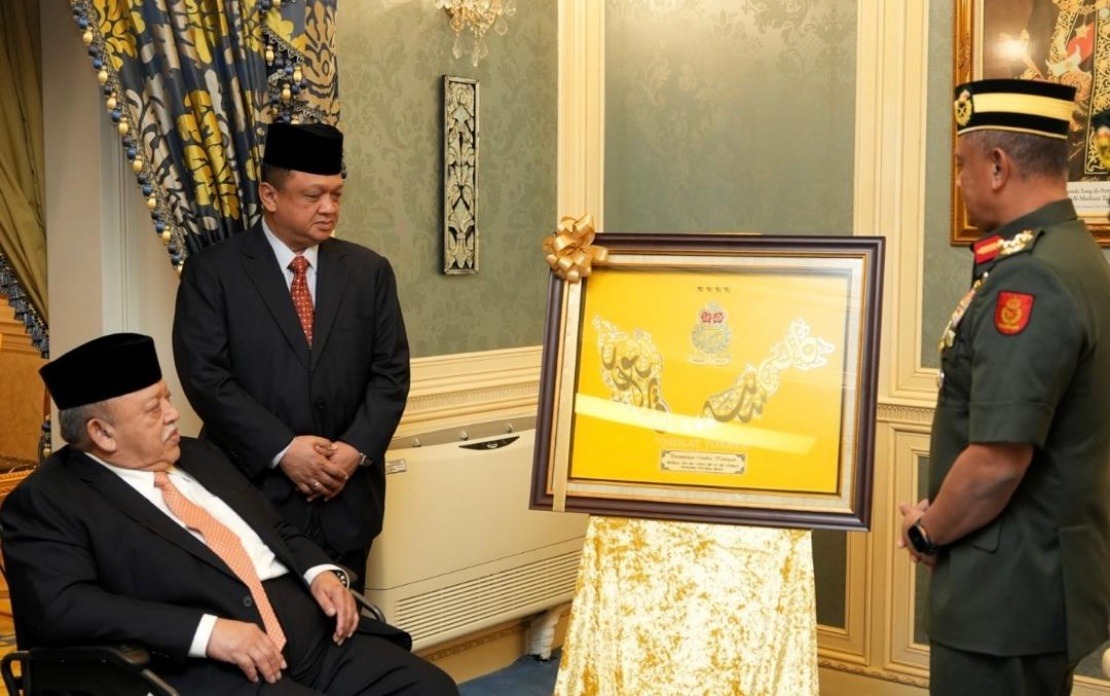
The Raja of Perlis, Tuanku Syed Sirajuddin Jamalullail, received the Chief of Defence Force General Tan Sri Azhan Md Othman during an official audience on July 29 at the Balai Menghadap Biru chamber within Istana Arau in the state capital. The formal gathering underscored the enduring institutional relationship between Malaysia's monarchical structure and its military leadership, a cornerstone of the nation's constitutional framework and security architecture.
The Raja Muda of Perlis, Brigadier General Tuanku Syed Faizuddin Putra Jamalullail, attended the meeting alongside his father. The Raja Muda holds the concurrent position of Commander of the 504th Territorial Army Regiment, which operates from Kem Bukit Keteri near the border town of Padang Besar, demonstrating the direct involvement of Perlis's royal household in the state's military administration and defence operations.
According to a statement released by Istana Arau, the audience served as an occasion to reinforce the longstanding relationship between Perlis's royal institution and the armed forces. Such formal meetings between state rulers and senior military officials carry particular significance in Malaysia's system of government, where the monarchy maintains constitutional responsibility for defence matters and the armed forces operate under the formal authority of the Crown.
The Raja of Perlis holds the ceremonial title of Colonel-in-Chief of both the Royal Ranger Regiment and the Royal Military Police Corps, positions that reflect the traditional role of Malay rulers as patrons and custodians of military institutions within their respective states. These honorary appointments, while largely ceremonial, carry symbolic weight in strengthening bonds between civilian leadership and the defence establishment.
The statement from the palace emphasised that the engagement reflected a shared commitment to utilising military-royal cooperation as a mechanism for advancing multiple national priorities. Rather than a purely ceremonial exercise, the audience was characterised as a platform for discussing strategic collaboration across security, public welfare, and broader economic development initiatives affecting both the state and the nation.
Perlis, located in Malaysia's northern frontier, occupies a distinctive position in the country's security landscape. The state shares a direct international border with Thailand near Padang Besar, making it strategically important for cross-border security cooperation, transnational crime prevention, and regional stability efforts. The presence of territorial army units within the state reflects the military's commitment to maintaining readiness along this sensitive frontier zone.
The meeting also highlighted the armed forces' recognition of the constitutional and ceremonial role that state rulers play in Malaysia's defence framework. The monarchy's involvement in military affairs extends beyond symbolic recognition to include formal consultative processes, particularly regarding appointments of senior officers and policies affecting security and defence matters within individual states.
For Malaysia's military establishment, such engagements with state-level leadership serve multiple purposes: they reinforce the principle of civil-military cooperation under constitutional monarchy, demonstrate the armed forces' commitment to working within established governance structures, and provide opportunities to brief royal patrons on operational matters affecting their respective states and territories.
The emphasis on strengthening ties between defence and royal institutions comes at a time when Malaysia faces complex security challenges ranging from transnational organised crime and terrorism to maritime security concerns and cybersecurity threats. By maintaining robust institutional relationships across all levels of government, military and civil authorities can coordinate more effectively in addressing these multifaceted challenges.
From a Malaysian constitutional perspective, such formal audiences reaffirm the principle that the armed forces operate under the constitutional authority of the Yang di-Pertuan Agong and the state rulers rather than as an autonomous institution. This foundational principle distinguishes Malaysia's military-civilian relationship from many other regional and global counterparts.
The Perlis royal household's direct military engagement through the Raja Muda's command position demonstrates how individual states have integrated royal authority with practical military administration. This model has been successfully sustained throughout Malaysia's post-independence period, creating a framework where traditional monarchical institutions and modern defence structures reinforce rather than compete with one another.
Moving forward, such regular exchanges between state-level royal leadership and military commanders are likely to continue as mechanisms for addressing state-specific security needs, coordinating responses to transnational challenges particularly in border regions, and ensuring that the strategic interests of individual states are reflected in broader national defence planning.

