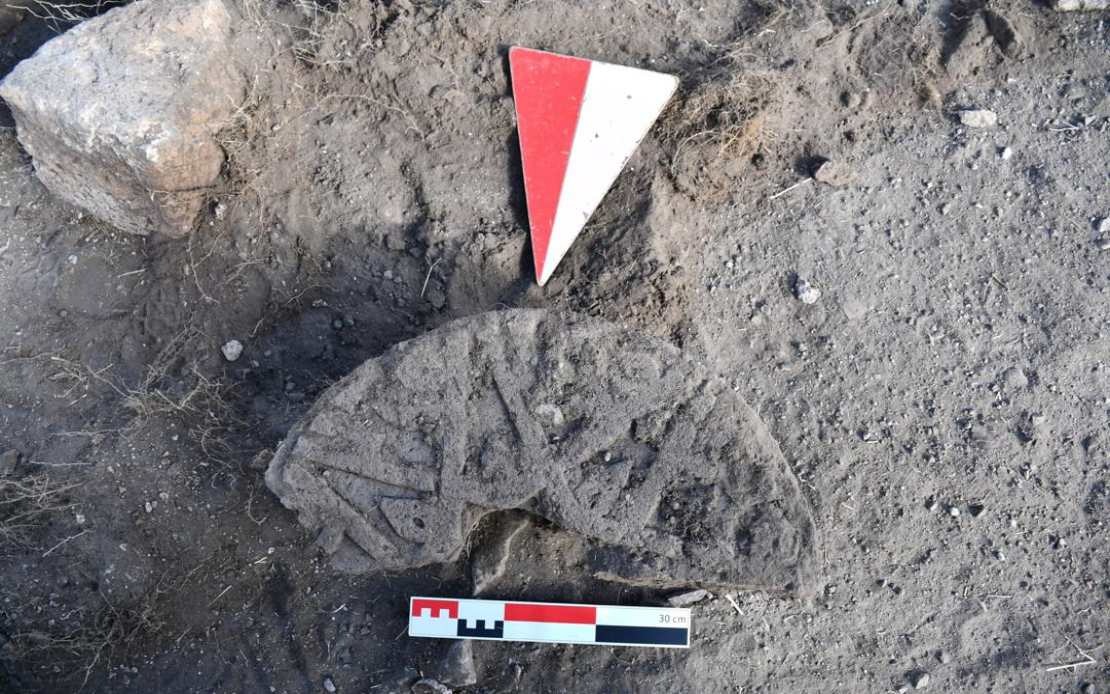
Turkish authorities have made a significant archaeological discovery at the historic Ani site in eastern Türkiye, unearthing a stone artefact bearing multiple inscriptions of Prophet Muhammad's name. Turkish Culture and Tourism Minister Mehmet Nuri Ersoy announced the finding through social media, describing the carved stone as offering important clues about the region's Islamic heritage. The discovery underscores the ongoing value of systematic excavation at one of the Eastern Mediterranean's most culturally significant archaeological zones.
The stone features the Prophet's name inscribed six times in Kufic script, the ancient angular form of Arabic writing that flourished during the early Islamic period. According to Minister Ersoy's account, three of these inscriptions have been meticulously carved into a decorative band that curves around an eight-pointed star motif. This artistic arrangement reflects the sophisticated design principles that characterised Seljuk decorative traditions, blending geometric patterns with sacred Islamic calligraphy in a manner typical of medieval Islamic art found throughout Anatolia and the broader Middle East.
Archaeologists believe the stone originated from a Seljuk tomb tower, suggesting it once served a commemorative or devotional function within the funerary architecture of the medieval Islamic period. The discovery emerged during systematic excavations at a Seljuk cemetery that has been the focus of scholarly investigation since 2021. This sustained research programme has gradually revealed the burial practices and material culture of the Seljuk communities who inhabited the region centuries ago, contributing to a more textured understanding of daily life and religious expression in medieval Anatolia.
The Ani site itself occupies a storied position in the history of the eastern Caucasus region and the Silk Road network. Nestled in Kars province on the Turkish-Armenian border, this ancient settlement functioned as a crucial commercial and cultural junction connecting East and West during antiquity and the medieval period. The city flourished particularly during the 10th and 11th centuries when it served as the capital of the Bagratid Armenian kingdom, a powerful state that controlled significant territories and commanded considerable economic and military influence throughout the region during its zenith.
Ani's strategic location meant it rarely remained under single rule for extended periods. Following the decline of Bagratid Armenian power, the city fell successively under Byzantine administration, then Seljuk Turkish control, and eventually Ottoman governance as the Ottoman Empire expanded eastward. Each successive power left architectural, artistic, and cultural imprints upon the settlement, transforming Ani into a multilayered palimpsest of different civilisations and faiths. These historical transitions shaped the city's character and created the archaeological richness that continues to attract international scholarly attention.
The broader significance of the Ani discovery extends beyond the immediate finding to illuminate patterns of cultural interaction and religious expression in medieval Anatolia. The Seljuk period represents a crucial chapter in the Islamicisation of Anatolia, yet archaeological evidence from specific sites like Ani helps scholars understand how this transformation unfolded at the local level. The presence of sophisticated Islamic calligraphy on funerary monuments speaks to the deep integration of Islamic artistic and religious practices within Seljuk society, even in border regions and formerly non-Muslim territories.
For Malaysian and Southeast Asian audiences with interest in heritage conservation and archaeological methodology, the Ani project offers instructive lessons. The systematic, long-term excavation approach adopted since 2021 mirrors best practices in regional archaeological projects. Turkey's commitment to scientific excavation and international scholarly collaboration at Ani demonstrates how heritage sites can be studied and preserved to benefit both local communities and global understanding of human history. This approach contrasts sharply with looting and uncontrolled excavation that has damaged numerous sites across the region.
Ani's designation as a UNESCO World Heritage Site in 2016 reflected international recognition of its outstanding universal value. The inscription acknowledged the site's exceptional testimony to architectural and urban planning traditions spanning multiple centuries and civilisations. The recent discovery of the inscribed stone reinforces this assessment, demonstrating that systematic scientific study continues to yield new insights even at well-known archaeological locations. Such findings validate continued investment in heritage preservation and research, particularly at sites located in politically sensitive border regions where access and resources may be limited.
The Kufic script inscriptions themselves merit consideration as artefacts of cultural and religious significance. Kufic developed in the early Islamic period and represents one of the earliest standardised forms of written Arabic. Its appearance on objects across the Islamic world, from Spain to Central Asia, testifies to the unifying role of Islamic civilisation during the medieval period. The choice to employ Kufic script on a Seljuk-period tomb monument demonstrates how communities in Anatolia during the 12th and 13th centuries maintained connections to broader Islamic cultural and artistic traditions, even as they developed distinctly Turkish and Anatolian characteristics.
Archaeological discoveries at Ani contribute to ongoing scholarly debates about cultural continuity and change in medieval Anatolia. The transition from Bagratid Armenian rule to Seljuk Turkish control involved complex processes of accommodation, assimilation, and occasionally conflict. Physical evidence from excavations, such as the newly discovered inscribed stone, provides concrete data that can test and refine historical narratives constructed primarily from written sources. The artefact's presence in a Seljuk cemetery demonstrates that Islamic religious practices and artistic expression were firmly established at Ani by the Seljuk period, reflecting broader patterns of settlement and cultural reorganisation across Anatolia.
The timing of this announcement carries symbolic weight as Türkiye continues efforts to position itself as a custodian of Islamic cultural heritage. The publication of the discovery through official government channels reflects contemporary Turkish engagement with archaeological findings as matters of national cultural importance. This visibility serves multiple purposes: it publicises Turkey's archaeological achievements internationally, demonstrates ongoing investment in heritage preservation, and signals the nation's commitment to uncovering and protecting material evidence of its diverse historical past.
For researchers studying Islamic art, Seljuk civilisation, and medieval Anatolian history, the inscribed stone promises to become a significant reference point in scholarly literature. The artefact's careful documentation and analysis will contribute to broader understanding of Seljuk epigraphy, tomb monument decoration, and religious expression. Museums and academic institutions worldwide are likely to reference this discovery in exhibitions and publications addressing medieval Islamic art and Anatolian history, extending its influence well beyond the immediate archaeological context of the Ani site itself.

