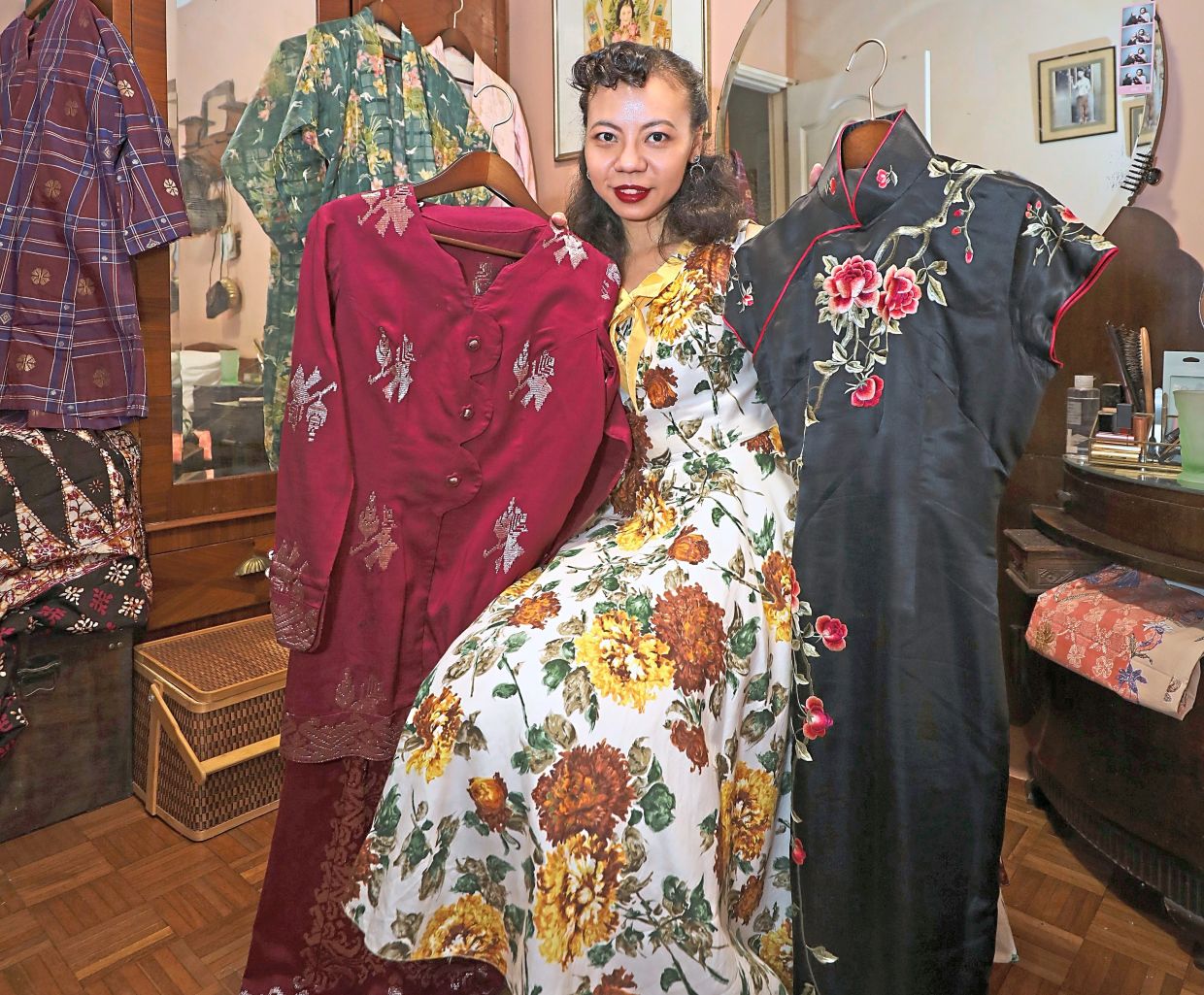
Framed black-and-white photographs can hold entire worlds within them. For Suzanne Lim, a grainy image of her grandparents mid-twirl on a dance hall floor in the 1950s became the genesis of a deeper journey into Malaysia's sartorial heritage. That single snapshot—capturing two figures dressed in their finest, moving with the unguarded joy of an era—sparked a fascination that would eventually see the 33-year-old graphic designer amass a substantial collection of vintage Malaysian textiles and garments ranging from kebaya to songket, each piece a tangible connection to lives lived generations earlier.
Lim's pathway into this realm was woven from multiple threads. Her grandfather's enthusiasm for rock and roll and her grandmother's work as a taxi dancer meant that fashion and movement occupied central places in family life. She began dancing at age four, progressed through formal Latin and ballroom training, and competed throughout her childhood. This early immersion in rhythmic arts naturally led her toward the elaborate costumes worn during cultural performances when she joined her secondary school's cultural club. Those ornate garments, complete with intricate accessories, planted seeds that would germinate into an adult passion. What began as casual curiosity hardened into conviction when she purchased her first vintage piece; the transaction itself became a turning point, transforming what might have remained a nostalgic hobby into something far more purposeful.
Today, Lim uses her social media presence to document herself wearing these historical pieces, deliberately positioning herself against heritage backdrops to create visual narratives about how Malaysians dressed in previous decades. Her approach is fundamentally educational. She views vintage clothing not merely as aesthetic objects but as primary historical documents—windows into the economic circumstances, social hierarchies, and lived experiences of their original wearers. A worn batik sarong or an aged cheongsam becomes evidence of a past that photographs alone cannot fully convey. In an era when younger Malaysians increasingly bypass traditional repositories of cultural knowledge like museums and published historical texts, Lim has identified a gap that she deliberately attempts to fill through her curation and presentation of authentic pieces.
She is not alone in this mission. Mohamad Alif Daniel Mohammad Nor, 25, approaches historical material culture from a different angle, yet arrives at remarkably similar conclusions about its pedagogical value. His entry point was personal narrative rather than family photographs—stories shared by his late grandmother opened a door that led him sequentially from oral history into musical interest, then historical cinema, and ultimately into the specificity of historical uniforms and artifacts. His collecting began earnestly in his mid-teens with Japanese occupation-era currency, a tangible object that embodied political rupture and colonial trauma. This initial interest matured into involvement with Persatuan Reka Ulang Sejarah (PRUS), an organization dedicated to historical re-enactment, where he has become engaged in embodied learning—wearing historical garments and inhabiting historical moments to understand them from within.
For both Lim and Mohamad Alif Daniel, the insight is consistent and powerful: fashion and historical artifacts teach dimensions of the past that textbooks cannot adequately convey. Wearing or studying a vintage garment provides direct confrontation with material reality—the weight of fabric, the construction techniques, the practical constraints imposed by historical fashion. This tactile engagement communicates information about social aspiration, economic access, gender norms, and aesthetic values far more vividly than written description. Mohamad Alif Daniel emphasizes that this experiential learning transmits cultural knowledge and identity formation in ways that conventional historical instruction fundamentally cannot replicate. He has observed that his social media documentation of traditional attire has encouraged others, particularly younger Malaysians who felt embarrassed or alienated from their heritage, to reclaim these garments with pride.
Yet both practitioners acknowledge the tension between historical authenticity and creative contemporary expression. Lim does not insist on strict period accuracy in every outfit; she frequently blends vintage pieces with modern elements, creating hybrid aesthetic statements that honor historical foundation while asserting contemporary identity. She recognizes that younger Malaysians are drawn to vintage not as a means of literal historical reenactment but as a vehicle for creative experimentation—a way to access tactile, material culture as a counterbalance to the ethereal, screen-based existence of modern digital life. There is genuine yearning, she observes, for something more physically grounded, more connected to tangible reality, a form of escapism from the disembodied quality of contemporary existence.
This generational hunger for vintage and historical material may reflect broader psychological needs emerging within digitally saturated societies. Young Malaysians increasingly collect vintage clothing and objects not primarily to recreate past periods but to participate in what Lim describes as a fundamentally creative practice—taking historical inspiration and infusing it with personal modern vision. This approach permits aesthetic and cultural freedom while maintaining connection to heritage. Yet boundaries matter. Both Lim and Mohamad Alif Daniel insist that this creative latitude must operate within defined parameters; fundamental characteristics of garments must be preserved to prevent cultural dilution or misrepresentation that could ultimately threaten the coherence of Malaysian cultural identity itself.
The stakes of this preservation work are significant within Malaysia's contemporary context. As globalization accelerates and younger generations spend increasing portions of their lives in digital environments, the intergenerational transmission of cultural knowledge faces unprecedented challenges. Museums remain relatively inaccessible to many; written historical sources require active seeking and literacy levels that not all segments of the population possess. Meanwhile, social media platforms provide immediate, visually compelling access to cultural narratives. By positioning themselves as cultural intermediaries—documenters and interpreters of heritage through the medium of fashion—figures like Lim and Mohamad Alif Daniel occupy crucial territory in the broader ecosystem of cultural preservation and transmission.
Lim has witnessed expanding circles of young Malaysians engaging in vintage collection and curation, suggesting that what began as niche enthusiasm may be crystallizing into broader cultural movement. This shift correlates with increased availability of vintage pieces through online marketplaces and growing sophistication in historical knowledge dissemination through digital platforms. The question of representation becomes paramount in this context. When Lim emphasizes carrying "as accurate a representation as I can," she articulates awareness that her platform carries responsibility. The image of herself wearing an authentic kebaya or songket, presented with contextual information, reaches audiences who might never encounter such garments in museums or family closets. That representational power creates obligation—obligation to honor the integrity of historical objects and the communities and eras they embody.
What emerges from conversations with these practitioners is a portrait of heritage preservation no longer confined to institutional contexts or formal academic channels. Instead, young Malaysians are democratizing access to cultural knowledge through personal creative practice, leveraging social media platforms to circulate historically grounded narratives on their own terms. This represents neither pure nostalgia nor antiquarian fetishism but rather a conscious effort to maintain cultural coherence amid rapid social change. By wearing vintage garments, documenting their details, and sharing these narratives with peers, Lim and Mohamad Alif Daniel participate in essential cultural work—ensuring that future generations inherit not merely theoretical knowledge of their heritage but tangible, embodied understanding of what it means to be Malaysian.

