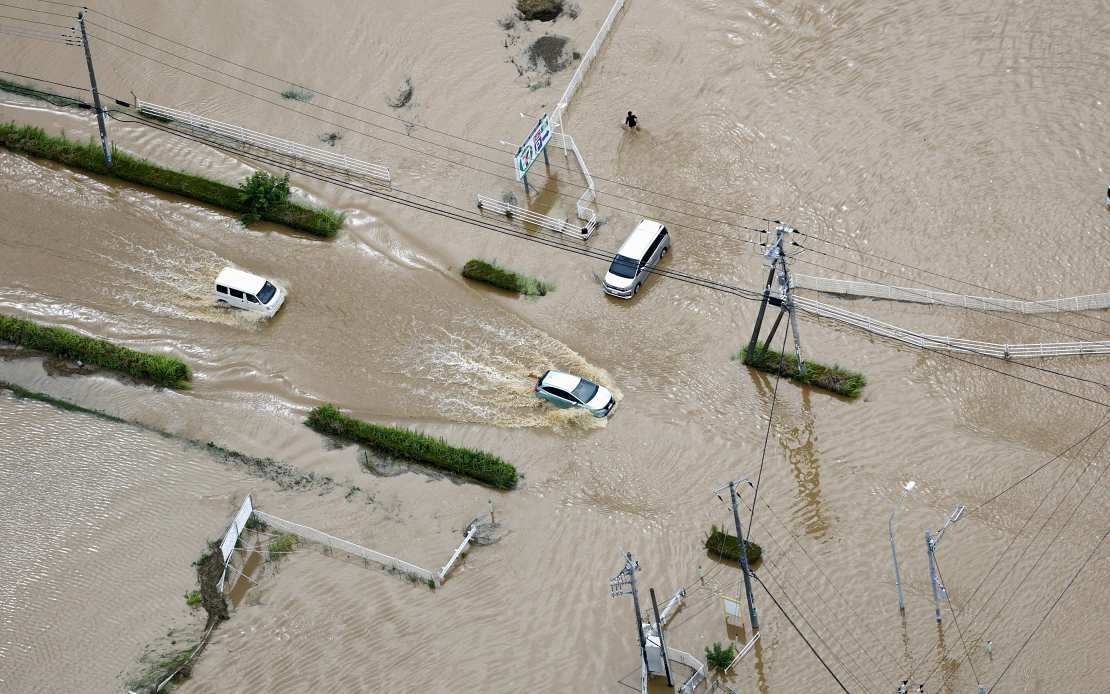
Japan's Chiba Prefecture faced one of its most severe weather emergencies in recent memory as torrential downpours swept through eastern Japan early Friday, leaving eight people dead across multiple municipalities and raising concerns about the region's vulnerability to extreme precipitation events. The death toll, confirmed by the Chiba Prefectural Government, spans the cities of Chiba, Kashiwa, Ichikawa, Sakura and Yachiyo, while four additional residents suffered minor injuries from the weather-related incident. The scale of the disaster underscores the growing threat posed by increasingly intense rainfall patterns in Japan and neighbouring regions of East Asia, a phenomenon many climate scientists attribute to shifting weather systems and warming ocean temperatures.
The meteorological measurements recorded during the storm illustrate the extraordinary intensity of the weather system. Chiba City received 348 millimetres of rain within a compressed 12-hour window ending at 1:40 am local time on Friday, according to Japan Meteorological Agency data. This deluge represented approximately three times the city's typical rainfall total for the entire month of August, condensed into merely half a day. Such concentration of precipitation creates severe flooding conditions and increases the risk of landslides in hilly or mountainous terrain, compounding the dangers faced by residents in affected areas.
In recognition of the crisis unfolding across the prefecture, the Japan Meteorological Agency escalated its alert status to Level 5—the most severe warning tier in its classification system—specifically addressing threats from both heavy rainfall and potential landslides in vulnerable zones of Chiba Prefecture. This maximum-level alert remained in effect through much of Friday before being downgraded to Level 4 or lower as the most intense precipitation subsided. However, meteorological officials cautioned that additional heavy downpours could develop, prompting them to urge residents and visitors to maintain heightened awareness and follow evacuation directives issued by local authorities.
The immediate humanitarian consequence of the flooding became visible in the scale of the evacuation operation. As of 11 am local time on Friday, approximately 102,600 residents remained under formal evacuation orders, having been compelled to abandon their residences for designated shelters or safe locations at higher elevations. This massive displacement reflects both the breadth of the affected zone and the precautionary approach adopted by Chiba authorities to prevent additional casualties. The coordination of such large-scale evacuations places considerable strain on local emergency management infrastructure, particularly when residents must be accommodated, fed, and provided medical attention in temporary facilities.
The transportation network serving the prefecture and connecting it to broader Japan suffered substantial disruption. Narita Airport, a major international travel hub located within Chiba Prefecture, saw approximately 7,000 passengers stranded overnight as train and bus services throughout the region ground to a halt. The airport operator reported that the intensity of the rainfall created conditions too hazardous for normal operations of ground transport systems, stranding travellers and creating logistical bottlenecks that rippled across Japan's transportation ecosystem. Such incidents at major transportation nodes have ripple effects extending far beyond the affected region, disrupting business travel, international arrivals, and supply chain movements.
For Malaysian and Southeast Asian observers, Japan's experience with record rainfall carries particular relevance. Malaysia and the broader ASEAN region face similar—and in many cases more frequent—challenges from extreme precipitation events, tropical storms, and monsoonal systems. The infrastructure responses employed in Japan, including early warning systems, hierarchical alert mechanisms, and coordinated evacuation protocols, represent proven approaches that regional governments continually evaluate and adapt. The Japan Meteorological Agency's multi-tiered warning system has become a reference point for regional meteorological services across East and Southeast Asia seeking to improve their own disaster communication frameworks.
The Chiba disaster also highlights the unequal vulnerability of different communities to extreme weather. Urban centres with established warning systems and evacuation infrastructure, such as Chiba City itself, can mobilize responses relatively quickly, yet even these organised responses result in significant displacement and loss of life. Rural or mountainous areas face even greater challenges, with fewer resources for early warning, less developed evacuation routes, and populations that may be more dispersed and harder to reach. In the Southeast Asian context, where urbanization is accelerating but infrastructure development remains uneven, such disparities in disaster response capacity present ongoing governance challenges.
The frequency of record-breaking rainfall events in Japan has intensified over recent decades, with meteorologists and climate researchers increasingly confident that anthropogenic climate change contributes to these patterns. Warmer ocean temperatures expand the moisture content that weather systems can transport, potentially intensifying precipitation when conditions converge. Japan's dense population in vulnerable coastal and riverside zones, combined with aging infrastructure in some regions, creates a precarious situation that demands continuous investment in adaptation measures, from improved drainage systems to sophisticated early warning networks and community preparedness programmes.
Chiba Prefecture's experience illustrates why Japan maintains one of the world's most advanced meteorological monitoring systems and disaster response frameworks. The JMA operates an extensive network of weather stations, radar installations, and satellite monitoring capabilities that collectively provide real-time data on developing weather systems. This infrastructure, combined with established protocols for issuing alerts and coordinating with local governments, represents the outcome of hard lessons learned through previous disasters. The system is far from perfect—people still died despite warnings—yet it demonstrates how institutional capacity and technological investment can mitigate disaster consequences, even when nature's raw power cannot be prevented.

