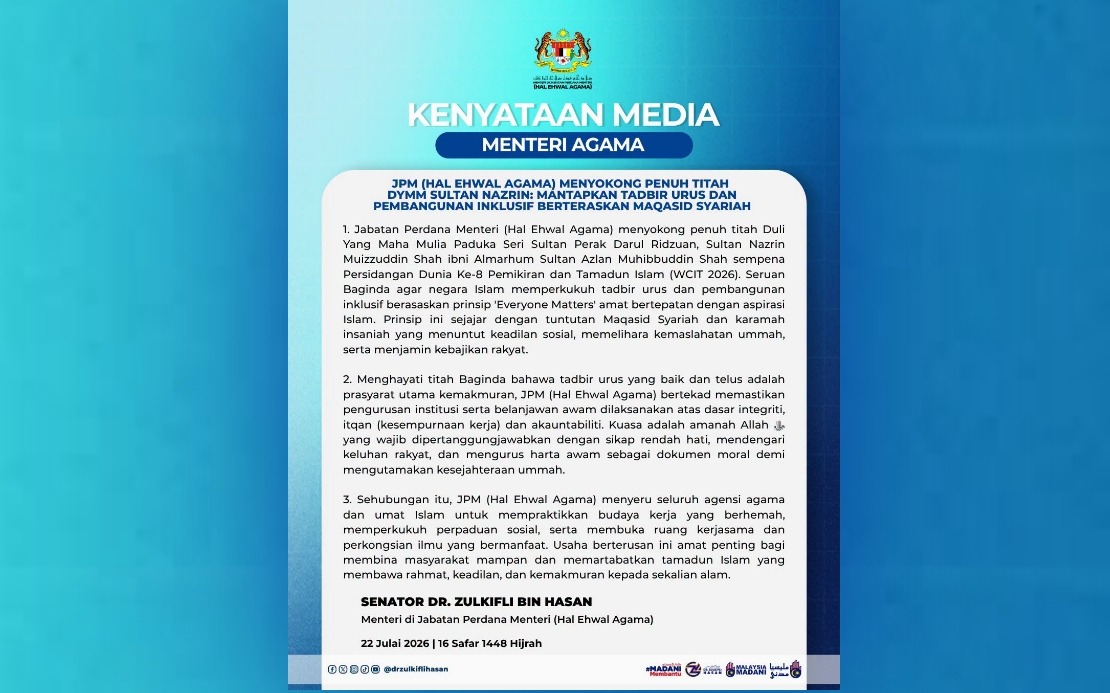
Malaysia's approach to religious governance will be fundamentally reshaped around Sultan Nazrin Shah's call for inclusive leadership, with the Prime Minister's Department (Religious Affairs) pledging to embed the principle of "Everyone Matters" into its institutional framework. The commitment reflects a broader pivot toward governance structures that prioritise public welfare, human dignity, and accountable stewardship of state resources, positioning Malaysia as a model for how Islamic values can underpin modern administrative practice.
Dr Zulkifli Hasan, the minister overseeing religious affairs within the Prime Minister's Department, articulated this strategic realignment in statements issued following Sultan Nazrin Shah's keynote address at the 8th World Conference on Islamic Thought and Civilisation (WCIT) in Putrajaya. The minister emphasised that the monarch's governance philosophy does not represent a departure from Islamic principles but rather a contemporaneous interpretation of them, grounding modern administrative expectations in foundational Islamic jurisprudence. This framing proves significant for Malaysian policymakers seeking to demonstrate that good governance and Islamic values are mutually reinforcing rather than competing imperatives.
The intellectual anchor for this governance model lies in Maqasid Syariah, the overarching objectives of Islamic law that extend beyond ritualistic observance to encompass social welfare, justice, and the protection of human interests. Dr Zulkifli's invocation of karamah insaniah—the concept of human dignity—signals that Malaysia's religious institutions will operate within a framework that views all citizens as entitled to equitable treatment and responsive governance regardless of their religious or political affiliation. This universalist dimension of Islamic governance carries particular resonance across Southeast Asia, where plural societies navigate religious identity alongside national citizenship.
Sultan Nazrin's intervention at WCIT addressed a fundamental governance challenge confronting Muslim-majority nations: the tension between particularist religious identity and inclusive state institutions. The monarch articulated that public services reflecting unity across religious and ethnic lines represent not a dilution of Islamic values but their authentic expression through humble, consultative leadership. His emphasis on listening to citizens before legislating embeds participatory democracy within an Islamic governance paradigm, providing intellectual justification for broader democratic practices within religiously-informed states. For regional observers, this represents a sophisticated articulation of how monarchical authority can champion inclusive institutions.
The principle of "Everyone Matters" operates as more than rhetorical flourish; it functions as an operational directive for how the Religious Affairs Ministry must recalibrate its institutional practices. Dr Zulkifli's statement indicates that budgeting processes, personnel management, and programme design must be evaluated against criteria of integrity and accountability to public interest rather than narrow sectarian preferences. This administrative reorientation potentially addresses longstanding concerns about patronage networks and resource allocation within Malaysia's religious bureaucracy, suggesting that performance and public welfare rather than political connection should guide institutional decisions.
The minister's emphasis on framing authority as a divine trust requiring humility and moral responsibility redefines leadership expectations within religious governance structures. By explicitly stating that public funds constitute a sacred responsibility toward collective welfare rather than instruments of political advantage, Dr Zulkifli signals expectations that religious officials will internalise accountability mechanisms beyond statutory oversight. This appeal to moral self-regulation within Islamic frameworks may prove particularly effective in contexts where religious identity carries deeper legitimacy than secular law alone. The approach acknowledges that institutional behaviour is shaped not only by external rules but by the normative commitments of officials themselves.
Malaysia's positioning of inclusive governance as consonant with Islamic jurisprudence carries implications beyond domestic policy. In an environment where some narratives oppose Islamic governance to democratic accountability, the Sultan Nazrin framework provides counterweight by demonstrating that majority-Muslim states can champion transparency, citizen participation, and cross-communal justice as authentic Islamic expressions. This intellectual positioning matters for Southeast Asian states managing religious diversity while maintaining Islamic institutional frameworks, offering an alternative to governance models premised on religious exclusivity or majoritarian dominance. The WCIT platform allowed this Malaysian contribution to circulate among religious scholars and policymakers across the wider Islamic world.
Dr Zulkifli's call for religious agencies to embrace courteous workplace culture and strengthen social collaboration suggests that institutional change extends beyond policy frameworks to organisational behaviour. The minister's emphasis on knowledge-sharing among religious bodies indicates recognition that siloed institutional structures may undermine collective welfare objectives. This collaborative orientation contrasts with competitive dynamics sometimes observable within religious bureaucracies and suggests ambitions to reorient institutional incentives toward collective problem-solving. For practitioners within Malaysia's religious establishment, these directives signal expectations that narrow jurisdictional protection should yield to broader impact orientation.
The invocation of itqan—excellence in work—introduces a quality and perfectionist dimension to governance frameworks, suggesting that integrity and accountability must be coupled with high-performance standards. This concept prevents inclusive governance from becoming synonymous with mediocrity or mere procedural compliance. By grounding excellence within Islamic tradition, Dr Zulkifli recasts quality performance as a religious obligation rather than secular management principle, potentially mobilising greater commitment from officials who understand work quality as spiritual practice. This framing addresses challenges facing many regional bureaucracies where procedural compliance exists alongside inconsistent service delivery.
Sultan Nazrin's observation that no nation can isolate itself from global economic and technological currents grounds the governance discussion within realistic assessment of state constraints and opportunities. This acknowledgment that prosperity emerges through international engagement rather than autarkic isolation implies that inclusive domestic governance must be complemented by outward-looking foreign relations and institutional openness. For Malaysia, maintaining religious institutional legitimacy while participating in global knowledge systems and investment flows requires governance frameworks that can accommodate diverse intellectual traditions. The Sultan's framing suggests that Islamic governance need not mean institutional insularity or resistance to external influences.
The relationship between Sultan Nazrin's principles and implementation within Malaysia's religious affairs machinery will determine whether this pronouncement catalyses substantive institutional change or remains aspirational rhetoric. The minister's statement indicates awareness that commitment requires concrete mechanisms: budget allocation reflecting public welfare priorities, personnel evaluation including accountability metrics, and institutional structures enabling citizen feedback and grievance resolution. Translating "Everyone Matters" into operational reality across Malaysia's religious bureaucracy—encompassing federal and state religious departments, Islamic courts, and religious education bodies—presents substantial implementation challenges requiring sustained political support and resource reallocation.
For Malaysia's broader governance trajectory, the Religious Affairs Ministry's adoption of Nazrin-inspired principles may generate spillover effects within other government agencies, establishing precedent that inclusivity and accountability represent Islamic rather than merely secular governance imperatives. This positioning allows Malaysian leaders to advance administrative modernisation while grounding legitimacy in religious values rather than external pressure. The framework also provides intellectual resources for addressing persistent critiques of Malaysia's religious institutions by demonstrating commitment to standards transcending sectarian particularism. Whether this commitment translates to observable institutional transformation will shape public confidence in religious governance and the credibility of Malaysia's model across the Islamic world.

