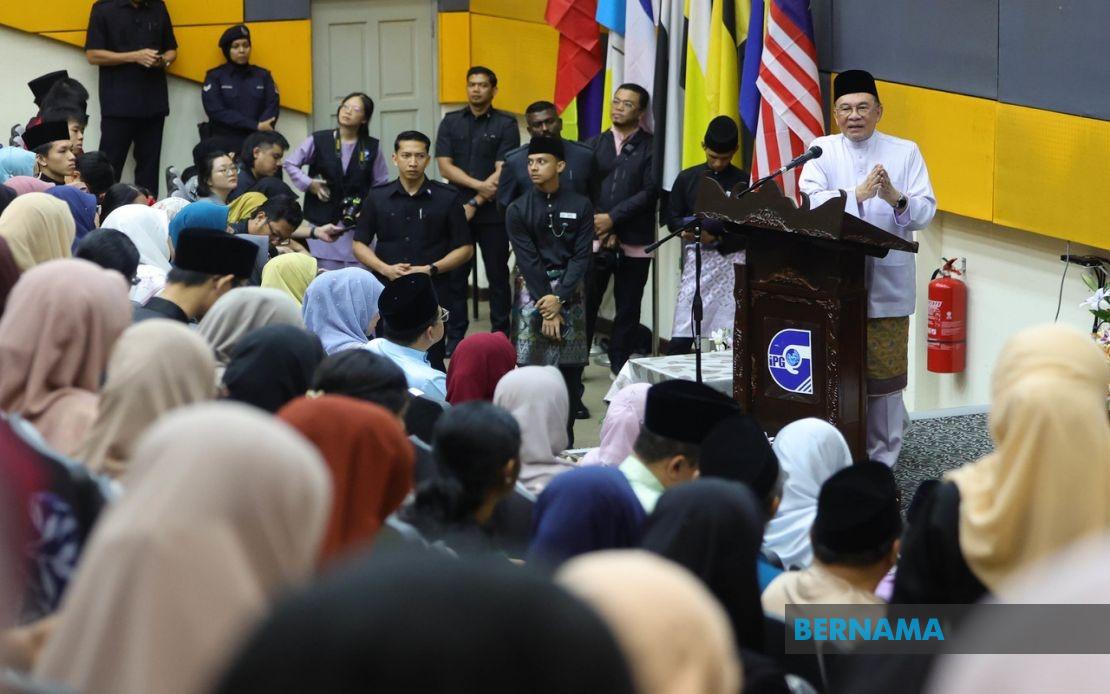
Prime Minister Datuk Seri Anwar Ibrahim has pinpointed a fundamental impediment to Malaysia's reform agenda: not the absence of technical capability or specialist knowledge, but rather the unwillingness of influential segments of society—particularly among the elite—to relinquish established patterns of behaviour, including practices that normalise corruption and institutional dysfunction. Speaking at the Technical Education Campus of the Institute of Teacher Education in Bandar Enstek, Anwar framed the resistance to systemic change as a deeply rooted cultural and structural challenge that transcends mere opposition to specific policies.
During his address at the "Temu Anwar" engagement with students and educators, the Prime Minister reflected on his more than three years in office, observing that successive attempts to overhaul governance frameworks and dismantle corruption have encountered sustained pushback from those who have become accustomed to the status quo. This observation carries significant weight given Malaysia's recent history of governance struggles and the high expectations placed upon the current administration to deliver meaningful institutional transformation. Anwar's characterisation suggests that the obstacles to reform operate at a deeper psychological and social level than merely administrative inertia.
The Prime Minister emphasised that while reform efforts may prove unpopular in certain circles, their continuation remains non-negotiable if Malaysia is to achieve the transparency, accountability and administrative effectiveness necessary for long-term institutional health. He articulated a principled stance that improvement of governance systems is not merely a pragmatic imperative but also a moral and civilisational obligation. This framing positions anti-corruption work and systemic reform as matters of fundamental values rather than partisan political positioning, an approach designed to broaden the moral legitimacy of the government's agenda beyond its immediate political base.
Anwar identified a particularly telling paradox in Malaysian society: those who resist change often adopt the external trappings of modernity—contemporary dress, sophisticated lifestyles, globalised perspectives—yet retain deeply traditional attachments to hierarchies and practices that benefit their personal interests. This observation highlights a disconnect between surface-level modernisation and genuine institutional evolution, suggesting that cosmetic adoption of modern standards can coexist with substantive resistance to the redistributive effects of genuine reform. The Prime Minister's point underscores how reform resistance frequently operates not through overt denial of the need for change but through subtle obstruction and the maintenance of informal networks that perpetuate advantage.
The timing and venue of these remarks warrant consideration. By addressing teachers and future educators at a technical training institution, Anwar sought to communicate with individuals who will shape Malaysia's human capital and institutional culture for decades ahead. Teachers occupy crucial positions in either perpetuating or challenging established norms, making them strategically important audiences for messages about systemic transformation. The choice to engage with IPG students and staff suggests recognition that educational institutions constitute potential levers for broad-based cultural change regarding attitudes towards governance and institutional integrity.
The Prime Minister's acknowledgment that no system achieves perfection and that perpetual improvement remains necessary reflects mature institutional thinking, yet it also carries an implicit recognition that Malaysia's governance challenges extend beyond mere technical adjustment. The assertion that religion, culture and civilisation all demand continuous systemic improvement frames reform efforts within frameworks that transcend secular political discourse, potentially appealing to diverse constituencies who might otherwise view institutional change through narrowly partisan lenses. This rhetorical strategy attempts to shift the terrain of debate from political positioning to foundational values.
Anwar's emphasis on the comfort that individuals and groups derive from longstanding practices speaks to a crucial insight about organisational resistance: people who have benefited from existing systems—whether through corruption, patronage or informal advantage—naturally perceive reform as threatening. Unlike change that promises universal improvement with no losers, anti-corruption initiatives and institutional reform invariably threaten those whose power and enrichment depend upon opaque systems and informal hierarchies. Understanding reform resistance as rational self-interest by beneficiaries rather than mere ignorance or ideological obstinacy represents more sophisticated diagnosis than simple calls for greater public awareness.
For Malaysian citizens and observers of Southeast Asian governance, the Prime Minister's candid assessment carries important implications. It suggests that institutional reform in Malaysia will not proceed smoothly or swiftly, as entrenched interests possess both resources and networks to obstruct change. Simultaneously, Anwar's framing commits the government to persistence despite resistance, suggesting that the administration views comprehensive reform as non-negotiable rather than contingent upon achieving widespread immediate popularity. This raises questions about the sustainability of reform efforts should political circumstances shift or alternative coalitions gain influence.
The broader context of Malaysia's governance transformation adds weight to Anwar's observations. Following years of institutional crisis and high-profile corruption scandals, public expectations for comprehensive reform remain elevated, yet the practical implementation of such transformation encounters precisely the kinds of resistance the Prime Minister identifies. The gap between public demand for clean governance and the resilience of entrenched practices that serve powerful interests represents one of the most significant tensions facing Malaysian public administration. Anwar's articulation of this tension suggests recognition that solving Malaysia's governance challenges requires not only policy innovation but also sustained pressure to reshape the underlying culture and power relationships that perpetuate dysfunctional practices.

