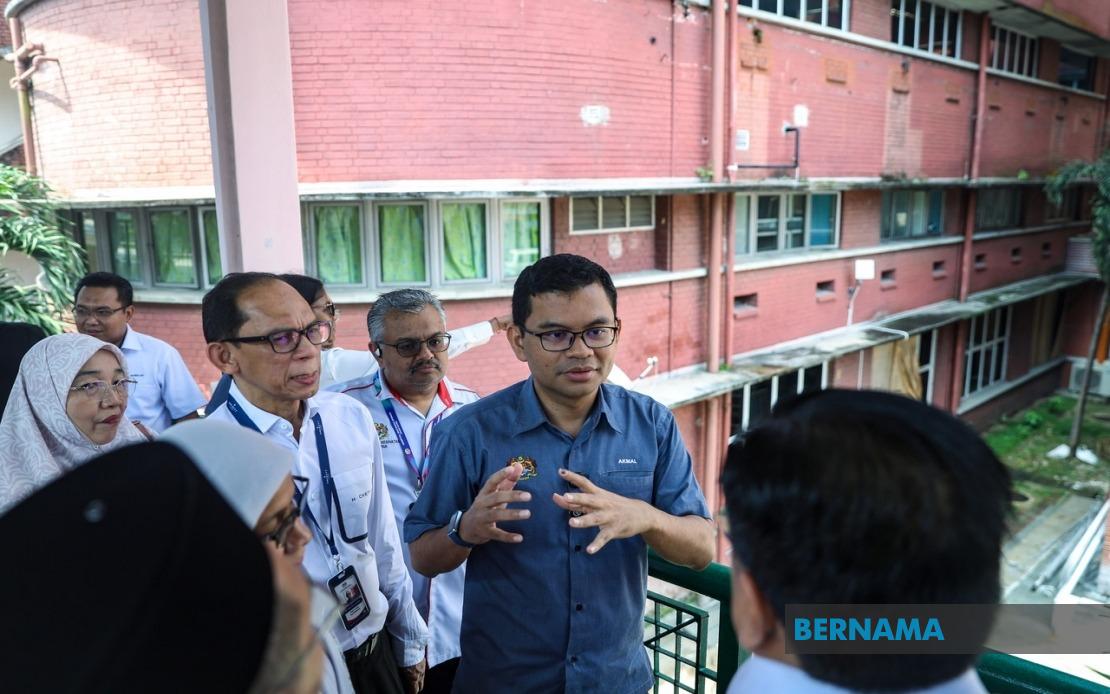
A significant healthcare infrastructure investment is reshaping Sultanah Aminah Hospital in Johor Bahru, with seven interconnected development projects collectively valued at RM1.139 billion advancing simultaneously. Economy Minister Akmal Nasrullah Mohd Nasir confirmed the multi-year initiative during a working visit to the state on August 7, underscoring the federal government's commitment to enhancing medical service capacity in Malaysia's southern corridor.
The modernisation programme encompasses a diverse range of clinical and operational improvements designed to address capacity constraints and upgrade ageing infrastructure. Among the foundational work is a RM159 million overhaul of the hospital's main electricity supply together with its electrical and mechanical systems, a project already 76.49 per cent complete. These upgrades prove critical for a large tertiary facility, as reliable power distribution underpins everything from operating theatres to intensive care units and diagnostic imaging departments. The electrical and mechanical systems form the backbone of hospital operations, affecting both patient safety and staff working conditions across all departments.
The centrepiece of the expansion strategy involves construction of an Ambulatory Care Centre incorporating a multi-storey car park and the HSA Specialist Clinic Complex in two phases, collectively representing RM877.54 million of the total investment. The specialist clinic complex addresses a persistent challenge in Malaysian healthcare—the concentration of outpatient demand in tertiary hospitals and inadequate capacity to manage the volume efficiently. By establishing dedicated specialist facilities within the hospital campus, administrators anticipate streamlined patient flow and reduced waiting times for consultation and diagnostic procedures. The multi-storey parking component tackles a secondary but significant issue affecting hospital accessibility, particularly for outpatients attending frequent appointments.
The implementation timeline for these interconnected projects varies considerably, presenting a complex coordination challenge that Akmal Nasrullah acknowledged directly. Conducting major construction and electrical work whilst maintaining uninterrupted hospital services demands meticulous scheduling and careful management of work sites to prevent disruption to emergency departments, operating theatres, and wards. The minister indicated that the Letter of Acceptance for contractors on the specialist clinic complex and car park project is targeted for February of next year, suggesting the current phase involves final design refinement and tendering processes.
A particularly noteworthy component involves the expansion of surgical capacity through construction of three new operating rooms, increasing the hospital's total theatre complement from twelve to fifteen. For a hospital serving a population centre the size of Johor Bahru and its hinterland, this represents meaningful augmentation of capacity for elective and emergency surgical procedures. Each theatre requires not merely physical space but sophisticated anaesthetic equipment, surgical infrastructure, and trained personnel—investments that collectively signal confidence in growing surgical demand across the region.
The Johor initiative reflects broader patterns of federal infrastructure development across the state. According to Akmal Nasrullah, a cumulative 613 development programmes and projects worth RM56.12 billion have been implemented or are currently underway in Johor since 2000 through to the present year. This portfolio comprises 154 entirely new projects alongside 459 extension or upgrade initiatives, indicating that development strategy balances creation of new facilities with enhancement of existing infrastructure. For a state with Johor Bahru's status as a major economic centre and second-largest urban agglomeration in Malaysia, such investment levels remain commensurate with demographic and economic growth trajectories.
Budgetary execution demonstrates reasonable progress against allocation targets. As of late July, the state had expended RM2.5 billion representing 50.51 per cent of the RM4.95 billion annual allocation, placing implementation roughly on schedule for the financial year. This spending pattern suggests that projects are neither languishing in early stages nor experiencing the acceleration that might indicate rushed execution. Consistent expenditure throughout the fiscal year provides stability for contractors and allows for orderly project completion.
The Sultanah Aminah Hospital projects carry particular significance for healthcare accessibility across the southern peninsula. Johor Bahru functions as a primary healthcare destination not only for Johor's 4.1 million residents but increasingly for cross-border patients from Singapore seeking private and public sector treatments. Enhanced specialist clinic facilities and expanded surgical capacity directly address unmet demand driven by demographic trends and rising prevalence of chronic diseases across the region. For Malaysian patients, particularly those in the lower income brackets, adequately resourced public hospitals represent essential access points to quality care.
The upgrade also reflects evolving standards in tertiary hospital design and operation. Modern specialist clinics segregate patient flows by discipline, improving efficiency and creating more focused environments for complex diagnostic and therapeutic decision-making. Multi-storey parking addresses urban congestion patterns inherent to contemporary hospital campuses, where surface parking proves both land-inefficient and patient-inconvenient. These design improvements, whilst sometimes appearing peripheral to clinical care, substantially influence patient experience and operational effectiveness.
The minister framed these projects within a broader strategic objective of ensuring smooth completion and optimal benefit for the population. This emphasis on seamless execution acknowledges that delays in healthcare infrastructure projects carry genuine costs—postponed surgical cases, continued bottlenecks in specialist outpatient services, and deferred modernisation of electrical systems that pose latent reliability risks. The coordination challenges Akmal Nasrullah mentioned underscore why healthcare construction demands particularly careful project management compared to other infrastructure sectors.
For Malaysian healthcare planners and policymakers monitoring Johor's experience, the Sultanah Aminah Hospital development provides a real-world case study in managing large-scale tertiary hospital modernisation amid ongoing operations. Successful execution of these seven interconnected projects could inform similar initiatives elsewhere, particularly in other high-population states where capacity constraints mirror Johor's challenges. The RM1.139 billion investment represents a significant allocation reflecting recognition that infrastructure forms the physical foundation upon which healthcare quality and accessibility ultimately depend.

