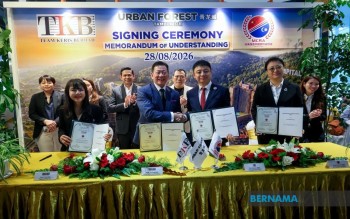
Perak's tourism landscape is set for significant transformation through an ambitious RM1 billion urban forest development in Tambun, a project that stakeholders believe will catalyse broader economic growth across the state when completed within the next three years. The 84-acre initiative represents a strategic pivot toward positioning Ipoh and Perak as a destination of international standing, moving beyond the region's traditional reliance on domestic tourism channels.
Team Keris Bhd, the project's developer, has forged strategic partnerships with RJJ Hotels and the Malaysian Chinese Restaurant Association to build a diversified ecosystem combining tourism, hospitality, food and beverage retail, and commercial operations. This coordinated approach reflects a recognition that modern tourist destinations require integrated offerings that span accommodation, dining, entertainment and experiential activities rather than standalone attractions.
The initiative gains particular relevance given Perak's existing tourism infrastructure. The Lost World of Tambun and various hospitality developments already operate in the vicinity, creating a foundation upon which the urban forest can build. Perak's Tourism, Industry, Investment and Corridor Development Committee chairman Loh Sze Yee emphasized that the new development would elevate these existing assets by introducing international-standard facilities and services. His vision extends beyond incremental improvements toward a comprehensive repositioning of Ipoh and Perak within regional and global tourism markets, moving the state away from purely domestic appeal toward capturing international visitor spending.
A central element of the strategy involves curating a food and beverage offering that balances authenticity with international accessibility. The project allocates 40 percent of F&B operations to Malaysian Chinese Restaurant Association members, with the remaining 60 percent reserved for broader Malaysian operators. This composition aims to showcase Malaysia's culinary diversity to international visitors while ensuring that established local dining establishments gain exposure to overseas markets. Team Keris group executive chairman Datuk Lee Seng Hee positioned food as a powerful attractor capable of drawing visitors across geographical boundaries, with the urban forest functioning as both a dining destination and a gateway to wider Perak experiences.
Religious and dietary diversity considerations feature prominently in the project design. Approximately 30 percent of the F&B offering will be explicitly Muslim-friendly, addressing requirements for halal certification and Islamic dining practices. The association's efforts to develop Muslim-friendly dim sum selections and other halal offerings reflect awareness that international tourism markets increasingly include visitors from Muslim-majority countries and regions. This inclusive approach expands the project's appeal while positioning Malaysia's halal certification as a competitive advantage for future regional expansion.
RJJ Hotels brings substantial international connectivity through its affiliation with Jin Jiang Hotels, a network encompassing more than 200 million members across more than 50 countries and 40 hotel brands globally. Chief executive officer Yap Lip Seng articulated how this global platform facilitates packaged travel arrangements that address a persistent barrier to Perak tourism: the challenge of reaching the state conveniently from major entry points like Kuala Lumpur and Penang. By integrating transportation, accommodation and dining experiences, RJJ positions extended stays as the norm rather than brief overnight visits, fundamentally altering visitor spending patterns and economic impact.
The partnership structure reveals broader strategic thinking about supply chain development and local industry upgrading. Rather than importing expertise and operations entirely, the initiative commits to skills training and professional development for local workers and restaurant operators, aiming to elevate standards across Perak's hospitality sector. This capacity-building dimension suggests the project's developers recognize that sustainable competitive advantage requires developing local talent alongside infrastructure investment.
The Malaysian Chinese Restaurant Association's broader ambitions extend to supply chain localization, including potential establishment of manufacturing facilities in Perak for sauces, spices and food ingredients. This vertical integration strategy could generate ancillary employment and export opportunities beyond the tourism sector itself. Association president Gao Houyun positioned Malaysia's halal certification as an export advantage, suggesting that food products and culinary brands developed within Perak could expand regionally, creating new investment pathways and employment opportunities across Southeast Asia.
For Malaysia's regional positioning, the project carries implications beyond Perak's borders. Competition for tourism spending across Southeast Asia remains fierce, with Thailand, Vietnam and Indonesia aggressively developing tourism infrastructure. Perak's urban forest project represents an attempt to differentiate Malaysia's offering through integrated experiences emphasizing culinary tourism, cultural authenticity, and hospitality standards. Success could establish a replicable model for developing tourism ecosystems in secondary cities across Malaysia, potentially dispersing visitor spending beyond Kuala Lumpur and established beach destinations.
The three-year development timeline introduces execution risk that will test whether ambitious vision translates into operational reality. Coordinating multiple stakeholders—hotel operators, restaurant associations, local government, and retail partners—requires sustained alignment and conflict resolution capabilities. Previous tourism development projects in Malaysia have encountered delays and cost overruns, suggesting that the urban forest's success will depend heavily on project management discipline and stakeholder commitment throughout the construction and launch phases.
Economically, the project's impact will extend beyond direct employment at hospitality and retail establishments. Construction activity will generate immediate economic activity, while operational phase employment will span hotel staff, restaurant workers, retail employees, and support services. The supply chain localization ambitions could create manufacturing employment if ingredient production facilities establish operations in Perak. However, realizing these broader economic benefits requires careful attention to worker remuneration, skill development, and local participation in ownership and management decisions.

