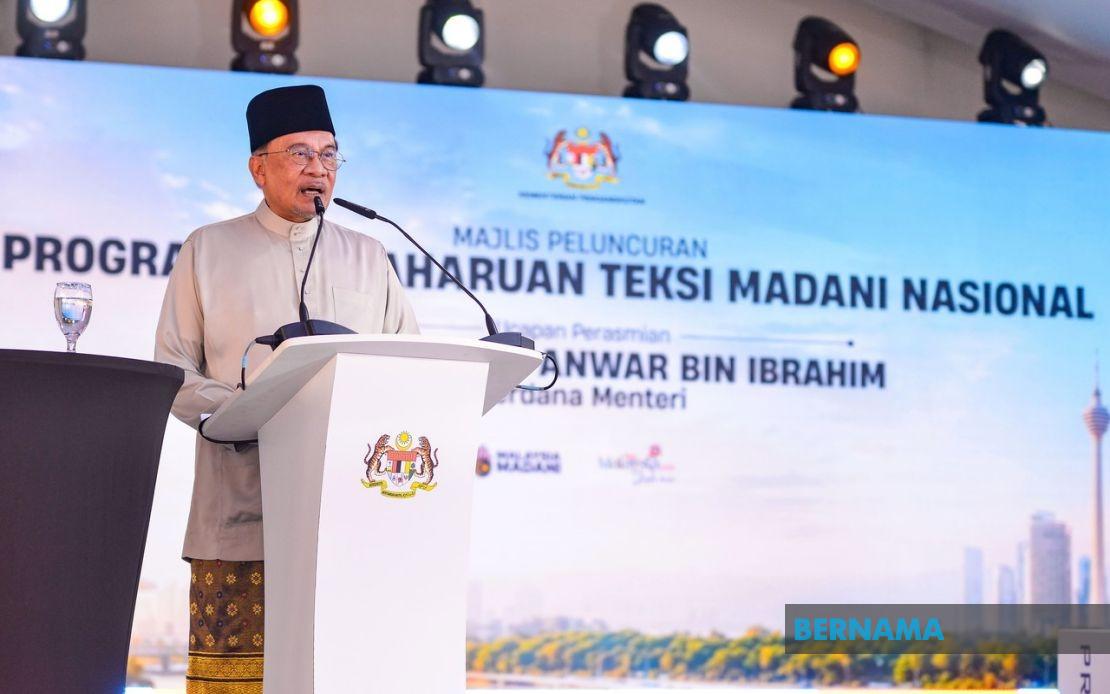
Prime Minister Datuk Seri Anwar Ibrahim has injected fresh momentum into the government's taxi modernisation agenda by announcing an additional RM10 million allocation for the Vehicle Replacement Matching Grant Programme. The move underscores the administration's determination to revitalise an industry that has faced mounting pressure from ride-sharing competitors and ageing vehicle fleets. Speaking at the launch of the National MADANI Taxi Reform Programme at Dataran Merdeka on July 3, Anwar—who holds the dual portfolio of Finance Minister—revealed that the supplementary funding responds directly to overwhelming demand for the initial RM10 million pool unveiled in Budget 2026.
The decision to boost the taxi replacement scheme reflects a calculated policy shift towards supporting traditional transport operators at a time when their economic viability faces sustained challenges. Malaysia's taxi industry, which has historically formed a backbone of urban mobility infrastructure, has witnessed declining driver participation and deteriorating vehicle standards. By frontloading capital assistance, the government seeks to incentivise vehicle upgrades and improve service quality without placing the full burden on individual operators whose profit margins remain constrained.
Crucially, the government has brokered a strategic partnership with automobile manufacturer Proton and the Transport Ministry to establish a dedicated financing mechanism for taxi operators seeking to purchase the Proton S70. This initiative represents more than a mere subsidy; it constitutes an integrated industrial policy that simultaneously supports the local automotive sector while addressing transport modernisation. By directing taxi operators towards a domestic vehicle platform, authorities aim to sustain Proton's production volumes and employment while ensuring that capital injections circulate within the Malaysian economy rather than enriching foreign competitors.
The Proton S70 financing scheme carries particular significance given the company's ongoing efforts to strengthen its market position. The sedan, which competes in the mid-range segment, offers the kind of comfort and reliability that modern taxi passengers expect, particularly as ride-hailing services have raised consumer expectations around vehicle condition. By making S70 ownership financially accessible to taxi drivers through government-facilitated credit arrangements, policymakers hope to catalyse a visible transformation in street-level transport quality while providing Proton with a substantial captive customer base.
The enthusiastic response to the initial RM10 million allocation, according to Anwar, provided clear evidence that taxi operators possess appetite for modernisation when capital barriers are removed. This positive reception validates the government's premise that financial constraints, rather than inherent resistance to change, have prevented faster fleet renewal. The additional RM10 million injection therefore represents both recognition of existing demand and a strategic wager that further capitalisation will yield multiplicative effects across the sector.
The programme's launch drew attendance from Transport Minister Anthony Loke, Federal Territories Minister Hannah Yeoh, and Chief Secretary to the Government Tan Sri Shamsul Azri Abu Bakar, signalling high-level commitment across multiple government portfolios. This coordinated approach suggests that taxi reform has transcended departmental silos to become a cross-cutting policy priority within the MADANI governance framework. The involvement of the Transport Ministry and Prime Minister's Department underscore efforts to integrate fleet modernisation within broader urban mobility strategies and federal territories administration.
For Malaysian taxi drivers, the expanded funding pool represents tangible relief from vehicle acquisition costs that have long constrained business expansion and competitiveness. Operators who have postponed vehicle replacement due to capital scarcity now face a narrowing window to capitalise on matching grants before allocations exhaust. The competitive pressure to modernise will likely accelerate across the sector, as early adopters establish reputational advantages through superior vehicle standards and customer experience improvements.
Beyond immediate relief, the scheme embeds implicit incentives for industry consolidation and professionalisation. Drivers capable of meeting application requirements and financial obligations will access preferential terms, while those facing structural barriers—such as poor credit history or informal employment status—may find themselves increasingly marginalised. This bifurcation could reshape industry composition over time, potentially strengthening the taxi sector's long-term sustainability even as total driver numbers contract.
The timing of this announcement also reflects broader economic considerations. As Malaysia navigates inflationary pressures and seeks to maintain consumer confidence in essential services, investing in transport infrastructure modernisation generates visible public benefits. Passengers experiencing higher service standards develop restored confidence in taxi travel, potentially reversing ridership migration to ride-hailing platforms. Enhanced fleet quality also reduces maintenance-related disruptions that undermine service reliability and driver earnings.
Regionally, Malaysia's approach to taxi modernisation offers instructive lessons for other Southeast Asian economies grappling with similar challenges. By coordinating vehicle replacement subsidies with domestic automotive industrial policy, the government demonstrates how social spending can simultaneously pursue industrial development objectives. This integrated approach contrasts with reactive regulation that restricts ride-sharing without providing viable alternatives to traditional operators.
Looking forward, the success of this initiative will depend substantially on implementation efficiency and accessibility. The government must ensure that application processes remain transparent and that matching grant mechanisms function smoothly, preventing bottlenecks that could frustrate eligible operators. Additionally, sustained technical support and driver training programmes will be essential to maximise the return on public investment and ensure that new vehicles are operated safely and professionally.
The allocation ultimately signals that Malaysia's government views taxi sector viability as a legitimate public concern rather than purely a market-driven matter. This philosophical positioning, coupled with concrete financial commitments, provides operators with stronger assurance that policy support will remain predictable and sustained. Whether the RM20 million total allocation proves sufficient for comprehensive fleet transformation will become evident over coming months as uptake data emerges.

