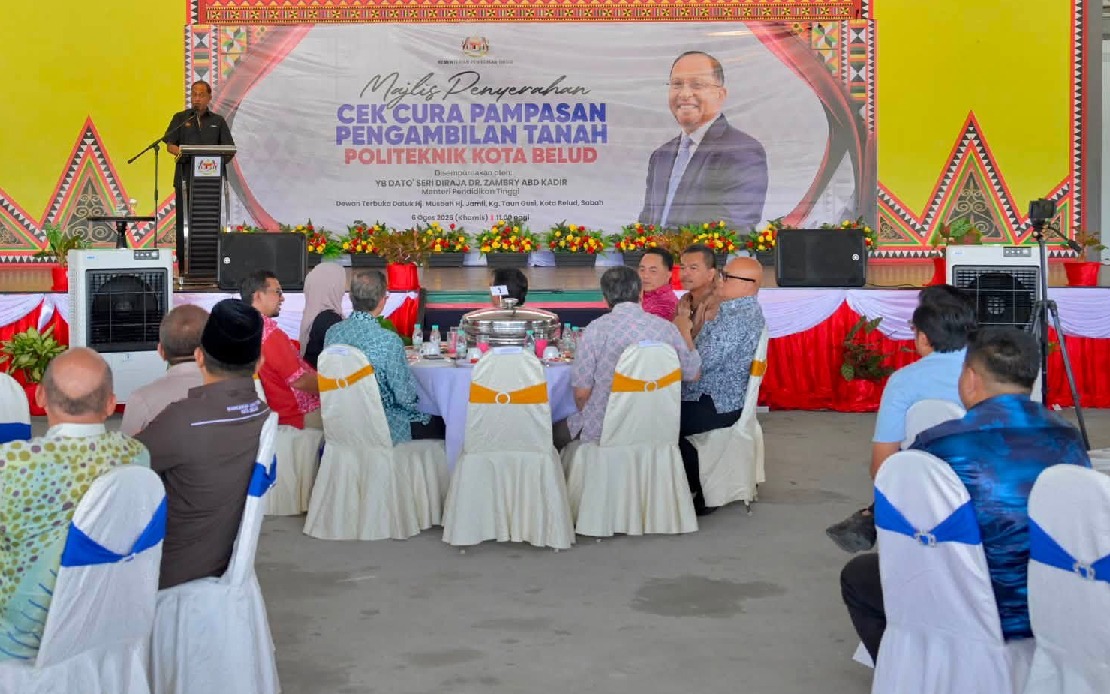
The RM250 million Politeknik Kota Belud in Sabah has reached a pivotal milestone with the official commencement of its construction phase following the settlement of land compensation to affected property owners. Higher Education Minister Datuk Seri Zambry Abd Kadir marked this transition during a ceremony in Kota Belud, signalling that nearly three years of planning have crystallized into tangible progress on the ground. The mock cheque presentation to landowners represents far more than a financial transaction—it represents the formal authorisation to begin transforming the acquisition site into a modern tertiary institution.
The polytechnic initiative traces its origins to a proposal made in 2017 by then-MP Datuk Seri Abdul Rahman Dahlan, reflecting a considerable gestation period typical of major infrastructure projects in Malaysia. The trajectory from initial concept to implementation demonstrates the complexity of securing land rights, navigating environmental assessments, and aligning stakeholder interests across different government bodies. Zambry indicated that with this compensation phase now concluded, the project can proceed through design and detailed planning stages, with full-scale development anticipated under the Third Rolling Plan component of the 13th Malaysia Plan beginning next year.
The institution's curriculum strategy positions it to address a critical skills gap emerging across Southeast Asia's rapidly digitalising economies. Rather than offering generic technical qualifications, Politeknik Kota Belud will concentrate on programmes spanning green energy, artificial intelligence, computer science, and smart technology-based agriculture—sectors where employer demand consistently outpaces graduate supply across the region. This sector-specific approach reflects lessons learned from earlier polytechnic expansions, which sometimes produced graduates whose skills misaligned with labour market requirements. By anchoring its offerings to Sabah's particular economic trajectory and regional opportunities, the institution aims to maximise employment outcomes for its cohort.
The enrolment strategy reveals deliberate expansion planning that acknowledges the distinction between pilot operations and sustainable scale. The inaugural intake is capped at approximately 500 students, providing manageable cohort sizes for curriculum refinement and quality assurance. However, long-term capacity targets of between 1,000 and 1,500 students suggest institutional ambitions that extend beyond serving purely local demand. This scaling pathway allows the polytechnic to establish pedagogical standards during its initial years while remaining positioned to absorb increased intake as reputation solidifies and employer recognition spreads throughout Malaysia and potentially across ASEAN labour markets.
For Malaysian policymakers focused on spatial equity and regional development, Politeknik Kota Belud represents strategic investment in tertiary infrastructure outside the Klang Valley and major peninsular urban centres. Sabah has historically faced underrepresentation in polytechnic networks relative to population size, creating barriers for school leavers seeking affordable, work-oriented qualifications without interstate or international relocation. The institution thus addresses both supply-side educational deficiencies and enables retention of local talent within the state, potentially reversing migration patterns that have seen Sabahan graduates cluster in peninsular job markets.
The 2030 completion target aligns with Malaysia's broader digitalisation ambitions articulated in successive national plans, though this timeline carries inherent execution risks. Infrastructure projects of this magnitude—involving site preparation, building erection, laboratory facilities establishment, and staff recruitment across technical and support functions—frequently encounter delays stemming from supply chain disruptions, contractor challenges, or design modifications discovered during implementation. The phased approach Zambry outlined, which separates land acquisition from design and construction phases, provides some buffer for adjustments, yet stakeholders should remain vigilant regarding progress milestones.
The polytechnic's focus on emerging technology domains reflects understanding that Sabah's economic future increasingly depends upon sectors beyond primary production. Agricultural transformation toward precision farming and mechanisation, renewable energy transition from fossil fuel dependency, and integration into digital supply chains all require a workforce versed in computational thinking and technical problem-solving. By developing human capital aligned with these trajectories, the polytechnic strengthens Sabah's competitive positioning amid regional competition for investment and talent.
Regional comparative analysis suggests this initiative places Malaysia favourably within ASEAN tertiary education landscape, where technical and vocational qualifications increasingly serve as viable alternatives to traditional university pathways. Neighbouring countries including Indonesia, Thailand, and Vietnam have expanded polytechnic networks substantially over the past decade, recognising that not all labour force participants require or benefit from bachelor-level credentials. Politeknik Kota Belud contributes to maintaining Malaysian parity in this regard, particularly significant given demographic trends favouring workforce skill specialisation over generalised academic qualifications.
From a fiscal perspective, the RM250 million investment merits contextualisation against comparable infrastructure projects and anticipated return on investment. Polytechnic graduates typically enter employment within six months of completion, generating immediate tax revenue and reducing social welfare expenditure. Over a multi-decade operational horizon, the institution's cumulative contribution to state GDP through enhanced worker productivity, reduced unemployment among school leavers, and attraction of technology-oriented businesses becomes substantial. However, sustained funding beyond capital expenditure remains essential—staffing, equipment maintenance, curriculum updating, and facility upgrades demand ongoing budgetary commitment.
The timing of this announcement, arriving amid broader discussions regarding Malaysia's economic transition and human capital development, positions Politeknik Kota Belud within a larger narrative of national renewal and regional competitiveness. The institution embodies recognition that demographic dividend advantages dissipate without corresponding educational infrastructure investment. By 2030, Malaysia's labour force composition will have shifted meaningfully, with secondary school completion rates stabilising and competition for university places intensifying. Polytechnics serving as reliable pathways to credible employment become correspondingly more valuable to national economic resilience and social cohesion.

