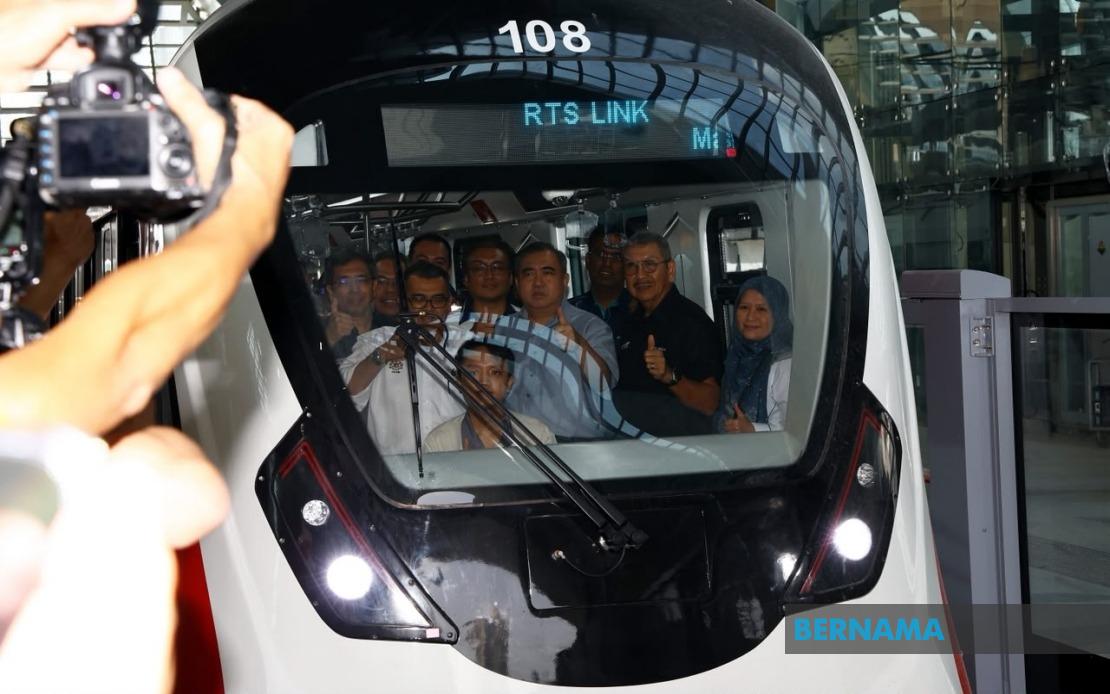
The Malaysian government has committed RM60 million to construct a dedicated bridge linking the Bukit Chagar RTS Link Station with the adjacent KTMB Komuter terminus, a strategic infrastructure move designed to eliminate navigation bottlenecks and create seamless public transport connectivity. Transport Minister Anthony Loke unveiled the plan during a site visit to the Bukit Chagar facility in Johor Bahru, signalling the administration's determination to position the forthcoming rapid transit corridor as a modern, integrated mobility hub rather than a standalone rail project operating in isolation.
The bridge project represents a deliberate response to a practical operational challenge: currently, passengers transferring between KTMB Komuter services and the RTS Link must navigate an indirect route through JB Sentral, adding unnecessary distance and time to their journey. By constructing a direct pedestrian passage between the two stations, the government aims to dramatically simplify the passenger experience and encourage greater uptake of public transport across the wider Johor Bahru region. For commuters living near Komuter stations, this development essentially compresses what would otherwise be a fragmented trip into a unified, convenient transition.
Loke confirmed that the Ministry of Economy has already sanctioned the additional expenditure, with implementation now falling under the Transport Ministry's purview. The project timeline of approximately 12 months positions completion well before or coinciding with the RTS Link's January 1 launch date, ensuring that passengers arriving at the new station will immediately benefit from the enhanced connectivity infrastructure. This coordination reflects deliberate planning to avoid opening the RTS Link with known access constraints that could handicap early passenger adoption and demand forecasting.
The bridge initiative sits within a broader ecosystem of transport modernisation currently underway across the Johor Bahru metropolitan area. Alongside the bridge, the government is simultaneously rolling out Stage Bus Service Transformation 2.0, a programme intended to inject at least 200 additional buses into the network, specifically routing services from residential clusters around Johor Bahru directly to Bukit Chagar. This expansion acknowledges a critical insight: rapid transit systems function optimally when supported by effective first-mile and last-mile connectivity, ensuring passengers can realistically board at suburban origins and reach their final destinations without reverting to private vehicles.
Negotiations with the bus operator regarding the SBST 2.0 expansion are in their final stages, with the Ministry of Finance awaiting the formal award documentation. By timing this bus service expansion to launch alongside the RTS Link, planners intend to distribute arriving and departing passengers across multiple transport modes, preventing congestion at any single point and maximising the utility of the wider network. The synchronisation demonstrates integrated transport thinking rather than siloed infrastructure development.
The Bukit Chagar RTS Link Station itself is envisioned as something more ambitious than a conventional railway terminal: it will function as a multi-modal interchange hub incorporating connections to JB Sentral, ride-hailing services, and conventional public transport options. This consolidation transforms what might otherwise be disparate transportation nodes into a unified passenger distribution system. For Malaysian travellers increasingly familiar with mobility-as-a-service concepts, the integrated approach should enhance convenience, reduce decision-making friction, and promote public transport as a competitive alternative to private vehicles.
On the RTS Link project's physical progress, Loke reported that construction of the station building, the Customs, Immigration and Quarantine complex, and the rail infrastructure itself has reached completion. The project has transitioned into the critical testing and commissioning phase, during which system integration protocols are being validated, followed by fault-free operational trials. This methodology is standard for complex transport infrastructure connecting international borders, where safety and reliability standards are extraordinarily demanding. Any system failures discovered during this phase must be rectified before passenger operations commence.
The RTS Link represents a significant cross-border mobility initiative, connecting Bukit Chagar in Johor Bahru with Woodlands North in Singapore across the Johor Strait. The design capacity targets 10,000 passengers per hour in each direction, positioning it as a high-volume commuter corridor anticipated to reshape travel patterns between the two jurisdictions. For Malaysian residents working in Singapore and Singaporean citizens accessing Johor Bahru employment or commercial opportunities, the rapid transit connection will provide an attractive alternative to road-based congestion.
From a regional perspective, the Bukit Chagar RTS Link symbolises deepening infrastructure integration across Southeast Asia's most densely interconnected border. Malaysia and Singapore have historically maintained robust transport relationships, but this project elevates that cooperation to metropolitan-scale capacity. The bridge connecting Bukit Chagar with KTMB Komuter, though ostensibly a local infrastructure detail, exemplifies how governments are rethinking transport planning to prioritise passenger experience and mode integration rather than isolated project implementation.
The RM60 million bridge investment, while substantial, should be contextualised against the broader RTS Link capital expenditure and the anticipated passenger economic value. Transit-oriented development principles suggest that enhanced accessibility generates increased ridership, which in turn justifies higher operational frequencies and network expansion. The bridge thus functions as a relatively cost-effective enabler of higher utilisation rates on the RTS Link itself, multiplying the return on the significantly larger primary infrastructure investment.
For Malaysian policymakers monitoring public transport modernisation efforts, the Bukit Chagar project offers instructive lessons about integrated planning. Rather than treating the RTS Link as a standalone achievement, authorities are methodically building supporting infrastructure—the bridge, expanded bus services, multi-modal coordination—that transform it from an isolated rail corridor into a comprehensive mobility system. This approach should theoretically drive stronger passenger adoption and economic impact than the rail component alone could achieve.

