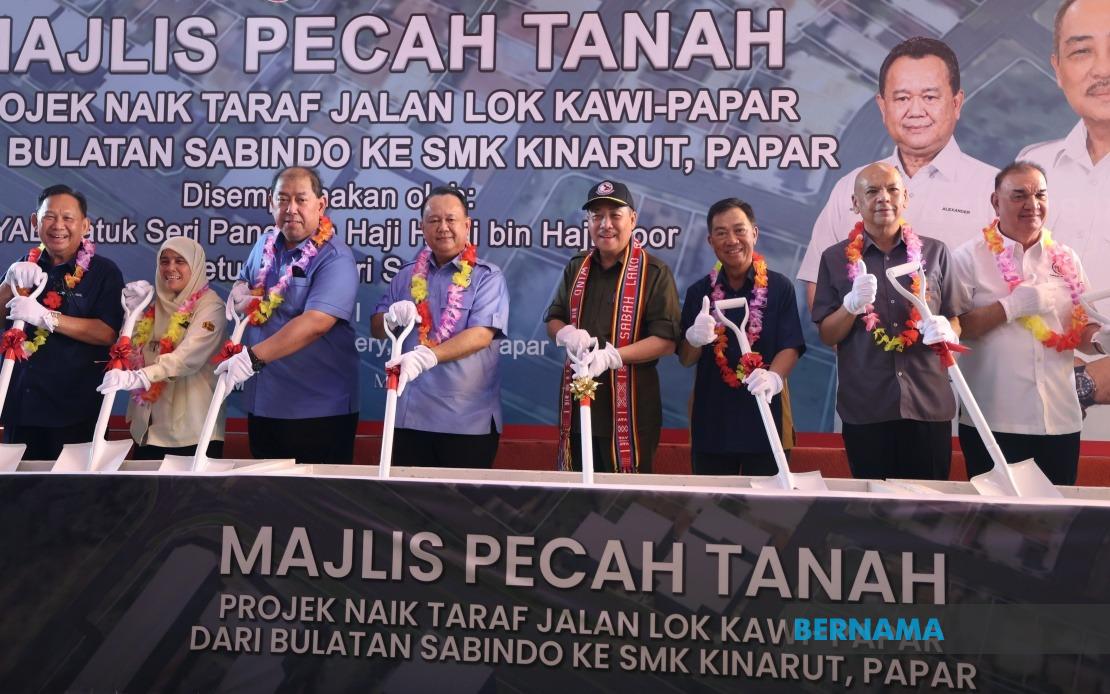
Sabah's state government has formally launched a RM70.6 million infrastructure project to upgrade Jalan Lok Kawi, a 1.3-kilometre stretch connecting Sabindo Roundabout to SMK Kinarut. Chief Minister Datuk Seri Hajiji Noor announced the groundbreaking ceremony in Papar, positioning the initiative as a cornerstone of the federal government's commitment to enhancing road infrastructure across the state through the Ministry of Works. The project represents a significant investment in addressing mobility challenges that have emerged along one of Sabah's most dynamic growth corridors.
The Lok Kawi-Pengalat-Papar corridor has undergone substantial transformation in recent years, attracting substantial residential, commercial, and institutional development. Housing projects have proliferated across the region, while government facilities, schools, and tourism attractions have expanded the area's economic base. This concentrated growth has created mounting pressure on existing transportation networks, with traffic volumes climbing steadily and congestion becoming increasingly acute during morning and evening peak hours. Road users have voiced growing frustration with delays and safety concerns, prompting calls for infrastructure improvements that match the region's rapid urbanisation.
The upgrade will convert the existing two-lane road into a four-lane dual carriageway, fundamentally increasing the corridor's traffic capacity. Hajiji emphasised that the project extends beyond simple road widening, incorporating a comprehensive approach to user safety and convenience. The enhanced facility will include an overhead pedestrian bridge, a covered walkway serving students at SMK Kinarut, designated bus stops, and motorcycle shelters. These complementary features acknowledge the diverse transportation needs of residents and commuters, from schoolchildren to public transport users to two-wheeled vehicle operators.
The Chief Minister stressed the government's determination to streamline bureaucratic processes and prevent administrative delays from impeding project delivery. He called for accelerated action from all relevant government departments and utility agencies on land acquisition and the relocation of utility infrastructure—two historically time-consuming components of road projects. Hajiji's explicit warning against bureaucratic red tape reflects awareness that large infrastructure projects frequently encounter implementation bottlenecks, and he signalled that inter-agency coordination between federal and state entities must be strengthened to meet construction timelines.
For Malaysian and Southeast Asian observers, the Jalan Lok Kawi upgrade illustrates a broader pattern of infrastructure investment aimed at accommodating rapid urbanisation in secondary cities. Unlike Kuala Lumpur or Penang, where mature transport networks already exist, Sabah's newer urban centres must expand capacity preemptively to sustain growth without creating chronic congestion. This project serves as a microcosm of the infrastructure challenges facing Malaysia's emerging urban regions, where population movement and economic diversification are creating demand for roads designed to future-proof corridor development.
Hajiji articulated a strategic vision connecting transport infrastructure to broader economic objectives. He identified efficient and safe road networks as catalysts for socio-economic growth, investment attraction, and tourism sector stimulation. The Papar area, in particular, is undergoing multifaceted transformation through concurrent infrastructure and commercial initiatives. Once the Pan Borneo Highway reaches completion, the Chief Minister suggested, Papar is positioned to become a strategic gateway for visitors from Brunei and Sarawak, potentially converting a transit corridor into a destination with genuine economic potential.
The groundbreaking event also witnessed the announcement of complementary infrastructure commitments in the Papar district. A second bridge project received approval, alongside emergency rock and earth embankment works at Kogopon Intake riverbank and protective measures along adjacent riverbanks. These announcements underscore a coordinated approach to infrastructure expansion, with multiple projects advancing simultaneously to address congestion, flood risk, and connectivity in the area. Papar Member of Parliament Datuk Armizan Mohd Ali, who attended the ceremony alongside Works Minister Datuk Seri Alexander Nanta Linggi, had reportedly requested these initiatives.
The timing of the Jalan Lok Kawi project reflects national development priorities emphasising regional balance. Federal investment in Sabah's road infrastructure sends a signal about commitment to equitable development beyond Peninsular Malaysia. For regional stakeholders in Brunei and Sarawak, improved connectivity through upgraded routes like Jalan Lok Kawi enhances the viability of cross-border trade, tourism, and people-to-people movements. The project thus carries implications extending beyond Sabah's internal development agenda, potentially facilitating deeper economic integration across Borneo.
The four-lane dual carriageway configuration carries particular significance for high-growth corridors in Southeast Asia where limited land availability and existing development patterns constrain expansion options. Unlike completely new road construction, upgrading existing routes preserves established communities and commercial centres while expanding capacity. This approach minimises social disruption whilst addressing congestion—a balance that road planners across the region continually seek.
State government cooperation on land acquisition will prove crucial to avoiding the protracted property negotiations that frequently delay Malaysian infrastructure projects. Hajiji's assurance of Sabah's full participation in resolving land matters signals political will to expedite implementation, though execution ultimately depends on administrative machinery functioning efficiently. The success of this project may influence public expectations for subsequent infrastructure initiatives, making timely delivery a priority for the state government.
From a Malaysian development perspective, the Jalan Lok Kawi upgrade exemplifies how secondary cities require targeted infrastructure investment to realise their economic potential. Papar's transformation from a modest township into an emerging regional centre depends substantially on transport connectivity that permits efficient movement of goods, services, and people. The RM70.6 million investment, while significant for a 1.3-kilometre stretch, represents the incremental expenditure necessary to prevent infrastructure becoming a constraint on growth—a lesson equally applicable to other developing corridors throughout Malaysia.

