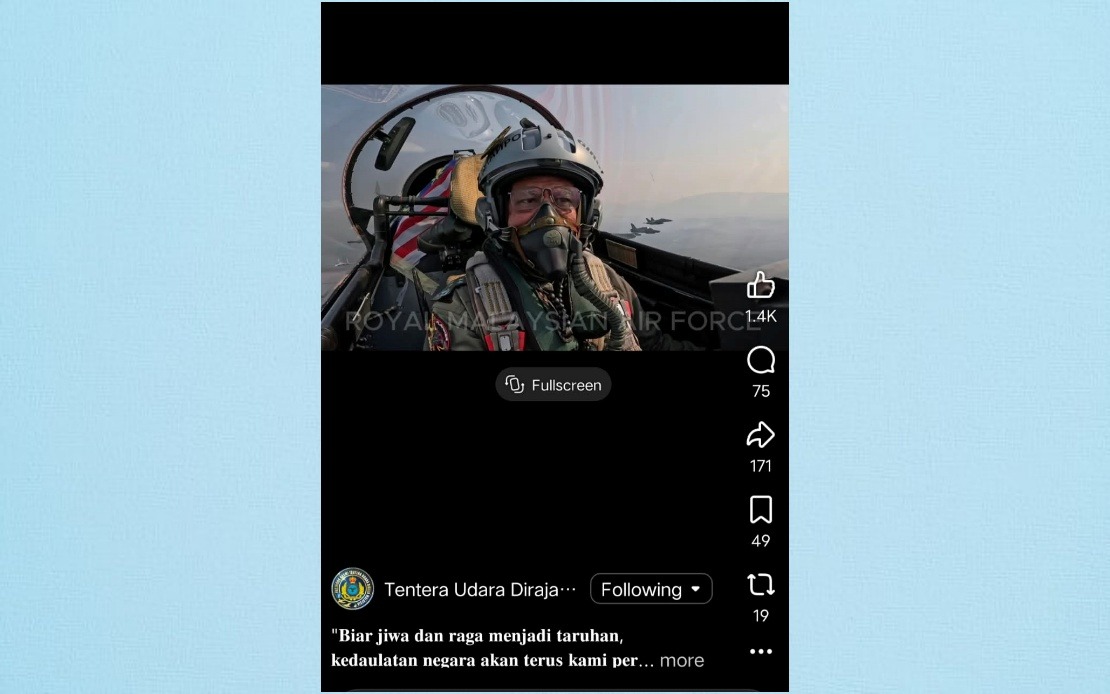
Thousands of spectators gathered at Dataran Putrajaya on National Day to witness an impressive demonstration of Malaysia's aerial firepower, as the Royal Malaysian Air Force orchestrated a carefully choreographed display that showcased both the nation's combat and logistical capabilities. The 10-minute spectacle, which commenced at 9.30 am on August 31, featured the thunderous roar of multiple fighter jets cutting through the skies above the federal administrative centre, drawing sustained applause and excitement from the assembled crowds.
General Tan Sri Muhamad Norazlan Aris, the RMAF chief, personally commanded the display by taking the controls of a Sukhoi Su-30MKM fighter jet, continuing his tradition of leading the National Day air show for the second consecutive year. His decision to fly at the forefront of the formation underscores the significance the military leadership places on demonstrating the force's operational preparedness and technical excellence to the Malaysian public. This gesture also reinforces the symbolic connection between institutional leadership and practical expertise within the armed forces.
The combat portion of the display involved eleven fast-jet aircraft performing in tight formation, including four Su-30MKMs—Malaysia's primary air-superiority fighters—alongside four F/A-18D Hornets and three BAE Hawk 208 jets. These aircraft executed a sequence of sophisticated aerial manoeuvres collectively known as the Kite, Diamond, Delta and Victory Combine formations, each requiring extraordinary precision and coordination between pilots flying at high speeds mere metres apart. Such formations represent the pinnacle of pilot training and serve as both a technical demonstration and a public affirmation of the RMAF's combat readiness.
The air show incorporated running commentary from three RMAF officers—Major Patrick Dinnesh, Major Neny Suhaida Ab Suki and Captain Muhammad Iqbal Nasrudin—who provided real-time narration explaining the tactical significance and aerodynamic complexities of each manoeuvre. This educational dimension transformed the display from mere spectacle into an opportunity for civilians to understand the capabilities and operational doctrine of their air force, fostering public appreciation for the technical expertise required in modern military aviation.
Beyond the eye-catching fighter jets, the RMAF pivoted the display toward demonstrating its broader operational role within Malaysia's defence infrastructure. The appearance of transport and logistical aircraft, including the C-130H Hercules, A400M Atlas and CN235, illustrated the force's capacity to sustain extended operations through airlift and supply missions—capabilities that prove invaluable during humanitarian disasters, disaster relief operations and regional security contingencies. These aircraft rarely capture public attention the way fighters do, yet they represent the backbone of any military's operational sustainability.
The display further incorporated rotary-wing assets, with EC725 and AW139 helicopters flying in coordinated formations that demonstrated the RMAF's capacity for vertical lift operations. Notably, these helicopters appeared alongside aircraft from the Malaysian Army, Royal Malaysian Navy, Fire and Rescue Department of Malaysia and Royal Malaysia Police, presenting a unified display of the nation's security apparatus. This interagency coordination reflects the reality that modern national security challenges rarely fall neatly within single organisational boundaries, and such joint demonstrations reinforce the principle of integrated defence planning.
For the assembled spectators, many of whom had claimed viewing positions early in the morning to secure optimal sightlines, the experience represented a rare opportunity to witness military hardware in action outside of conflict scenarios. National Day air displays serve multiple purposes: they entertain the public, boost morale, demonstrate defence capabilities to potential adversaries, and reinforce national pride during patriotic celebrations. The combination of precision flying, synchronized formations and the sheer auditory impact of high-performance jet engines creates an visceral experience that transcends typical military recruiting messages.
The timing of such displays during National Day celebrations carries particular significance in Malaysia's context. August 31 marks the nation's independence from colonial rule, a milestone inextricably linked with national sovereignty and self-determination. Military displays during this observance underscore that Malaysia possesses indigenous capabilities to defend its airspace and territorial integrity—a message that resonates given regional security dynamics and ongoing territorial disputes in Southeast Asian waters. The demonstration of domestically-operated aircraft, some manufactured internationally but maintained and flown by Malaysian personnel, affirms the nation's technical competence and operational autonomy.
From a regional perspective, Malaysia's willingness to conduct such open displays of military capability reflects confidence in its strategic position within Southeast Asia and commitment to transparent military posturing. Unlike authoritarian regimes that might weaponize such displays primarily for domestic propaganda, Malaysia's National Day air shows emphasise professional military excellence and operational readiness. This approach aligns with the nation's broader defence philosophy of maintaining sufficient capability to deter aggression while avoiding provocative military buildups that might destabilise regional relationships.
The RMAF's rotation of different aircraft types throughout the display also communicated important messages about force modernisation and acquisition priorities. The presence of relatively modern platforms like the Su-30MKM and A400M, alongside older but still-serviceable aircraft like the C-130H, illustrated the practical reality that military forces must manage mixed fleets spanning multiple generations of technology. This reality constrains budget allocation, training requirements and maintenance planning—considerations that Malaysian defence planners navigate continuously as they balance strategic modernisation with fiscal responsibility.
Public engagement through such displays serves long-term strategic interests beyond the immediate celebratory context. Young Malaysians witnessing these demonstrations may be inspired toward military careers, while civilian populations develop appreciation for the investments made in their defence. Additionally, such displays provide opportunities for military personnel to showcase professional expertise and precision, countering negative perceptions sometimes associated with defence institutions and reinforcing the importance of the armed forces within the national fabric.
The success of the August 31 display ultimately reflected meticulous planning, extensive pilot training and considerable logistical coordination across multiple organisations. The fact that such complex operations can be executed safely before large civilian audiences speaks to the professional standards maintained by the RMAF and supporting agencies. As Malaysia navigates complex regional security challenges and ongoing defence modernisation, demonstrations like this one remind both domestic audiences and international observers that the nation possesses professional military capabilities and the institutional competence to maintain them effectively.

