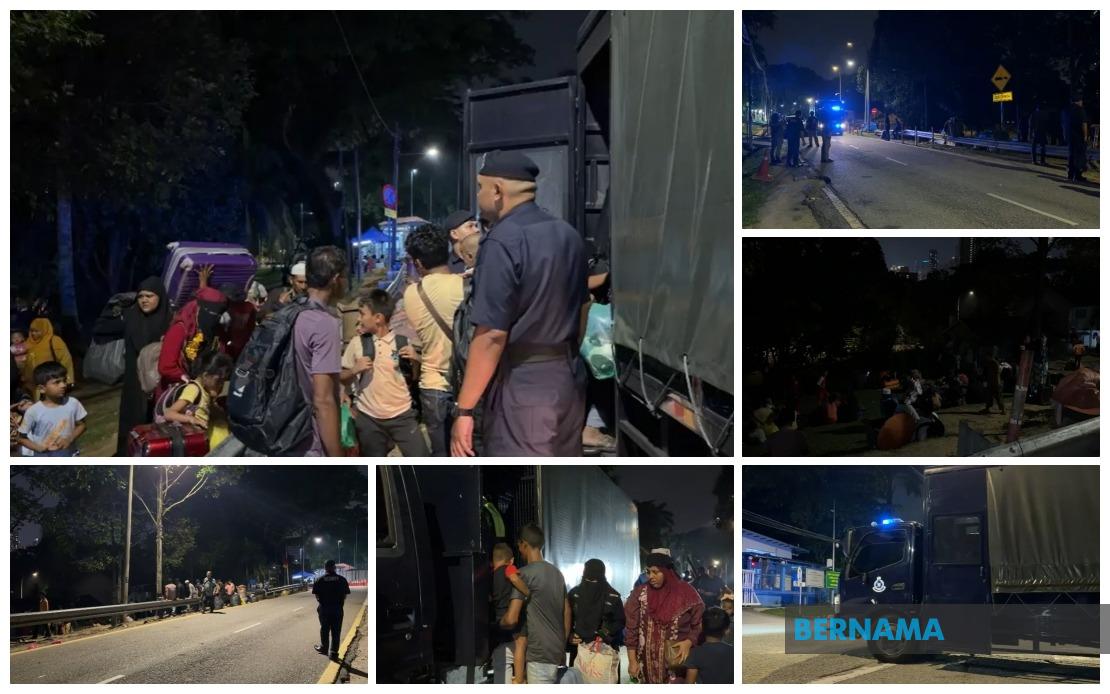
Hundreds of Rohingya refugees who congregated outside the UNHCR office on Jalan Bukit Petaling in Kuala Lumpur were transferred to the city's Police Contingent Headquarters on July 27 for processing and identity verification. The operation, confirmed by Kuala Lumpur police chief Datuk Fadil Marsus, unfolded over several hours as authorities worked to document and assess the refugee population that had travelled to the capital.
The relocation effort required significant police resources, with officers deploying four trucks to facilitate the movement after initial transport proved inadequate for the volume of people and their belongings. The operation commenced at 8.20 pm, reflecting the logistical challenges involved in processing such a large group. Many of the refugees carried luggage and personal possessions, necessitating additional vehicles to ensure safe and orderly transfer to the police facility.
The gathering itself resulted from a recent migration pattern, with the refugee group arriving in Kuala Lumpur on three buses after departing their established settlement in Penang. This relocation, apparently coordinated within the refugee community, drew immediate attention from federal authorities concerned about public order and the management of undocumented populations in urban areas. The movement highlighted ongoing tensions surrounding refugee populations in Malaysia and their relationship with government institutions tasked with maintaining order.
Upon arrival at police headquarters, the refugees entered an administrative process focused on verifying their legal status within Malaysia's refugee framework. The police conducted preliminary identity checks while documentation specialists prepared to assess individual cases. This initial phase serves as a critical sorting mechanism, distinguishing between those with legitimate refugee recognition and those whose status remains unclear or undocumented.
The National Security Council is expected to assume coordination responsibilities on the day following the relocation, taking the lead in determining the path forward for various categories of refugees. The MKN's involvement reflects the government's inter-agency approach to managing the situation, bringing together multiple stakeholders in determining appropriate outcomes. This coordination mechanism indicates that authorities view the situation as requiring careful assessment rather than immediate enforcement action across the board.
A crucial distinction in the MKN's forthcoming review will centre on UNHCR documentation. Refugees presenting valid UNHCR cards and evidence of legitimate refugee status will potentially receive consideration for suitable placement arrangements within Malaysia's refugee management framework. Conversely, those unable to produce such documentation or who cannot substantiate their refugee claims face different consequences within the system.
Individuals lacking UNHCR cards or unable to establish their legitimate refugee status through verification procedures will be transferred to the Immigration Department, which bears responsibility for handling cases of undocumented foreign nationals. From JIM's custody, such individuals would progress to immigration detention facilities pending arrangements for their repatriation to countries of origin. This pathway underscores Malaysia's established protocol for addressing irregular migration and undocumented populations.
Prime Minister Datuk Seri Anwar Ibrahim issued a forceful statement regarding the government's stance on refugee populations and public order, emphasizing that no refugee group would receive tolerance should they disrupt peace or attempt territorial control within Malaysian jurisdictions. The Premier instructed enforcement agencies including the Royal Malaysia Police, JIM, and local government bodies to apply consistent legal standards against violations of Malaysian law. This messaging clarified that while Malaysia maintains humanitarian commitments, such obligations do not supersede sovereignty or the maintenance of public order.
The incident reflects broader regional challenges facing Southeast Asia regarding refugee management and humanitarian obligation. Malaysia, hosting one of Asia's largest refugee populations, continually navigates the tension between international humanitarian principles and domestic security and administrative concerns. The Rohingya situation remains particularly complex given the ongoing displacement from Myanmar, the community's vulnerability, and the strains on Malaysian social services and security apparatus.
For Malaysian policymakers and residents, this episode demonstrates the operational complexities of managing refugee populations in urban centres, the resource requirements for proper documentation and verification, and the necessity for coordinated governmental responses. The incident also underscores how refugee movements, whether spontaneous or organized, can quickly escalate into security and administrative matters requiring high-level governmental coordination and enforcement agency involvement. Understanding these dynamics proves essential for Malaysian citizens seeking insight into how their government balances humanitarian responsibilities with national interests and public order maintenance.
The broader implications suggest that Malaysia will likely continue refining its refugee management protocols, potentially incorporating lessons from this incident into future operational procedures. The coordination between police, immigration authorities, and security agencies during this relocation provides a case study in inter-institutional cooperation, while also raising questions about long-term solutions for refugee populations and sustainable frameworks for managing displacement crises in the region.

