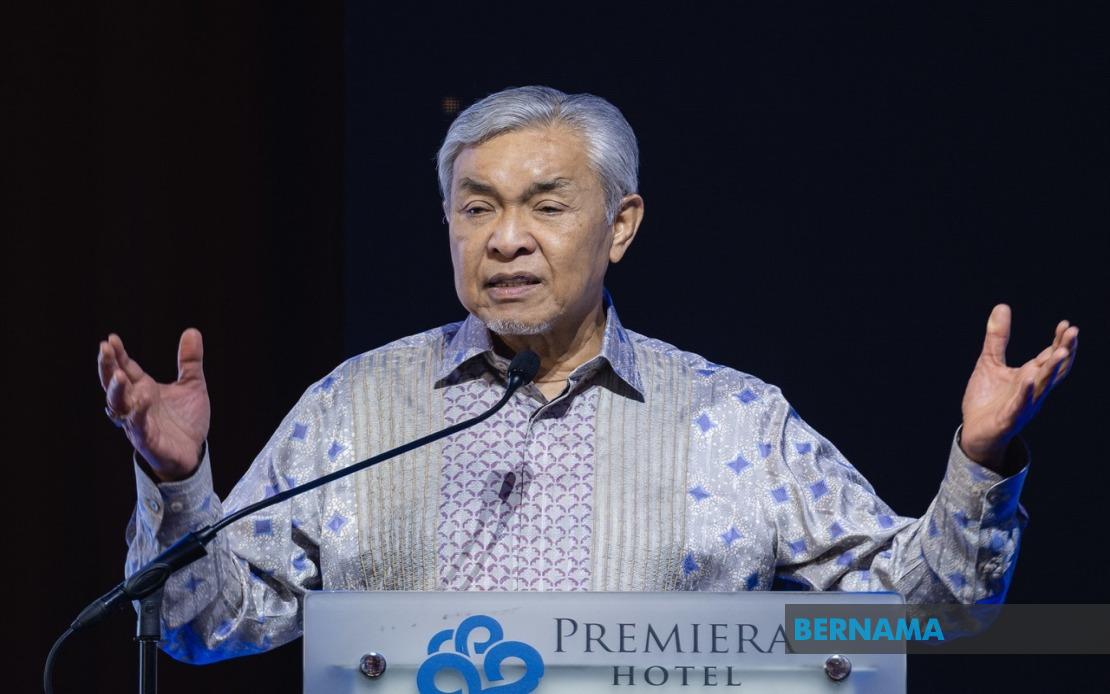
Requests for new rural road projects across Sabah and Sarawak that would improve connectivity between remote communities and major urban centres are being readied for evaluation in Budget 2027, according to Deputy Prime Minister Datuk Seri Dr Ahmad Zahid Hamidi. Speaking at the Ministry of Rural and Regional Development's annual service excellence awards ceremony in Kuala Lumpur, the minister responsible for rural development indicated that infrastructure gaps in East Malaysia remain a priority in federal planning discussions.
Ahmad Zahid framed the consideration of new projects within a broader governance shift. The ministry, under his stewardship, continues to position rural road construction as a core responsibility, specifically targeting areas that currently lack adequate pathways to connect with towns and established settlements. This designation preserves the ministry's mandate even as scrutiny of infrastructure spending grows more rigorous across government. The deputy prime minister's remarks underscored that inclusion in the upcoming budget would depend on genuine infrastructure deficits, not routine requests.
The commitment to evaluate East Malaysian proposals reflects longstanding regional development concerns. Both Sabah and Sarawak have historically faced infrastructure development gaps compared to peninsular Malaysia, a legacy of geographic remoteness and the dispersed nature of communities across vast territories. Improved road networks directly translate to better access for rural populations seeking medical services, educational opportunities, and commercial markets. For timber-dependent and agricultural communities, reliable road infrastructure can fundamentally alter economic viability.
However, Ahmad Zahid attached significant conditions to any budgetary allocation. Implementation of approved projects would remain subject to established regulations and procedures overseen by both the Ministry of Finance and the Public Works Department (JKR). This layered approval framework reflects current fiscal discipline and the need to harmonise infrastructure decisions across multiple government bodies. The deputy prime minister indicated that further refinement of specific proposals would occur only after consultation processes with relevant stakeholders are finalised. This staged approach suggests no immediate commitment but rather a structured pathway for serious consideration.
The minister's remarks came amid a broader push for operational restructuring within the Ministry of Rural and Regional Development. Ahmad Zahid called for a "new discipline" emphasising results-driven governance, where successful programmes receive expanded funding, underperforming initiatives are accelerated or reformed, and ineffective schemes are discontinued altogether. This performance-based framework represents a departure from traditional developmental spending patterns, where projects historically proceeded along planned timelines regardless of tangible community benefit. The approach reflects mounting pressure within Malaysian government to demonstrate concrete returns on rural development expenditures.
Beyond bricks-and-mortar infrastructure, Ahmad Zahid articulated an evolved vision of rural development. The ministry's role, he stressed, extends beyond constructing physical assets to cultivating broader economic ecosystems capable of generating sustainable employment and income pathways for rural populations. This conceptual shift acknowledges that roads alone cannot lift communities from poverty; they must be part of integrated strategies linking market access, skills development, and entrepreneurial opportunity. For East Malaysia specifically, this framing could justify investments in both transportation networks and complementary economic development initiatives.
The deputy prime minister also emphasised public service transformation within rural development institutions. He characterised modernisation not merely as the migration from manual to digital systems, but fundamentally as a shift in organisational mindset. He called for decision-making courage and cultural readiness for change, suggesting that many inefficiencies in rural programmes stem from institutional inertia rather than resource constraints. This cultural critique implicitly acknowledges that previous rural development efforts, despite substantial funding, have sometimes faltered due to implementation challenges rooted in administrative practice rather than budget limitations.
Staff development emerged as a key theme in Ahmad Zahid's remarks. He encouraged ministry personnel to embrace lifelong learning, foster innovation, and maintain stringent standards of integrity and accountability. These appeals reflect a recognition that the calibre of development outcomes depends significantly on the capability and commitment of implementing officials. In the context of East Malaysian projects, where geographic challenges compound administrative complexity, the quality of planning and execution becomes even more critical to project success.
The timing of these statements holds particular significance for Sabah and Sarawak stakeholders. As Budget 2027 enters its formulation phase, clarity on rural road priorities provides a window for both state governments and local communities to articulate infrastructure needs through established consultation channels. The deputy prime minister's conditional openness creates opportunity without guarantee, requiring East Malaysian interests to make compelling cases based on connectivity deficits and development potential. Given the competitive nature of national budgeting, projects that clearly demonstrate both genuine infrastructure gaps and realistic implementation capacity stand better prospects.
Sabah and Sarawak represent distinct geographic and economic contexts within Malaysia's broader development landscape. Rural communities across both states, particularly in interior regions, continue to experience limited road access that constrains economic participation and quality-of-life outcomes. Improved connectivity could unlock potential in agriculture, tourism, and resource extraction while enhancing service delivery in health and education. The prospect of budget consideration, even with attached conditions, signals renewed attention to these longstanding infrastructure challenges at the highest levels of government.

