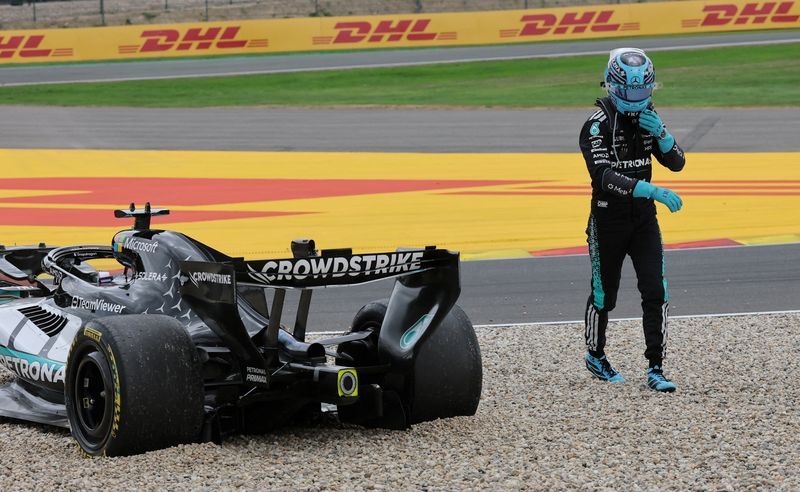
George Russell's weekend at Spa-Francorchamps ended in frustration and gravel when the Mercedes driver collided with Lewis Hamilton's Ferrari on the opening lap of Sunday's Belgian Grand Prix, a setback that underscores mounting technical troubles for the team. The British driver, starting from third on the grid, found himself unable to maintain position after losing significant ground through the opening sequence of corners, ultimately spinning off the track as the safety car was deployed. For Russell, the disappointment has become almost routine this season, prompting him to describe himself as emotionally numb to the recurring disappointments.
What makes Russell's exit particularly significant is the underlying technical failure that preceded the collision. The Mercedes driver explained that a battery recharge malfunction at Turn One left him severely compromised heading into Eau Rouge, one of the circuit's most demanding corners. Exiting the first corner with only 35 percent battery charge, Russell found his power unit unable to recover, leaving him vulnerable as three competitors swept past during his recovery. The turbo system also failed to stabilize, compounding an already precarious situation. By the time he reached Eau Rouge, Russell was operating on zero battery charge in a section where full power is critical for both competitive performance and driver safety—a combination that made further progress virtually impossible.
The collision with Hamilton was, in Russell's assessment, almost inevitable given his mechanical disadvantage. Though the stewards judged Hamilton primarily responsible for the contact and imposed a five-second penalty, Russell acknowledged that his former Mercedes teammate had not acted recklessly. What rankled Russell most was not the racing incident itself but the circumstances that forced him into such a vulnerable position. Had the battery recharge functioned as designed, Russell would likely have remained competitive and avoided the contact entirely. The incident highlights a recurring theme for Mercedes this season: when the machinery fails, title ambitions crumble quickly.
This represents Russell's third failure to score points in the 2024 season, a concerning pattern for a driver who harbors championship aspirations. The contrast with championship leader Kimi Antonelli, who started Sunday's race from pole position and who leads the standings by 25 points with nine races completed from the 22-race calendar, illustrates the stakes involved. Antonelli, Russell's Mercedes teammate, has won six times already this season, demonstrating both the competitive potential of the Silver Arrows' machinery and the disparity in results between the two drivers. Meanwhile, Antonelli himself has experienced two points-scoring blanks, suggesting that reliability remains a concern across the Mercedes lineup.
Russell's technical explanations point to a pattern of issues that extend beyond Sunday's race. On Saturday qualifying, the driver had already flagged serious concerns about his car's performance on the straights, suggesting that the electrical and power unit problems were not one-off anomalies but symptomatic of deeper engineering challenges. These straight-line performance deficits place Mercedes at a structural disadvantage on a circuit like Spa-Francorchamps, where top speed and aerodynamic efficiency over long distances determine positioning. For a team fighting for championship honors, such vulnerabilities in core powertrain performance cannot be overlooked.
The timing of Russell's exit is particularly damaging to his title hopes. With nine of the 22 races completed, the championship is still very much in play, but attrition in the form of mechanical failures and collisions compounds the challenge of recovering a significant points deficit. In Formula One's modern context, where reliability has ostensibly improved markedly compared to earlier eras, a driver failing to score due to power unit malfunctions represents a significant competitive disadvantage. Teams and drivers at the sharp end of championship fights typically enjoy more consistent mechanical support and fewer unforced technical errors.
Hamilton's continued participation in the race, despite the penalty, presented an interesting dynamic given the shared Mercedes heritage between the two drivers. The five-second penalty for causing the collision meant Hamilton would need to manage the deficit in subsequent pit-stop calculations, but at least he remained in the competition. Russell's removal from the race entirely underscores the different trajectories the two veteran drivers are following within the team structure. While Hamilton remains competitive despite the penalty, Russell faces questions about whether his machinery and luck are conspiring against his championship credentials.
For Mercedes as an organization, the Belgian Grand Prix results raise strategic questions beyond the immediate championship implications. A 25-point gap with 13 races remaining is substantial but not insurmountable if reliability improves and consistency increases. However, the pattern of electrical and power unit issues affecting different drivers at different times suggests that the problem may be systemic rather than isolated to individual installations. The team's technical leadership will need to conduct a thorough review of the battery management and turbo stabilization systems before the championship fight continues in earnest.
Russell's philosophical acceptance of repeated disappointment—describing himself as numb to the letdowns—reflects both the psychological toll of unreliability and the resignation of a competitor facing circumstances partially beyond his control. In professional motorsport, where margins between success and failure are measured in milliseconds and where machinery must function perfectly for 90-plus minutes, such technical deficiencies are career-defining setbacks. Russell will hope that Mercedes' engineering teams can rapidly diagnose and rectify the power unit problems before the next race, as further failures of this magnitude could definitively extinguish his championship hopes.

