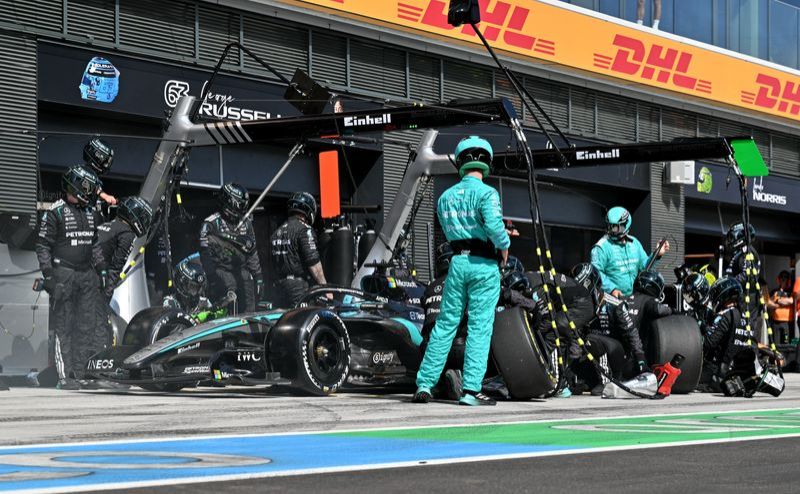
George Russell's patience is wearing thin. The Mercedes driver limped away from the Hungarian Grand Prix on Sunday having endured yet another technical malfunction—this time an anti-stall system activation that sent him tumbling from sixth on the grid to the rear of the field on the opening lap. His recovery to seventh place proved inadequate compensation, particularly as his 19-year-old Italian teammate Kimi Antonelli claimed a podium finish in third, further widening the championship gap to 59 points across 11 of 23 rounds.
The incident itself was mundane by modern technical standards, yet revelatory about Russell's season. With the lights about to extinguish, his engine began revving uncontrollably, refusing to respond to throttle inputs despite being brand new. "No idea," Russell told reporters in typically blunt fashion, his frustration barely contained. For a driver who entered 2025 as a pre-season championship favourite, this catalogue of misfortune has become almost routine. Russell's exasperation transcended disappointment—he acknowledged crossing into territory where daily frustration risks becoming counterproductive to his mental state and competitive focus.
The broader context makes Russell's position particularly galling for Mercedes. He has managed just two victories compared to Antonelli's six, and three of his race finishes this season have netted zero championship points. Last weekend in Belgium, a first-lap spin following contact with Lewis Hamilton's Ferrari relegated him further, though the seven-time champion received a penalty for the incident. The accumulation of setbacks—some technical, some circumstantial—has created a narrative of misfortune that no driver should endure over half a season.
Mercedes team principal Toto Wolff acknowledged the unacceptable pattern, accepting full responsibility for a situation that has hobbled one of his star drivers. "The problems are happening to me, but the whole team feels it too," Russell noted, suggesting that while the issues disproportionately affect him, Mercedes' engineering challenges represent a broader malaise rather than personal car setup problems. Yet the statistical disparity troubles him most—reliability nightmares appear substantially concentrated on his side of the garage compared to Antonelli's relatively cleaner campaign.
For Malaysian and Southeast Asian motorsport enthusiasts, Russell's predicament illuminates the razor-thin margins in contemporary Formula One. Mercedes remains a championship-contending outfit, yet internal performance gaps can widen dramatically through mechanical attrition and strategic misalignment. The situation parallels historical championship collapses where one driver's car becomes demonstrably unreliable, forcing teams into damage-control mode and resource reallocation that inevitably advantages the functioning vehicle. Russell's growing resignation—his statement that he "doesn't usually feel like needing a break, but definitely does this year"—signals psychological strain extending beyond mere sporting disappointment.
The timing of the summer recess, commencing after Hungary until late August, offers Russell essential mental respite and Mercedes critical diagnostic time. Technical investigations may identify whether manufacturing inconsistencies, component fatigue, or systemic design flaws plague his machinery. Wolff's commitment to resolving these issues carries urgency; Russell's historical competence and raw pace—demonstrated repeatedly despite mechanical failure—suggest that once reliability stabilises, rapid championship point accumulation remains feasible. Yet mathematics impose harsh constraints: climbing from 59 points adrift with 12 rounds remaining demands near-perfect execution and Antonelli's performance regression simultaneously.
Russell's philosophical shift toward accepting what lies beyond his control reflects maturity born from repeated frustration. His acknowledgment that continued disappointment about external factors would render him "disappointed every day of the week" demonstrates emotional intelligence, yet also resignation to circumstances that should not exist at a team of Mercedes' calibre. The contrast with Antonelli—a teenager executing at championship-contending level—underscores that team execution extends beyond individual brilliance. Where Russell possesses elite-level speed, apparent here despite mechanical handicaps, Antonelli has combined decent pace with the fortune of reliability.
The Hungarian Grand Prix result exemplifies modern F1's complexity: track performance alone proves insufficient when machinery betrays ambition. Russell's grid position and subsequent recovery demonstrated competitive capability, yet a technical malfunction transformed a potentially points-scoring result into strategic relegation. For observers across Southeast Asia following Formula One's technical and sporting narratives, Russell's season encapsulates the sport's harsh lesson—driver talent represents merely one variable within an intricate equation encompassing engineering, logistics, reliability, and happenstance.
Mercedes faces strategic choices extending beyond technical repair. Should Russell's mechanical issues persist, questions will inevitably emerge regarding resource allocation and whether championship mathematics justify continued heavy investment in his campaign, or whether pivot toward securing Antonelli's title represents optimal team strategy. Wolff's public support remains steadfast, yet boardroom pragmatism often diverges from public statements. Russell's immediate priority involves mental reset during the recess and renewed confidence that returning to action will bring mechanical vindication and competitive restoration.

