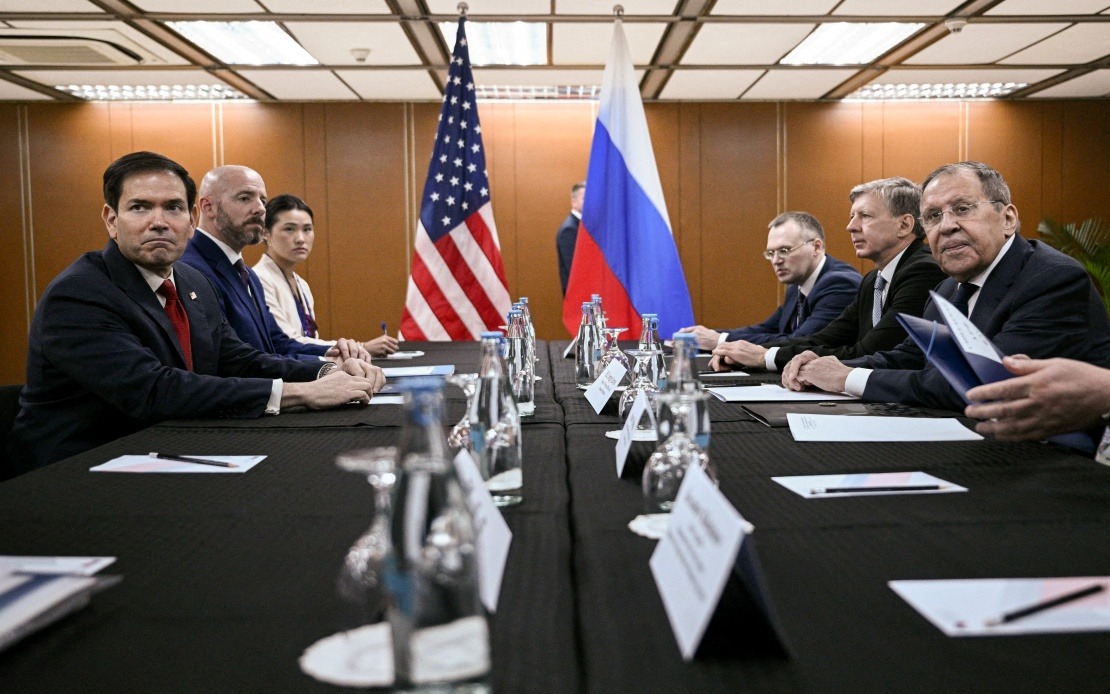
Russian Foreign Minister Sergey Lavrov and United States Secretary of State Marco Rubio have committed to maintaining active diplomatic channels between their respective foreign ministries, a development that signals continued engagement despite broader geopolitical tensions. The agreement emerged from their meeting in Manila, with the Russian Foreign Ministry confirming on Thursday that both officials would sustain contacts through multilateral frameworks involving international organisations where Russia and the United States participate.
The commitment to preserve diplomatic lines carries symbolic importance in the current global climate. Even as bilateral relations remain strained over multiple policy disagreements, the willingness of both Moscow and Washington to keep communication channels open suggests recognition that complete isolation serves neither nation's interests. For Southeast Asian observers, particularly those in Malaysia where regional stability depends partly on predictable great-power conduct, such commitments provide some reassurance that superpower competition will not escalate into uncontrolled confrontation.
Beyond the headline agreement on diplomatic contacts, the two officials also addressed the operational difficulties facing their respective diplomatic missions. Normalising working conditions for Russian and American embassies has become increasingly important as both nations navigate restrictions and complications that have accumulated over recent years. These practical arrangements, though less dramatic than high-level policy pronouncements, form the essential foundation that allows day-to-day diplomatic work to proceed effectively.
A particularly noteworthy element of the Manila discussions involved space exploration cooperation. Lavrov and Rubio welcomed the resumption of full-scale contacts between Russia's state space agency Roscosmos and the United States National Aeronautics and Space Administration (NASA). This development suggests that even amid political disagreements, both countries recognise the mutual benefits of scientific and technological cooperation. Space exploration represents an arena where competition and collaboration have historically coexisted, and the restoration of high-level institutional contacts points toward pragmatism overriding ideology.
The emphasis on space cooperation holds particular resonance for regional players in Southeast Asia. Nations like Malaysia harbour their own space ambitions and benefit from the technological spillovers and international standards that emerge from leading-edge programmes. When Russia and the United States work together in space, they establish protocols and practices that eventually benefit smaller spacefaring nations aspiring to expand their own capabilities.
Interparliamentary exchanges featured prominently in the statement released by the Russian Foreign Ministry. Both officials called for developing these legislative-level contacts, recognising that dialogue between parliamentarians offers a different avenue for understanding compared to executive-level discussions. Such exchanges provide opportunities for legislators from both nations to build personal relationships, understand differing domestic perspectives, and potentially identify common ground on issues where executive-level agreement remains elusive.
The revival of cultural ties represented another dimension of the agreement. Culture and people-to-people exchanges serve as stabilising forces during periods of political tension, allowing ordinary citizens from different nations to interact and form bonds beyond official government positions. For Russia and the United States, cultural cooperation spanning everything from academic collaboration to artistic exchanges can humanise relationships that public rhetoric sometimes reduces to abstract geopolitical competition.
The Manila location itself merits consideration. The Philippines, as a regional power navigating complex relationships with both Western nations and China, provides symbolic neutral ground for such encounters. That Lavrov and Rubio chose to conduct these discussions there suggests an awareness that Southeast Asia maintains importance in their diplomatic calculations and that regional acceptance of their engagement matters.
For Malaysia and other ASEAN members, the maintenance of dialogue channels between Russia and the United States reduces uncertainty about superpower intentions in the Indo-Pacific region. Unpredictable great-power behaviour creates problems for middle-power nations that must calibrate their own foreign policies accordingly. The explicit commitment to continued contacts through international organisations provides some assurance that both capitals will engage through established multilateral frameworks rather than pursuing unilateral actions that could destabilise the regional order.
The agreement also reflects practical recognition that numerous global challenges require Russian and American cooperation. Issues ranging from climate change to pandemic preparedness to nuclear proliferation extend beyond bilateral disputes and demand engagement across traditional divides. By agreeing to continue contacts, Lavrov and Rubio acknowledged that their countries' ability to address transnational problems depends on maintaining at least minimum levels of official communication.
Looking forward, these commitments represent modest but meaningful steps toward stabilising bilateral relations. Neither official announced breakthroughs on contentious issues, nor did the statement suggest imminent resolution of fundamental disagreements. Instead, the focus remained on preserving the mechanisms through which disagreement could be managed without complete breakdown of relations. Such incremental approaches to diplomacy, while lacking the dramatic appeal of sudden reconciliations, often prove more durable and realistic.
For Malaysian policymakers observing these developments, the lesson centres on the continued viability of dialogue even amid serious international differences. As Malaysia itself navigates relationships across the global system, maintaining its own diplomatic channels and pursuing engagement through multilateral forums remains valuable. The Russia-US agreement in Manila demonstrates that even major powers benefit from refusing to allow political tensions to eliminate all forms of communication and cooperation.

