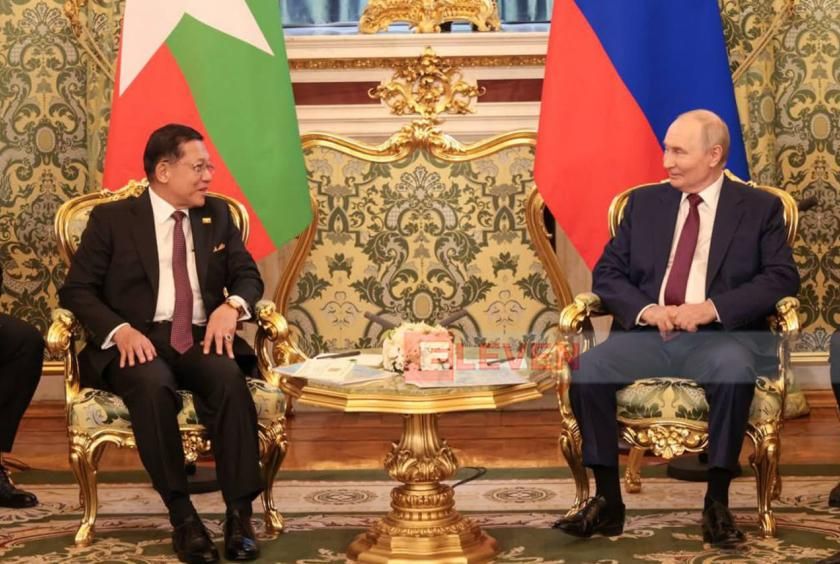
Russia and Myanmar are set to deepen their strategic partnership across energy, infrastructure and defence sectors, with Moscow offering comprehensive support for resource exploration and major industrial development. President Vladimir Putin made the commitment during a media address on August 18 alongside Myanmar President U Min Aung Hlaing, signalling Russia's sustained interest in strengthening ties with the Southeast Asian nation despite international pressures.
The energy sector emerged as the centrepiece of Moscow's engagement strategy. Putin specifically highlighted Russia's readiness to participate in Myanmar's offshore oil and gas exploration efforts, recognising substantial untapped resources in the nation's maritime zones. Beyond conventional hydrocarbon projects, he flagged the potential for Russian liquefied natural gas exports to Myanmar, with the possibility that some volumes could serve domestic consumption whilst others feed into regional export markets. The Kremlin leader portrayed such arrangements as mutually beneficial, positioning energy cooperation as foundational to broader economic ties.
Nuclear power development represents another significant dimension of the emerging partnership. Russia and Myanmar signed an agreement last year to construct a nuclear power plant—a transformative infrastructure project that Putin described as strategically important for both nations. This commitment reflects Myanmar's long-term energy planning needs and Russia's established expertise in reactor technology and civilian nuclear development. The initiative also signals Moscow's confidence in Myanmar's technical capacity and political stability to manage such complex facilities.
Beyond energy, the bilateral relationship encompasses an extensive array of industrial and transportation projects. Russian companies are engaged in building a coal-fired power station and an oil refinery in Myanmar, addressing the country's immediate electricity and petroleum processing requirements. Additional ventures under discussion include a steel manufacturing facility, a fertiliser production plant, and notably, a deep-sea port in southern Myanmar—infrastructure that would substantially enhance Myanmar's maritime logistics capacity and regional trade positioning. These projects underscore Russia's interest in Myanmar as both a market and a development partner.
The historical foundation of Russia-Myanmar relations provides essential context for contemporary cooperation. Putin acknowledged the Soviet Union's substantial contributions to Myanmar during the 1950s and 1960s, when Moscow provided technical assistance across social, economic and defence domains. Hospitals, universities and other institutional infrastructure built during that era continue serving Myanmar's population, creating enduring goodwill and familiarity with Russian developmental approaches. This legacy informs contemporary bilateral dynamics and Moscow's confidence in long-term engagement.
High-technology sectors increasingly feature in bilateral discussions. Putin highlighted Russian interest in Myanmar's digital economy, cybersecurity frameworks and advanced industrial applications. These fields reflect evolving global competition for technological influence and Moscow's effort to position itself alongside Myanmar's modernisation trajectory. Educational exchanges underpin this dimension, with approximately 400 Myanmar citizens currently enrolled at Russian universities, whilst some 17,000 Burmese have graduated from Russian institutions historically—a human capital foundation that facilitates technological and knowledge transfer.
Military and security cooperation constitutes another pillar of the relationship, though less prominently detailed publicly. Russia and Myanmar conduct regular military exercises in Myanmar's territorial waters, whilst Russian naval vessels maintain frequent port visits. This military dimension reflects both nations' strategic interests in regional security and Myanmar's diversified defence partnerships. For Myanmar, maintaining close defence ties with Russia provides an alternative to exclusive dependence on any single security patron.
Cultural and people-to-people exchanges have expanded significantly. Under a visa-free arrangement, scientists, students, tourists and athletes move freely between nations. Myanmar cultural and religious centres now operate in Russian regions including Altai, Kaluga and Moscow, whilst Myanmar has approved construction of a Russian Orthodox Church in Yangon—symbolising cultural reciprocity. The growing interest in Russian language education at Myanmar universities in Yangon and Mandalay, plus at the military academy, demonstrates sustained intellectual engagement. A new Myanmar consulate will open in Vladivostok, further institutionalising bilateral relations.
The twelve memorandums of understanding signed during President U Min Aung Hlaing's current visit formalise these commitments across multiple sectors. Putin characterised the bilateral payment system as reliable and trustworthy, suggesting confidence in financial mechanisms even amid international sanctions pressure on Russia. This financial stability provides reassurance for both private Russian companies and Myanmar entities undertaking joint ventures.
For Myanmar, the Russian partnership offers diversified development pathways and alternative strategic alignment options. As the nation navigates complex geopolitical dynamics following recent political transitions, maintaining strong ties with major powers including Russia provides leverage and reduces vulnerability to pressure from any single external actor. The energy and infrastructure projects, if successfully implemented, would meaningfully advance Myanmar's development agenda and regional economic positioning.
The emphasis on international issues and shared perspectives on non-interference signals alignment on broader geopolitical questions. Both nations have consistently opposed external interference in sovereign affairs and international organisation dynamics, reflecting convergent positions on contested global governance matters. This ideological alignment reinforces the bilateral relationship beyond transactional economic interests.
Russia's Myanmar strategy reflects broader Moscow positioning in Southeast Asia, where maintaining influence remains a priority despite Western sanctions and Asian regional diversification. The depth of proposed cooperation—spanning energy, infrastructure, defence, technology and culture—suggests sustained commitment rather than opportunistic engagement. For the region, Russia-Myanmar deepening ties represent another dimension of great power competition for influence, with implications for regional alignment patterns and strategic autonomy across Southeast Asia.

