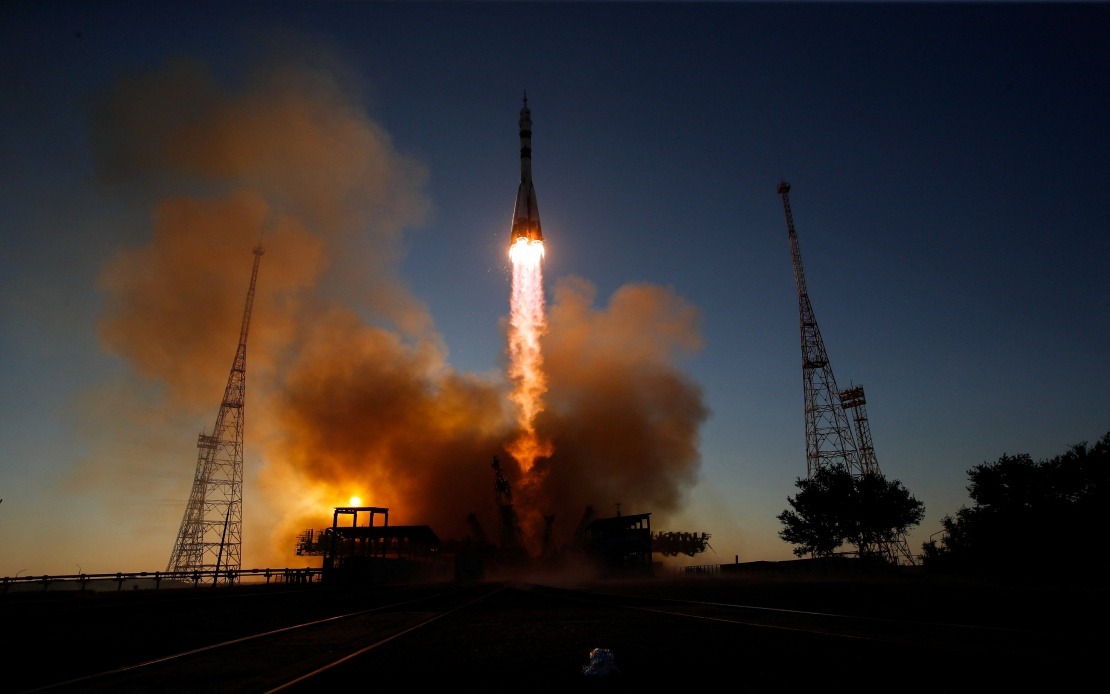
A Russian Soyuz spacecraft carrying two cosmonauts from Russia and one astronaut from the United States successfully undocked from the International Space Station on July 26, marking the beginning of the crew's journey home after more than eight months in orbit. The vessel, designated Soyuz MS-28, detached from the orbital laboratory as confirmed by live coverage from Roscosmos, Russia's federal space agency, with the three-person international crew aboard ready to begin their re-entry sequence.
The spacecraft houses cosmonauts Sergey Kud-Sverchkov and Sergey Mikayev alongside American astronaut Christopher Williams. This crew composition exemplifies the ongoing collaboration between the Russian space programme and the United States space agency, a partnership that has endured through various periods of geopolitical tension and remains central to operations aboard humanity's orbital outpost.
Following undocking, Roscosmos outlined the sequence of events required to bring the crew safely back to the surface. Once the Soyuz achieves sufficient distance from the ISS, flight controllers will execute what specialists term a deorbit burn—a controlled engine firing that gradually reduces the spacecraft's orbital velocity and initiates descent through progressively denser layers of atmosphere. This manoeuvre represents one of the most critical phases of any crewed spaceflight mission, requiring precision timing and flawless execution.
The spacecraft will subsequently separate into its constituent modules during re-entry, a standard procedure for Soyuz vehicles that dates back decades of operations. The descent module, which houses the crew in a protective capsule, will separate from the orbital and service modules before atmospheric heating reaches extreme levels. This modular design has proven reliable across numerous missions, offering redundancy and allowing non-essential components to be jettisoned before final descent.
Landing operations are scheduled for approximately 12:50 pm Moscow Standard Time, equivalent to 09:50 Greenwich Mean Time, in a remote region near Zhezkazgan in Kazakhstan's vast steppes. This location has served as a traditional landing zone for Soyuz missions for years, with recovery operations and infrastructure well established to retrieve the crew and their spacecraft. The Kazakh steppes, while inhospitable terrain, offer large expanses of relatively flat ground suitable for parachute landings and post-landing recovery activities.
The three crew members have occupied the ISS continuously since November 27, completing a full rotation of eight months in microgravity. During their tenure aboard the station, they participated in scientific experiments, performed maintenance operations, and conducted observations fundamental to the research mission conducted at the facility. The duration of their mission reflects standard expedition lengths that have become routine for ISS crew rotations.
This return mission underscores the intricate scheduling required to maintain continuous human presence on the International Space Station. As one crew departs, preparations advance for successor teams to launch and dock, ensuring uninterrupted operations aboard the orbiting laboratory. The transition between crews involves careful coordination between multiple space agencies and the transfer of knowledge regarding station status and ongoing experiments.
For Malaysian and Southeast Asian observers, missions such as this demonstrate the technological sophistication and international cooperation required for sustained space activities. While no Malaysian personnel are involved in this particular mission, the ISS programme represents a model of international collaboration that transcends terrestrial political divisions, an aspect potentially relevant to regional nations considering expanded space capabilities and cooperative frameworks.
The successful docking and undocking operations that bracket each expedition represent achievements of remarkable precision. Modern spacecraft autonomy systems, combined with ground-based support from multiple mission control centres, enable the complex manoeuvres necessary to rendezvous with and depart from a structure moving at approximately 28,000 kilometres per hour relative to Earth's surface. Each operation carries inherent risks that space professionals have worked systematically to minimise through decades of accumulated experience.
As space exploration continues to evolve with expanding private sector participation and emerging spacefaring nations, the proven reliability of established systems like Soyuz remains central to maintaining orbital operations. The spacecraft design, continuously refined over generations of missions, continues to serve as the primary transport vehicle for ISS crew rotations and has demonstrated remarkable longevity. The current deorbit and landing sequence represents the culmination of extensive preparation and training undertaken by the crew and supporting teams across international organisations.
The return of Kud-Sverchkov, Mikayev, and Williams to Earth concludes another chapter in the ongoing narrative of permanent human spaceflight. Their replacement crew will follow in subsequent launches, continuing the uninterrupted occupation of the station that has now persisted for more than two decades. This rhythm of crew rotations, enabled by reliable transport systems and international coordination, has become the defining characteristic of modern space operations.

