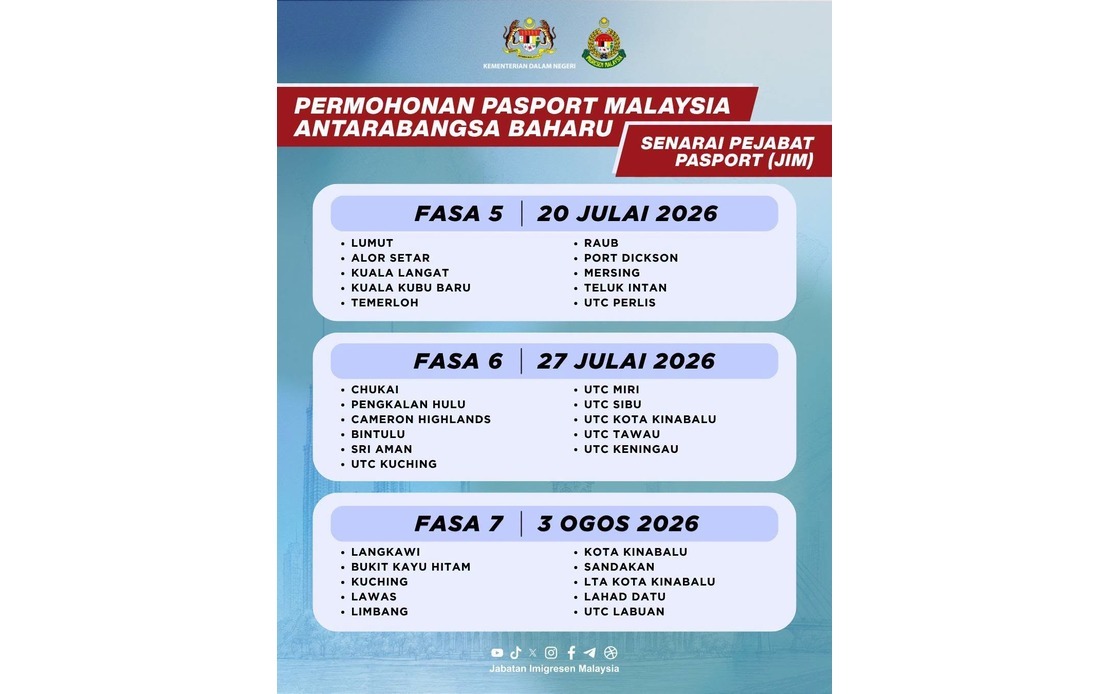
The Immigration Department has commenced a phased rollout of the newly designed Malaysian international passport in Sabah and Sarawak today, accelerating the nationwide implementation process. This staged approach reflects the government's strategy to manage the transition smoothly across the country's most geographically dispersed states, which present unique operational challenges given their size and population distribution.
Phase 6 of the rollout begins today at eight selected passport-issuing offices: the urban transformation centres in Bintulu, Sri Aman, Kuching, Miri, Sibu, Kota Kinabalu, Tawau, and Keningau. The second phase will commence on August 3, expanding the service to additional locations across both states. Phase 7 will cover offices in Kuching, Lawas, Limbang, Kota Kinabalu, Sandakan, Kota Kinabalu International Airport, Lahad Datu, and the Labuan Urban Transformation Centre. By specifying exact implementation dates for each location, the department aims to prevent queues and overcrowding at offices not yet equipped to issue the new document.
Malaysians seeking to apply for or renew their passports are advised to verify which offices in their area are participating and to schedule their visits accordingly. The department has emphasised that there is no urgent need to rush for the new passport, as existing passports retain their validity for up to six months before expiry. This messaging is particularly important for East Malaysian residents, who may face longer travel distances to reach participating centres compared to their counterparts in Peninsular Malaysia.
Prime Minister Datuk Seri Anwar Ibrahim unveiled the new international passport on June 30, introducing what officials describe as a significantly enhanced document fortified with 94 distinct security features. These upgrades are designed to strengthen Malaysia's position within international travel frameworks and enhance protection against document fraud and forgery. The comprehensive security enhancements reflect growing global standards for passport authentication in an era of increasing document-related risks.
Citizens aged 18 and above have had the opportunity to apply for the new passport since July 1. Applicants can select between two validity periods: five years or ten years, depending on their travel needs and personal circumstances. This flexibility caters to different usage patterns, with the longer option particularly appealing to frequent travellers who wish to avoid frequent renewal procedures. The choice also acknowledges budgetary considerations for citizens who may prefer to renew at shorter intervals.
The rollout strategy employed by the Immigration Department reflects a careful, measured approach to national implementation. The passport service was initially restricted to just 14 high-volume passport-issuing offices when the new document was first introduced. From this concentrated launch, the department expanded the service to 71 offices nationwide, demonstrating a commitment to broadening access while managing operational capacity. The timeline suggests completion of this nationwide expansion by early August, meaning the transition to the new passport will be substantially accomplished within a compressed timeframe of just over one month.
For Sabah and Sarawak residents, the rollout carries particular significance as East Malaysia has historically experienced different service delivery timelines compared to Peninsular Malaysia due to logistical constraints. The strategic placement of urban transformation centres as distribution points for the new passport reflects a broader government initiative to utilise these facilities as multi-service hubs, improving the accessibility of federal services across these states. This approach acknowledges that not all residents can readily travel to major cities, making decentralised service delivery essential for equitable access.
The introduction of the new passport represents a substantive modernisation of Malaysia's travel documentation system. Beyond aesthetic updates, the 94 security features incorporate contemporary technology designed to meet international standards enforced by immigration authorities worldwide. Malaysian passport holders will benefit from enhanced recognition and reduced scrutiny at international borders, as global recognition systems can more readily authenticate the document's legitimacy. This standardisation strengthens Malaysia's integration with international travel security frameworks.
For Malaysian nationals residing abroad or planning international travel, the new passport offers tangible advantages in document reliability and acceptance. The comprehensive security architecture addresses vulnerabilities that have increasingly become targets for sophisticated fraud operations. By upgrading their passport infrastructure, Malaysia demonstrates commitment to protecting its citizens' travel rights and maintaining confidence in the integrity of Malaysian travel documentation globally.
The phased implementation across Sabah and Sarawak should be completed within two weeks of today's launch date, bringing East Malaysian offices into alignment with the broader national rollout schedule. This timeline suggests that by early August, the vast majority of Malaysian passport-issuing offices will be equipped to process applications for the new document. Citizens should view this transition period as an opportunity to upgrade their passports at their leisure, rather than facing compressed deadlines that could create administrative bottlenecks.

