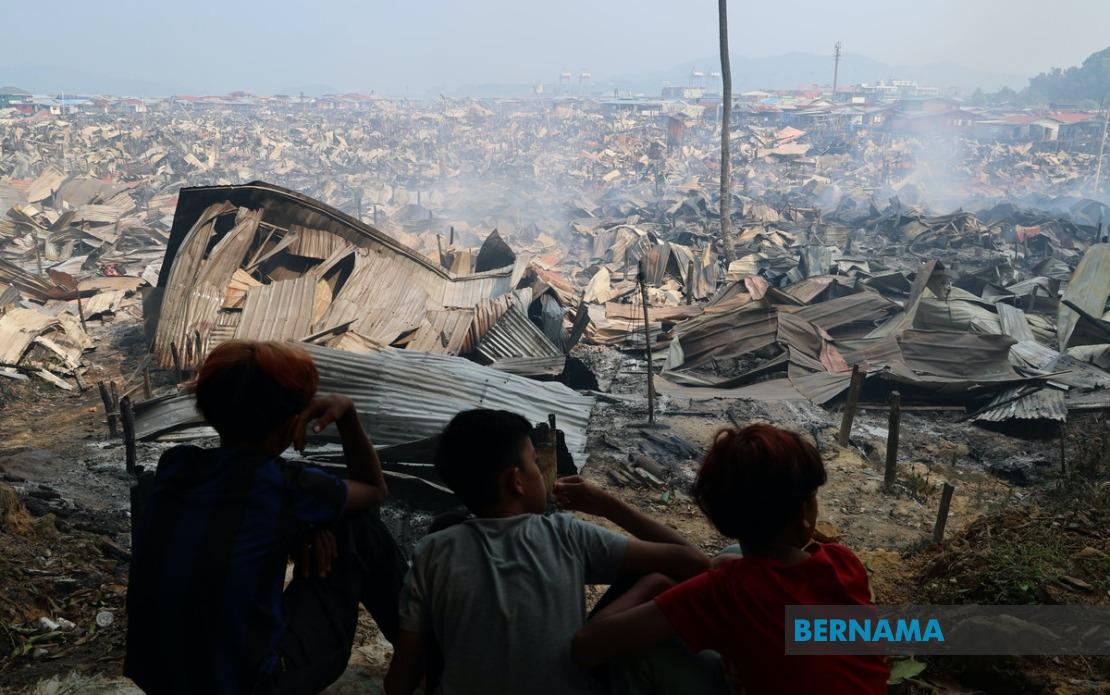
The Sabah state government has unveiled an immediate financial relief package of RM3,000 for each Malaysian household head affected by a catastrophic fire that swept through Kampung Lok Buta in Numbak early on August 31. Chief Minister Datuk Seri Hajiji Noor announced the assistance after visiting survivors sheltering at the Likas Multipurpose Hall temporary relief centre, pledging that the funds would help ease the financial strain on families who lost everything in the blaze.
The relief amount represents a coordinated contribution from three funding sources: RM1,000 each from the state government, the federal government, and the Yayasan Kebajikan Sabah. This tripartite approach to disaster relief underscores the scale of the emergency and the need for rapid deployment of resources across multiple government agencies and charitable institutions. The combined package signals an attempt to provide meaningful immediate support during the critical early phase of recovery, when displaced families face pressing needs for shelter, food, and essential supplies.
Beyond the direct monetary assistance, the Sabah government has committed to a broader rehabilitation strategy that extends well beyond emergency handouts. State authorities plan to coordinate housing reconstruction efforts through the State Secretary's Office working in tandem with Majlis Amanah Rakyat (MARA), indicating that long-term resettlement will be structured through established government development agencies rather than ad hoc measures. This institutional approach suggests officials are viewing the disaster not merely as an immediate crisis requiring emergency response, but as a reconstruction challenge demanding systematic, sustained effort.
The determination of where displaced residents will rebuild their homes remains contingent on detailed assessments of site suitability. Authorities have indicated that reconstruction may occur either at the original Kampung Lok Buta location or at alternative sites to be identified following careful evaluation of safety, infrastructure, and environmental factors. This flexibility recognises that the fire may have rendered the original settlement area inadequate for rehabilitation, and that relocation to properly planned alternative locations might ultimately serve survivors' long-term interests better than attempting to restore the compromised original site.
In a humanitarian gesture extending beyond citizenship requirements, the government has also committed RM1,000 in state-level assistance for each non-Malaysian household head affected by the fire. This provision reflects a compassionate acknowledgment that undocumented or non-citizen residents, often among the most economically vulnerable in any community, were equally devastated by the disaster regardless of their legal status. The decision to provide supplementary aid to this population demonstrates official recognition that humanitarian obligations sometimes supersede strict immigration or citizenship classifications.
Immediate provisioning of basic necessities will complement the cash assistance. The government will distribute food items and household supplies to all affected families, addressing the most pressing daily requirements while financial assistance becomes available. This layered approach—combining immediate material support with cash disbursements and longer-term housing reconstruction—reflects established disaster response protocols designed to stabilise situations in the critical days and weeks following major emergencies.
The fire itself erupted around 1:40 am on August 31, engulfing more than 200 residential structures and creating a humanitarian catastrophe that extended beyond property destruction. Three children perished in the flames: four-year-old Nana Abdullah, her six-year-old brother Mohd Asrul, and their eight-year-old cousin Nurfarahdilah Mohd Tajihah. The loss of young lives compounds the tragedy and underscores the particular vulnerability of children in informal settlements where fire safety infrastructure, evacuation procedures, and emergency response capabilities may be limited.
For Sabah and the broader Southeast Asian region, such disasters highlight persistent vulnerabilities in densely populated informal settlements where rapid urbanisation has outpaced infrastructure development. Kampung Lok Buta, like similar communities throughout Malaysia and the region, likely housed economically marginalised populations living in structures with inadequate fire safety provisions. The incident serves as a stark reminder that natural or accidental disasters disproportionately impact those with the fewest resources to recover independently, necessitating robust government intervention.
The government's response, while providing concrete material support, also demonstrates how state capacity to mobilise resources determines disaster recovery outcomes. The coordination between federal and state authorities, coupled with engagement of development agencies like MARA, reflects institutional frameworks that can theoretically deliver structured assistance beyond emergency handouts. However, the effectiveness of such systems ultimately depends on implementation fidelity, transparency in beneficiary identification, and sustained political will to see reconstruction through to completion.
The reconstruction timeline remains unspecified, raising questions about how quickly displaced families can transition from temporary relief centres to permanent housing. International experience with disaster recovery suggests that housing reconstruction typically extends over months or years, and that maintaining political commitment and funding levels throughout prolonged recovery phases presents significant challenges. Survivors will need assurance that initial emergency assistance translates into concrete progress toward permanent rehousing within reasonable timeframes.
Sabah's approach to this tragedy also carries implications for disaster preparedness across Malaysia and Southeast Asia more broadly. The incident underscores the need for stronger building codes, fire safety regulations, and enforcement mechanisms in informal settlements where rapid development has often proceeded without adequate regulatory oversight. Additionally, it highlights the importance of community-level fire prevention awareness and accessible emergency response infrastructure in settlements where residents may face language barriers or have limited familiarity with emergency procedures.
For Malaysian policymakers, the Kampung Lok Buta fire represents both an immediate humanitarian challenge requiring compassionate response and a longer-term policy imperative to address underlying vulnerabilities in informal housing. The government's financial assistance and reconstruction commitment represent necessary short-term measures, but sustainable solutions will require complementary investments in fire safety infrastructure, community education, and urban planning that reduces reliance on densely packed informal settlements as housing solutions for economically disadvantaged populations.

