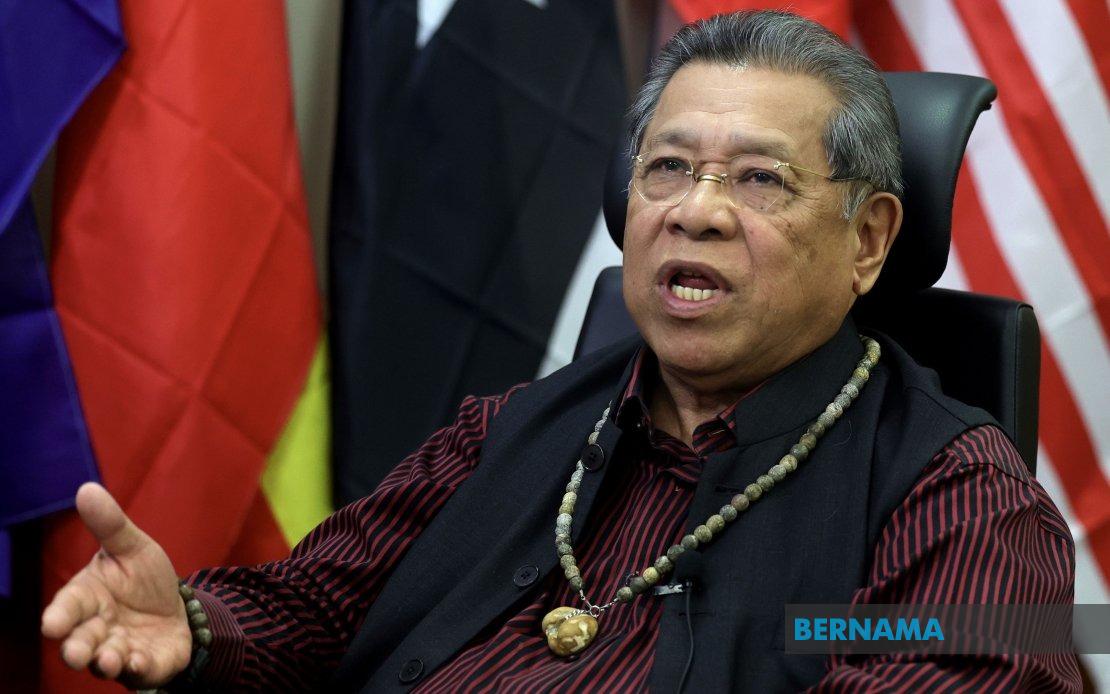
The state of Sabah stands to benefit substantially from a marked elevation in federal funding commitments, according to United Sabah National Organisation (USNO) president Tan Sri Pandikar Amin Mulia, who underscored the capacity of enhanced allocations to translate into tangible development gains for residents across the state.
Speaking at the 2026 PKR National Congress held at the Melaka International Trade Centre (MITC) in Ayer Keroh, Pandikar Amin emphasised that increased federal resources would permit the implementation of a broader portfolio of development initiatives, creating opportunities that extend beyond Sabah's borders to strengthen Malaysia's broader economic and social trajectory. His remarks come against the backdrop of Prime Minister Datuk Seri Anwar Ibrahim's presidential policy address to the gathering, in which the premier highlighted the Government's commitment to channelling resources toward the state's advancement.
The scale of the financial commitment reflects the Government's acknowledgment of Sabah's strategic importance within the Malaysian federation. According to figures presented at the congress, federal allocations to Sabah have climbed by 35 per cent in the span of four years, rising from RM13 billion in 2022 to RM17.6 billion in 2026. This trajectory demonstrates a consistent policy of resource prioritisation toward the state, signalling confidence in Sabah's capacity to leverage these funds for meaningful social and infrastructure outcomes.
Pandikar Amin's public endorsement of the funding increase carries particular weight given the USNO's positioning as a key Sabah-based political entity within the broader Malaysian political landscape. His assertion that Prime Minister Anwar Ibrahim remains essential to both the nation's international standing and domestic governance reflects a calculated political alignment, particularly at a moment when questions about resource distribution across Malaysian states continue to surface in public discourse. The USNO leader's statement effectively addresses concerns that certain regions may be receiving preferential treatment over others in the allocation of federal resources.
The Prime Minister himself moved to deflect criticism regarding uneven distribution of development funding, arguing that allocations to individual states reflect distinct priorities and development needs rather than political bias. This defensive posture suggests that questions about equitable resource distribution remain a persistent concern in Malaysian federalism, with some quarters questioning whether all states receive adequate consideration in budgetary processes. By pointing to the specific increase granted to Sabah, the Government appears to be constructing an empirical counterargument to such allegations.
For Sabah specifically, the uplift in federal resources carries implications that extend across multiple governance domains. Enhanced funding capacity typically translates into expanded opportunities for infrastructure development, particularly in transport, telecommunications, and utilities—sectors where Sabah, as an easternmost Malaysian state, has historically faced relative disadvantage owing to geographic distance and population dispersion. The increased allocation also potentially enables greater investment in human capital development, including education and healthcare facilities, which are critical to improving quality-of-life metrics across the state's diverse communities.
The timing of this funding announcement at the PKR National Congress carries symbolic significance. By highlighting the funding increase in an address to the ruling coalition's base, Prime Minister Anwar Ibrahim simultaneously demonstrates government effectiveness and reinforces political messaging to the party faithful. For USNO and its supporters in Sabah, the public recognition of increased allocations validates their continued participation in the MADANI Government framework and provides tangible evidence that alignment with the federal administration yields concrete benefits for their constituents.
From a broader Southeast Asian perspective, the case of Sabah's funding trajectory illustrates the challenges facing Malaysia's federal system in balancing regional development equity with centralised governance structures. As a state with significant natural resources yet geographical constraints, Sabah exemplifies the complexities inherent in managing a federation across an archipelago where development costs and logistical challenges vary dramatically by location. The Government's approach of calibrating allocations according to stated priorities represents one approach to this persistent challenge, though critics may argue that such flexibility permits subjective interpretation of what constitutes genuine need.
The 35 per cent increase also merits contextualisation within Malaysia's broader fiscal environment. While the absolute figure of RM17.6 billion represents substantial commitments, the real purchasing power and implementation capacity depend on efficient deployment, transparent procurement processes, and effective project management at the state level. The quantum of funding alone does not guarantee developmental success; execution remains paramount in determining whether these resources genuinely translate into the improved living standards and economic opportunities that residents expect.
Looking forward, the enhanced funding allocation to Sabah potentially sets a precedent for expectations among other Malaysian states seeking comparable resource increases. This may pressure the federal Government to justify differential allocations more rigorously or risk accusations of favouritism. Consequently, the Sabah funding announcement could inadvertently spark broader debates about fiscal federalism and resource distribution formulas that characterise Malaysian governance at higher political levels.
Pandikar Amin's endorsement of Prime Minister Anwar Ibrahim's continued leadership signals stable political cooperation between USNO and the federal administration, at least in the near term. This stability is valuable for Sabah, as continuity in political relationships typically facilitates more effective advocacy for state interests at the federal level. However, Malaysian political coalitions remain fluid, and such declarations of support should be interpreted as reflections of current positioning rather than guaranteed long-term commitments in an environment where political realignments occur with some frequency.

