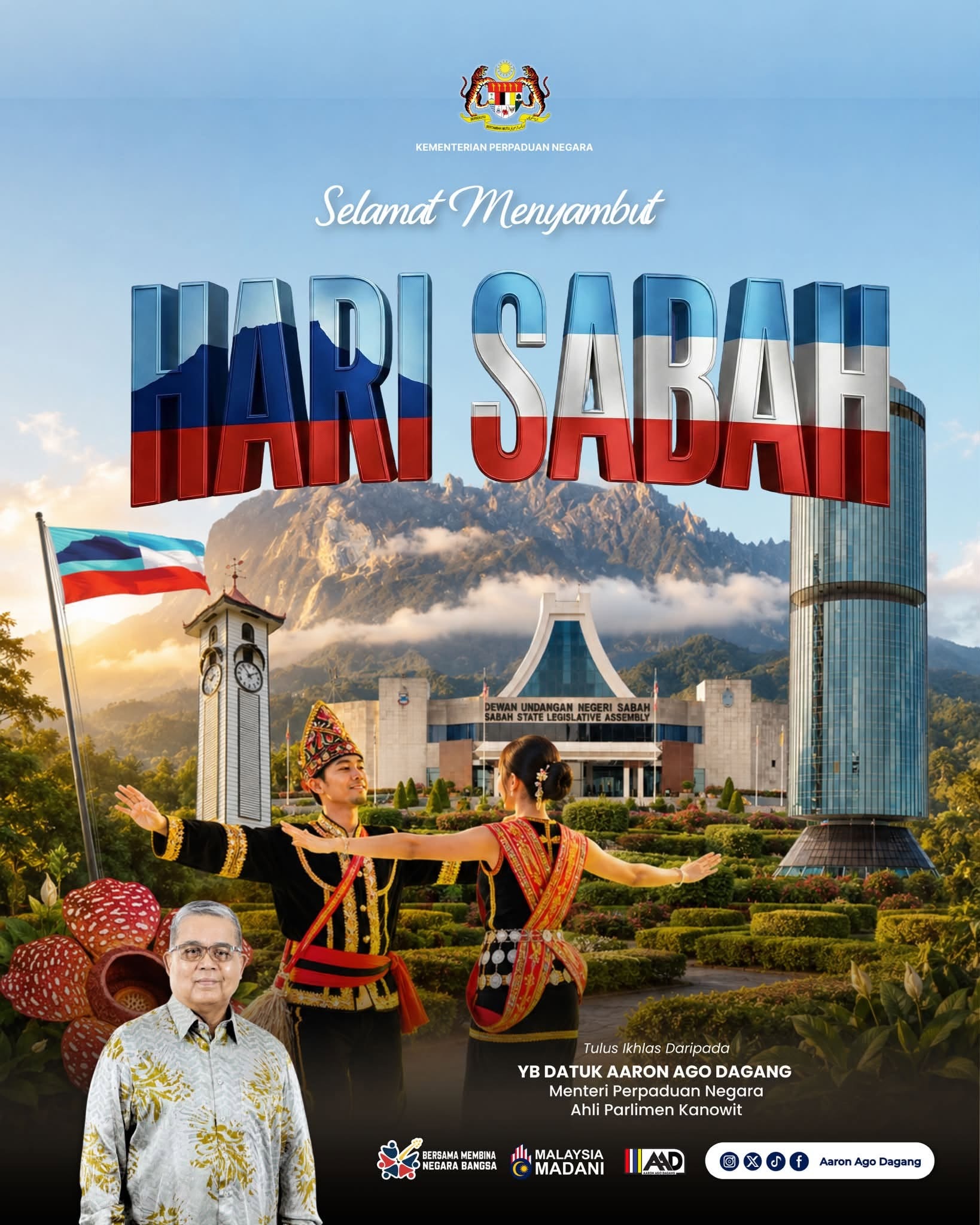
Sabah's remarkable ethnic composition, spanning 35 distinct ethnic groups and 217 sub-groups, constitutes one of the state's most valuable assets in building a harmonious and prosperous Malaysia, according to National Unity Minister Datuk Aaron Ago Dagang. Speaking on Sabah Day on August 31, the minister underscored how the intricate weave of different communities has created a unique identity that extends far beyond the state's borders, serving as a living demonstration of how multiracial coexistence functions in practice across the Southeast Asian nation.
Each of these communities brings its own distinctive contribution to Sabah's cultural landscape. The Kadazan, Dusun, Bajau, Murut, Rungus, Bisaya, Lotud, Lundayeh and numerous other groups maintain their own languages, traditional practices, distinctive clothing, musical forms, dance traditions and historical narratives. These elements, rather than existing in isolation, have become interwoven into the social and cultural fabric that defines contemporary Sabah. The minister's remarks suggest that what might appear as fragmentation in a less developed society has instead become a source of collective strength and identity for the state.
A central theme in the minister's message challenges the notion that cultural and linguistic diversity inevitably creates tension or division. Instead, Datuk Aaron Ago Dagang positioned diversity as fundamentally compatible with unity when grounded in mutual understanding and respect. He emphasised that the people of Sabah have consistently demonstrated their capacity to build and maintain harmonious relationships despite profound differences in how they worship, communicate, dress and celebrate their heritage. This model of coexistence carries particular significance for Malaysia as a whole, which similarly comprises multiple ethnic, religious and cultural communities navigating shared citizenship.
The historical context underlying Sabah's current status adds deeper dimension to the minister's remarks. August 31 marks the anniversary of Sabah's transition to self-governance in 1963, a milestone that followed centuries of varying political administration. The state's journey encompasses the era of North Borneo, the administration of the British North Borneo Company, a period of Japanese occupation during the Second World War, and subsequent British rule before finally achieving self-determination. This complex historical trajectory has shaped the political consciousness and social dynamics of the state in ways that continue to influence contemporary governance and community relations.
The formation of the Federation of Malaysia on September 16, 1963, represented another pivotal moment in Sabah's evolution. By joining the broader Malaysian federation, Sabah committed itself to a larger multiracial and multireligious political project. Rather than diluting Sabah's distinct identity, this union created opportunities for the state to contribute its unique cultural and social experiences to the national conversation while benefiting from the resources and frameworks of a broader political entity. The minister's invocation of these historical moments suggests that diversity within unity has been a defining characteristic of Sabah's journey for several decades.
Datuk Aaron Ago Dagang placed particular emphasis on intergenerational responsibility and forward-looking development. He acknowledged the sacrifices and contributions of previous generations who devoted their efforts, ingenuity and resources to building modern Sabah. However, he deliberately shifted focus to the present generation, suggesting that earlier achievements, while worthy of remembrance and respect, cannot satisfy the needs of a state seeking to advance in the contemporary era. The minister called explicitly for Sabah's younger citizens to demonstrate courage and ambition in driving progress across multiple domains simultaneously.
The specific areas identified for advancement—education, economic development, technological innovation and general infrastructure development—reflect contemporary priorities for Southeast Asian states seeking to enhance competitiveness and living standards. Education represents the foundation for generating human capital capable of navigating increasingly complex economies. Economic growth and diversification provide material wellbeing and employment opportunities for expanding populations. Technological advancement enables productivity gains and connection to global networks. These objectives, presented not as alternatives to cultural preservation but as complementary goals, suggest a vision of Sabah advancing while maintaining its distinctive character.
Critically, the minister framed cultural and historical preservation not as backward-looking nostalgia but as an essential dimension of sustainable development. By insisting that progress must be accompanied by continued protection of Sabah's history, culture and identity, he rejected a false binary between modernisation and tradition. This approach carries implications for how Southeast Asian societies navigate development more broadly. It suggests that maintaining cultural distinctiveness and pursuing economic advancement need not be opposing forces, and that communities can selectively adopt innovations while preserving elements of their heritage that provide meaning, cohesion and social stability.
For Malaysian policymakers and regional observers, the minister's comments on Sabah Day carry broader significance regarding the sustainability of multiracial political arrangements. At a time when various Southeast Asian nations grapple with questions of national identity, social cohesion and development strategy, Sabah's example—featuring 35 ethnic groups coexisting within a single state—offers important lessons. The success or failure of such arrangements depends significantly on whether political and community leaders actively celebrate diversity as strength rather than merely tolerating difference, and whether development efforts are framed in ways that benefit all communities rather than privileging particular groups.
The declaration of August 31 as official Sabah Day by the state government in 2024 institutionalises reflection on these themes. By creating a dedicated occasion for examining the state's identity, history and future trajectory, the government has established a platform for ongoing dialogue about what binds the diverse Sabah community together. For Malaysian media observers and analysts, such occasions provide opportunities to assess whether the principles articulated by national leadership regarding multiracial harmony and unity translate into concrete policies and resource allocation that demonstrably benefit all communities.

