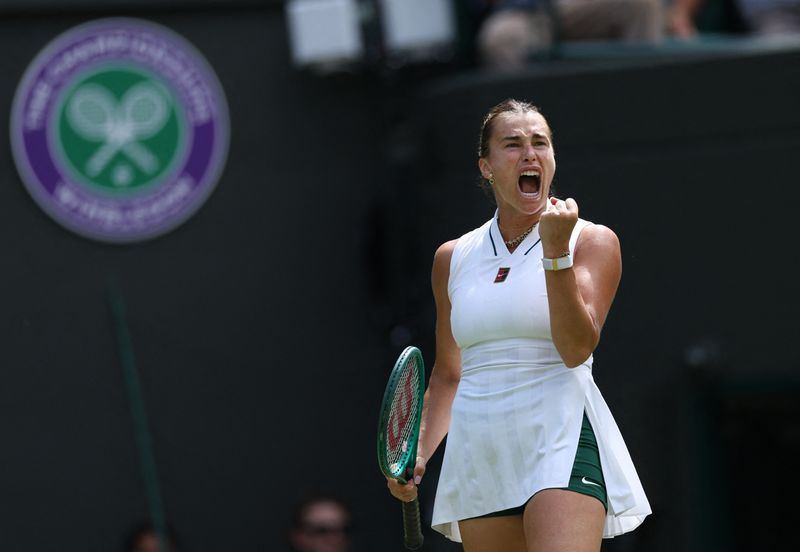
World number one Aryna Sabalenka's complicated relationship with Wimbledon's demanding grass courts resurfaced during her second-round clash with American McCartney Kessler on Wednesday, though the Belarusian's championship poise ultimately proved decisive in a 6-1 7-6(9) victory that was far closer than the opening set suggested.
Sabalenka made short work of the opening frame, commanding the court with the kind of baseline dominance that has defined her career on hard courts. The first set represented everything the world number one loves about her game—aggressive, controlled, and yielding minimal opportunities for opponents to gain a foothold. However, as Kessler mounted a determined fightback in the second set and surged to a 5-2 lead, frustration visibly seized the Belarusian, whose repeated angry slaps against her own thigh reflected the mounting tension and her struggle to adjust to the unpredictable nature of grass-court tennis.
Kessler's performance throughout the afternoon highlighted why grass is unpredictable terrain even for the world's elite players. The American entered the match with a remarkable distinction—she was the only player to have reached the second round without losing a single game, an extraordinary feat that underscored her aggressive serving and net play. As she consolidated her 5-2 advantage, Kessler appeared positioned to force a deciding set, twice coming within one point of the second set at 5-3, then mounting another assault during the tiebreak where she held two additional set points that could have altered the tournament's trajectory.
Yet Sabalenka's greater experience and superior shot-making quality proved decisive when the stakes escalated. Each time Kessler sensed victory within reach, the Belarusian responded with the kind of power and precision that has earned her two Australian Open titles and a reputation as one of tennis's most feared competitors. Her deeper reserve of tactical flexibility—refined through multiple Grand Slam campaigns and competitive matches at the sport's highest level—allowed her to find answers when Kessler's aggressive tactics threatened to overwhelm her game plan. The match ultimately lasted one hour and 39 minutes, with Sabalenka finally converting her third match point to seal the contest and extend her tournament run.
For Sabalenka, this victory holds particular significance beyond mere progression. The Belarusian has been searching for a Grand Slam title on grass, the only major surface where she has not yet claimed victory. Her previous two major championships came at the Australian Open, establishing her as a hard-court specialist who must adapt her power-based approach when playing on slower, more unpredictable grass. A potential Wimbledon title would diversify her Grand Slam portfolio and validate her ability to succeed across different court surfaces—a hallmark of truly elite tennis competitors.
In her post-match remarks, a visibly relieved Sabalenka acknowledged the severity of the challenge Kessler had posed. "She really tested me today and I am super happy to pass the test," she told reporters, her relief evident in her tone. The world number one elaborated on her opponent's tactical approach, noting that Kessler's aggressive serving and net-rushing style created legitimate difficulties that required Sabalenka to elevate her own performance throughout the second set. "She played incredible and played super aggressive and it was really tough to handle the second set and I am glad to have powered through," Sabalenka reflected, acknowledging that grass-court tennis demands different strategic thinking than the hard courts where she typically dominates.
Sabalenka's path through the tournament continues with a third-round encounter against Latvia's Jelena Ostapenko, a fellow Grand Slam champion who has her own complicated history with major championships and grass courts. Ostapenko won the French Open in 2017 but has since struggled to replicate that success at Grand Slam events, making her a player capable of elevated performances in specific circumstances but not consistently formidable across all tournaments.
For Malaysian and Southeast Asian tennis enthusiasts, Sabalenka's progression carries broader implications for how the sport continues to evolve. Her pursuit of a grass-court Grand Slam represents the increasing competitiveness of women's tennis, where even the world's top-ranked player cannot take matches for granted against rising challengers. The generation of players breaking through—exemplified by Kessler's impressive run—demonstrates that the traditional hierarchies of professional tennis are becoming more fluid, with younger competitors arriving with refined technical skills and tactical acumen that challenge established stars.
Sabalenka's determination to succeed on grass also reflects tennis's ongoing globalization. As players from diverse backgrounds and different developmental pathways enter the professional game, the diversity of playing styles and preparation methods has increased. Sabalenka's hard-court dominance now requires her to modify her approach for grass, illustrating how modern tennis demands versatility even from the sport's most specialized champions.
The victory also underscores how closely matched top-tier professional tennis has become. The difference between winning and losing at Grand Slams often comes down to fractional margins—converting match points versus conceding them, as Sabalenka demonstrated. For Asian tennis development, this reality suggests that breakthrough moments for regional players will require not just technical excellence but the mental fortitude and experience to navigate these razor-thin margins that define matches between elite competitors.

