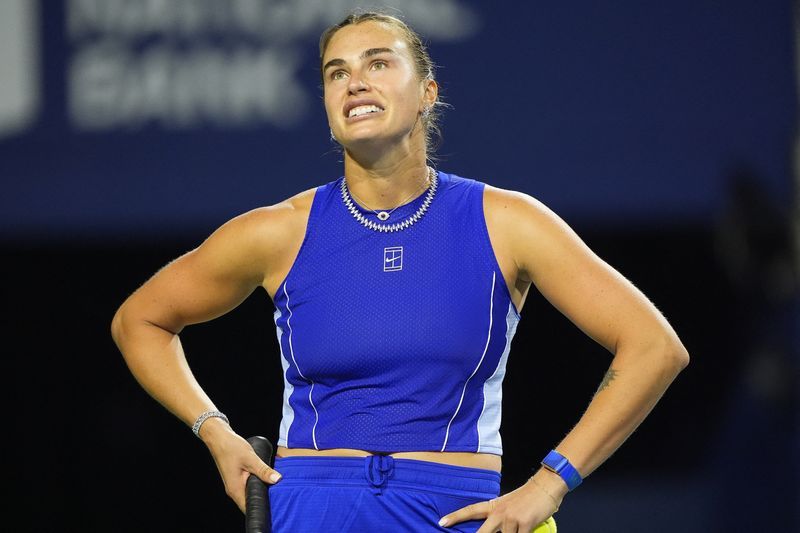
Aryna Sabalenka's bid to build momentum heading into the U.S. Open has suffered a notable setback at the Canadian Open in Toronto. The world number one and defending U.S. Open champion fell to 16th-seeded Ekaterina Alexandrova in a tightly contested fourth-round match on Saturday, bowing out 7-6(3) 4-6 6-4 after nearly two and a half hours of intense court play. The result marks an unexpected stumble for the Belarusian star in her final tuneup before the year's final Grand Slam tournament begins, raising questions about her form during the critical late-summer stretch.
The match unfolded as a tactical chess match between two powerful ball-strikers, with neither player able to establish clear dominance until the decisive final set. Sabalenka began promisingly, breaking Alexandrova's serve early in the opening set to seize control of the proceedings. However, the Russian refused to surrender, mounting a determined comeback to force the set into a tiebreak. Alexandrova's aggressive play proved decisive in the breaker, where she secured the first set after converting her opportunities at crucial moments. The opening set loss, while not insurmountable, shifted the psychological momentum in Alexandrova's favor as the match progressed.
Sabalenka demonstrated her championship pedigree by regrouping immediately in the second set. The four-time Grand Slam champion seized the initiative with a crucial break of serve that established a 4-3 advantage, then consolidated the gain by holding serve to level the match at one set apiece. This recovery underscored her experience and mental resilience, traits that have defined her tenure at the top of women's tennis rankings. Yet the momentum swing proved temporary, as Alexandrova's relentless shot-making and superior positioning in the decider ultimately overwhelmed the top seed's ability to maintain her intensity.
The final set proved to be the decisive battleground where Alexandrova's nerve and consistency prevailed over Sabalenka's championship credentials. As the match reached its climax with the score at 4-5, Sabalenka faced considerable pressure serving to remain alive in the contest. She managed to save two match points through aggressive tennis, demonstrating her refusal to surrender easily. However, a critical double fault on the third match point handed Alexandrova the breakthrough she had fought so hard to achieve, ultimately securing her place in the quarter-finals and eliminating the sport's top-ranked player from the tournament.
Alexandrova's post-match composure during her on-court interview revealed the psychological battle that had unfolded during their encounter. The Russian emphasized her point-by-point approach to the match, explaining that she attempted to maximize each scoring opportunity rather than allowing the overall narrative to affect her concentration. She acknowledged that after Sabalenka's second-set recovery, the match seemed to be slipping away, making her final-set triumph feel even more significant. Her ability to maintain focus despite such challenging circumstances speaks to her competitive maturity and her capacity to perform under extreme pressure against the world's best player.
Sabalenka's defeat carries particular significance given the timing relative to the U.S. Open, which represents her most important remaining tournament objective this calendar year. The defending champion typically arrives at Flushing Meadows with a run of strong results and elevated confidence, yet this loss introduces doubt about her physical sharpness and mental preparedness just days before the tournament commences. Having already secured the year-end number one ranking through consistency across multiple tournaments, Sabalenka's primary remaining challenge involves successfully defending her U.S. Open title and demonstrating her capacity to win consecutive major championships—an accomplishment that would solidify her legacy among tennis's elite performers.
The match statistics painted a compelling picture of how Alexandrova managed to overcome the overwhelming favorite. The Russian's aggressive approach and willingness to dictate points with her powerful groundstrokes forced Sabalenka into a position where she accumulated uncharacteristic errors, particularly in the deciding set. This pattern mirrors what elite challengers have discovered about playing the world number one: maintaining relentless offensive pressure often proves more effective than passive baseline rallies, as it limits Sabalenka's opportunity to establish her own rhythm and control.
Alexandrova's reward for this quarter-final victory brings a matchup against Ukraine's Elina Svitolina, who demonstrated her own form by defeating American eighth seed Amanda Anisimova 6-2 6-4 in her fourth-round encounter. Svitolina's commanding performance over a top-ten seeded opponent suggests that multiple players have found their groove during this crucial pre-U.S. Open period. The semi-final clash between Alexandrova and Svitolina promises to be another highly competitive encounter, with both players seeking to reach the Canadian Open final.
For Southeast Asian tennis enthusiasts and sports analysts monitoring the U.S. Open trajectory, this Toronto result introduces fascinating dynamics into the women's singles championship picture. While Sabalenka remains the heavy favorite for the title given her superior record and ranking, the loss demonstrates that the field contains capable challengers who can exploit specific weaknesses under pressure. As the world number one prepares to defend her crown at Flushing Meadows in the coming days, she will need to conduct meaningful analysis of her performance against Alexandrova and address the technical and tactical aspects that contributed to this unexpected defeat.

