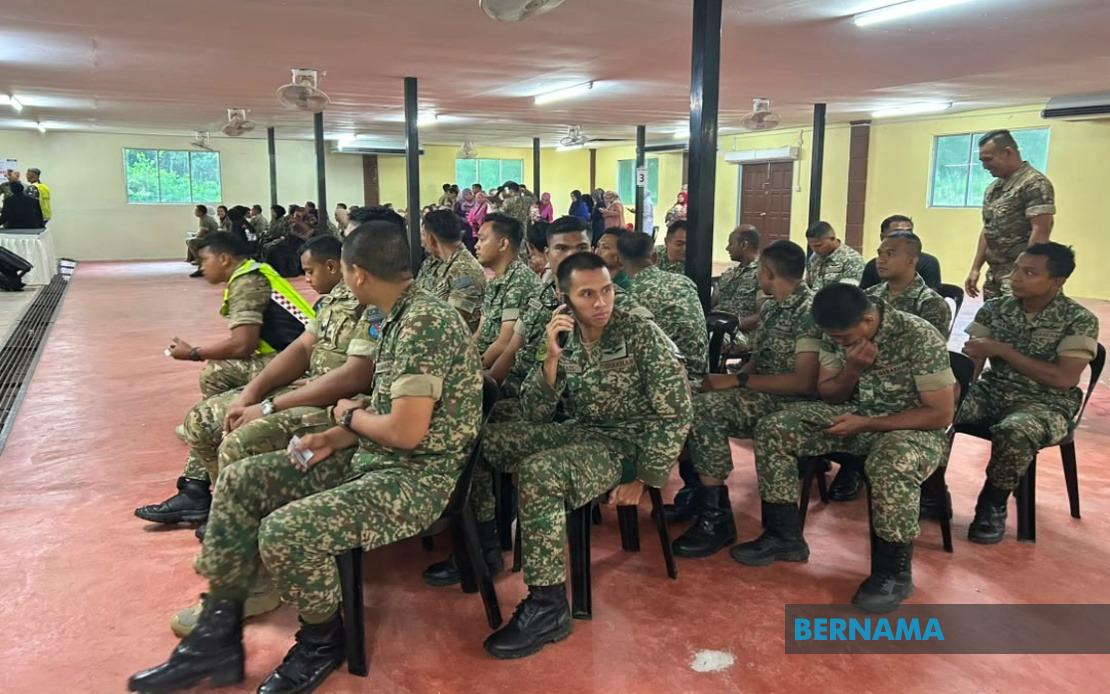
Security forces and their families are casting early ballots today in what officials describe as a critical moment for Johor's democratic process, with Home Minister Datuk Seri Saifuddin Nasution Ismail and Defence Minister Datuk Seri Mohamed Khaled Nordin issuing joint calls for integrity and civic participation as the state election enters its final stages.
The 24,751 registered early voters represent a significant portion of the 16th Johor State Election electorate, comprising 12,041 members of the Malaysian Armed Forces and their spouses alongside 12,710 police personnel and their relatives. This arrangement reflects Malaysia's electoral framework, which allows uniformed services to vote in advance due to their operational commitments on election day, ensuring their voices count despite duty obligations that may prevent standard-day participation.
Saifuddin Nasution, speaking through social media as both Home Minister and Pakatan Harapan secretary-general, framed early voting as more than a logistical convenience. His message emphasised that voters should "exercise your right with full responsibility and in the spirit of democracy," language that underscores the coalition's positioning ahead of Saturday's poll. The dual role of Saifuddin—bridging government and opposition coalition interests—highlights how early voting processes have become politically significant moments, with party leadership using such occasions to reinforce their democratic credentials.
Mohammed Khaled's parallel appeal focused on continuity and stability, urging early voters to ensure Johor "continues on its path of progress." This framing reflects the Defence Ministry's institutional interest in maintaining order and predictability, while also subtly endorsing the incumbent administration's record. The two ministers' separate yet complementary messaging suggests coordination between coalition partners to project unity during a competitive electoral period.
Menteri Besar Datuk Onn Hafiz Ghazi, representing Barisan Nasional, countered with an appeal targeting the same voter cohort, asking them to place trust in BN candidates as guardians of "stability, development and public welfare." The competing claims by both major coalitions over identical voter blocs illustrate the intense competition within Johor's political landscape, where security force support could prove decisive in marginal contests across the state's 56 seats.
The operational scale of early voting reflects the military and police commitment to electoral participation. Sixty-four early voting centres opened at 8 am across the state, operating in staggered closing times between noon and 6 pm to accommodate varying personnel schedules and voter concentrations at different locations. This logistical framework ensures that operational readiness is maintained while maximising participation, a model refined through decades of Malaysian electoral administration.
With 172 candidates contesting all 56 seats between Pakatan Harapan and Barisan Nasional, the election presents a comprehensive ideological and policy clash across the state. Both coalitions are leaving nothing to chance, particularly given security sector voting patterns' historical influence on marginal seats. The presence of Saifuddin and Khaled's public messages—delivered simultaneously to boost coalition morale—indicates how seriously both sides regard this contest for Johor's governance.
For Malaysian observers and regional analysts, Johor's election holds significance beyond state boundaries. As Malaysia's second-largest state by population and a crucial economic centre, Johor's electoral direction shapes federal political dynamics. A strong showing by either coalition would provide momentum for forthcoming national political moves, making today's early voting not merely procedural but strategically consequential for Malaysian politics at large.
The coordination between Home and Defence Ministry messaging reflects institutional support for the electoral process itself, regardless of partisan outcomes. By emphasising democracy, responsibility, and orderly voting procedures, both ministers communicate that the state and security apparatus remain neutral guarantors of fair elections—a message particularly important given international scrutiny of electoral integrity in Southeast Asia and Malaysia's democratic reputation among regional peers.
Security force voting patterns historically favour incumbent administrations, though this dynamic has shifted in recent elections as younger personnel and changing demographics reshape institutional voting preferences. The 2023 national elections and subsequent state contests demonstrated that no bloc votes monolithically, and today's early voting provides early indicators of sentiment within these constituencies that both coalitions will scrutinise for signals about Saturday's broader outcome.
The appeals issued by Saifuddin, Khaled, and Onn Hafiz deliberately frame voting as encompassing a moral dimension beyond the mechanical act of ballot-casting. This rhetorical strategy—linking electoral participation to national character, institutional integrity, and collective progress—aims to elevate turnout and voter engagement, particularly among personnel who might view early voting as an administrative obligation rather than a meaningful civic moment.
With Saturday's main polling day approaching, today's early voting establishes the campaign's closing chapter. The 24,751 votes cast by security personnel will likely influence both coalitions' strategies for the final campaign push, offering indicators of which messaging resonates and where ground organisation requires reinforcement. For Malaysian voters observing from other states, Johor's contest presents a live case study in competitive democratic politics and coalition dynamics within Malaysia's evolving political landscape.

