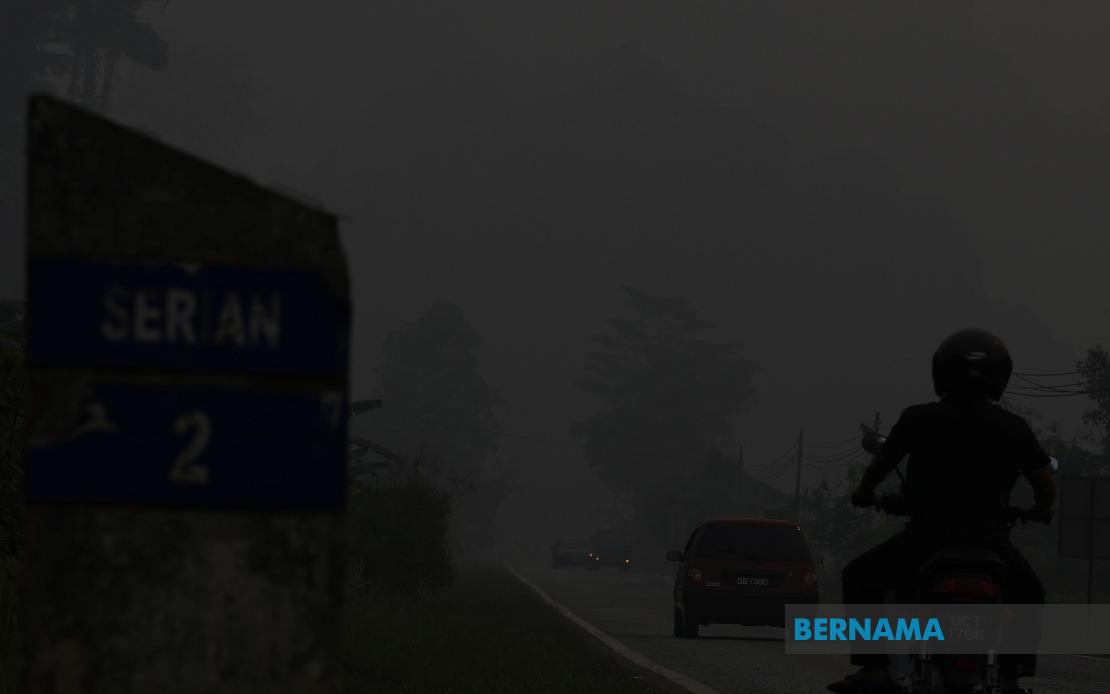
The Sarawak Disaster Management Committee has issued guidance to event organisers across the state to carefully evaluate haze conditions and Air Pollutant Index readings when determining whether their activities should proceed as scheduled. With air quality deteriorating sharply in multiple locations, the directive underscores growing concern about public health risks posed by transboundary haze pollution, a recurring challenge in Southeast Asia that often peaks during the dry season.
Datak Amar Douglas Uggah Embas, who chairs the SDMC and also serves as Sarawak Deputy Premier, emphasised that responsibility for event decisions currently rests with individual organisers rather than government mandate. However, he stressed the importance of making choices grounded in careful assessment of health hazards, particularly for programmes held outdoors where participants face direct exposure to contaminated air. This approach balances organisational autonomy with public welfare considerations, a nuanced position that reflects the complexity of managing large-scale events during environmental emergencies.
The committee has established clear thresholds for organisers to use as decision-making benchmarks. When the API exceeds 200, outdoor physical activities, sports competitions, and strenuous exercise programmes face strong recommendations for reconsideration, especially when children, elderly people, or other at-risk populations are involved. These vulnerable groups—whose respiratory and cardiovascular systems are more susceptible to air pollution—require particular protection during haze episodes. The guidance implicitly recognises that a one-size-fits-all approach fails to account for demographic variation in health vulnerability.
Beyond cancellation, the SDMC has encouraged organisers to explore creative alternatives that allow events to proceed safely. Moving activities indoors represents the most straightforward solution, transforming outdoor festivals, sports days, or community gatherings into climate-controlled environments. Other possibilities include modifying activities to reduce physical exertion or postponing events until air quality improves. Such flexibility acknowledges that cancellation imposes real costs—economic losses for vendors and organisers, disappointment for participants, and disruption to community calendars—making it a last resort rather than an initial response.
The threshold of API 500 marks a more severe escalation point in Sarawak's disaster response framework. Should pollution reach this extreme level, government and private sector offices and workplaces face mandatory closure, with only essential services continuing operations. This measure can only be activated following a formal Disaster Emergency declaration by the National Disaster Management Committee, a step that requires federal-level coordination and reflects the gravity of such conditions. Such closures, though disruptive, prioritise worker safety and reduce population exposure during peak pollution hours.
Real-time monitoring data from August 30 revealed the severity of haze conditions across Sarawak, with several districts entering hazardous air quality territory. The Serian District Police Headquarters monitoring station recorded the highest API reading at 412, well exceeding the 200-point threshold. Samarahan followed with 332, while Kuching registered 304. These three locations—representing both rural and urban areas—experienced what officials classify as unhealthy air quality, requiring immediate precautions. The geographic spread of high readings indicates a state-wide phenomenon rather than isolated incidents confined to specific regions.
Beyond these three zones, numerous other districts reported elevated but less critical pollution levels. Sarikei's API of 197 approached the concerning threshold, while Sibu at 190, Bintulu at 183, Mukah at 176, and Samalaju at 175 all registered unhealthy readings. Kapit, Miri, and the Miri Industrial Training Institute recorded slightly lower but still problematic values ranging from 156 to 161. The breadth of affected areas highlighted how transboundary haze affects the entire state, though with significant geographic variation in severity. Understanding these spatial patterns is crucial for targeted interventions and resource allocation.
The Sarawak Disaster Management Committee is actively coordinating with both state and federal agencies to maintain continuous monitoring and implement escalating measures as circumstances warrant. This interagency approach recognises that effective haze management requires cooperation across multiple jurisdictions and administrative levels. Federal involvement through NADMA ensures consistency with national disaster protocols while allowing state-level flexibility in response timing and intensity. Regular assessment and proportionate escalation—rather than premature overreaction or delayed response—characterise best practice in environmental crisis management.
For Malaysian and Southeast Asian communities, this situation encapsulates a persistent regional challenge. Transboundary haze, driven by land-clearing fires in neighbouring jurisdictions, recurs annually with significant public health and economic consequences. While individual events may adapt, the underlying problem demands sustained diplomatic pressure, cross-border enforcement, and investments in fire prevention and land management in source regions. Sarawak's approach to event management represents a pragmatic adaptation to an environmental reality that, absent upstream solutions, will continue shaping public life across the region.

