Deputy Prime Minister Datuk Seri Fadillah Yusof has announced the rollout of 52 projects under the Cakna MADANI Programme across Sarawak this year, representing a RM9.46 million investment aimed squarely at tackling two of the state's most pressing natural hazards: coastal and riverbank erosion alongside escalating flood vulnerability. The announcement underscores the federal government's recognition that Sarawak's geography—characterised by river systems and coastal zones—demands sustained infrastructure intervention to protect communities and economic assets from environmental degradation.
The project portfolio reflects varying stages of implementation maturity. Twelve of the 52 initiatives have already reached completion, indicating progress on earlier phases of the programme. A further thirteen projects are currently in active construction, demonstrating on-the-ground momentum. The remaining twenty-seven remain in pre-implementation planning stages, suggesting a pipeline of work stretching ahead as funding and logistical capacity allow. This staggered approach enables continuous engagement with erosion and flood challenges while maintaining fiscal discipline.
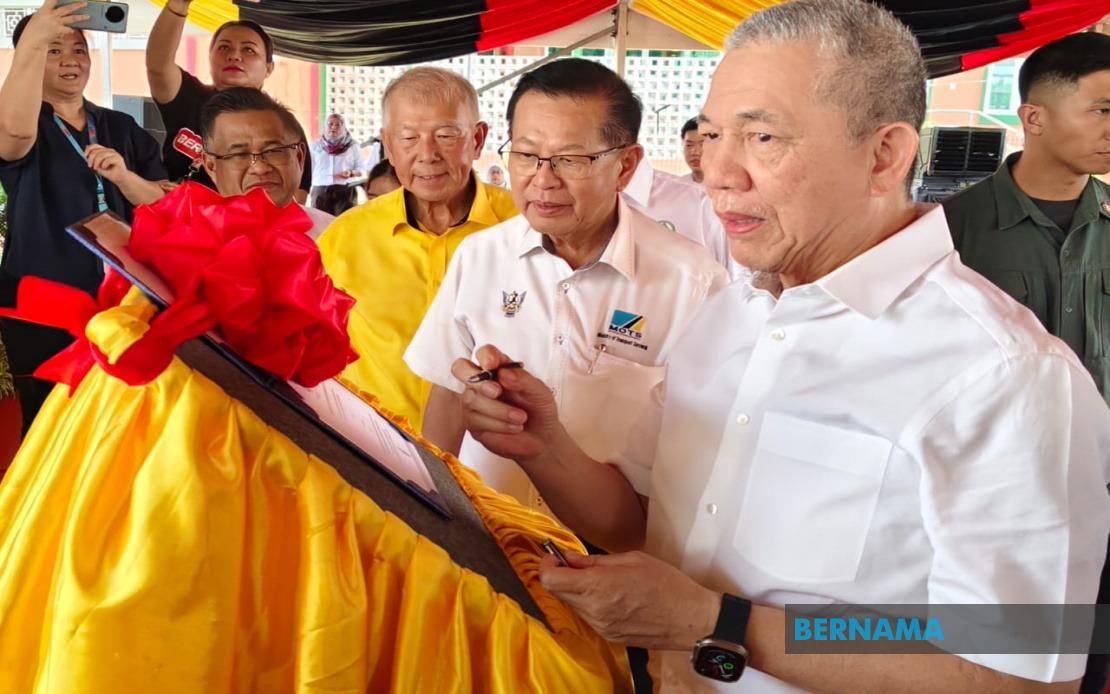
Fadillah, who concurrently holds the Energy Transition and Water Transformation portfolio, took the opportunity to personally inspect the Riverbank Stabilisation Project at Tab Cinaq Cemetery in Miri District during a state visit. The initiative, budgeted at RM134,682 and scheduled to run from May through November of this year, exemplifies the practical scale of individual interventions within the broader programme. The project's centrepiece involves constructing a 50-metre retaining wall designed to arrest ongoing riverbank erosion while simultaneously safeguarding the cemetery and proximate infrastructure from further environmental damage. Such targeted work in Miri is one component of three Cakna MADANI projects active within the district.
Beyond the immediate Cakna MADANI allocation lies an even more ambitious long-term infrastructure vision. Sarawak has secured approval for 29 flood mitigation projects collectively valued at RM3.834 billion—a figure that dwarfs the current annual allocation and signals commitment to comprehensive watershed and coastal management. This broader portfolio encompasses the Flood Mitigation Plan (RTB), High Priority Flood Mitigation schemes (TBBT), dedicated coastal erosion mitigation efforts, and river conservation initiatives spanning the state. The sheer financial magnitude reflects the scale of vulnerability that rapid urbanisation and climate variability have created across Sarawak's populated regions.
The composition of this longer-term portfolio reveals strategic prioritisation. Eighteen projects are classified as continuations of existing programmes, collectively costing RM3.567 billion and presumably having demonstrated efficacy through earlier phases. These represent institutional memory and tested methodologies applied across multiple sites. Conversely, eleven newly approved projects worth RM267 million represent fresh responses to emerging vulnerabilities or previously unaddressed hotspots. This mixture of renewal and innovation suggests adaptive management rather than simply replicating past approaches.
The RTB Sungai Miri exemplifies the multi-year commitment embedded in these flood mitigation schemes. This continuation project, attached with a RM31 million budget, commenced construction in October 2023 and has already achieved 58.11 per cent physical progress. The anticipated completion date of November 2026 indicates a three-year implementation window typical for complex hydraulic infrastructure. Such timelines underline why immediate allocation alone proves insufficient—maintaining momentum requires sustained funding commitments across electoral cycles and shifting political priorities.
For Sarawak specifically, these interventions address acute vulnerabilities rooted in the state's physiography and development patterns. Much of Sarawak's population concentrates along river corridors and coastal plains where economic activity thrives but where seasonal flooding and chronic erosion perpetually threaten livelihoods. Communities in divisions like Miri have historically endured inundation during monsoon seasons, with riverbank collapse simultaneously threatening settlements and agricultural land. The cumulative effect of decades of inadequate preventive investment has left numerous towns and villages in precarious situations. These infrastructure programmes thus represent belated but necessary course correction.
The broader Malaysian context for these initiatives lies in escalating climate variability and its intersection with rapid urbanisation. While Sarawak benefits from tropical rainfall that supports agriculture and hydropower, intense downpours increasingly overwhelm drainage infrastructure designed for historical precipitation patterns. Concurrently, coastal erosion has accelerated due to both natural processes and anthropogenic factors including deforestation and development encroachment on mangrove systems. Federal and state governments recognise that ad hoc responses prove insufficient—hence the shift toward systematic, budgeted interventions.
From a developmental perspective, these projects carry implications extending beyond flood prevention. Stabilised riverbanks and improved drainage systems create conditions enabling sustained agricultural productivity and residential security. Communities no longer preoccupied with annual inundation cycles can invest in education, enterprise development, and asset accumulation. Rural areas with reliable flood protection become more attractive for investment and settlement. Conversely, failure to address erosion and flooding perpetuates a cycle of vulnerability that suppresses economic aspiration and keeps vulnerable populations in perpetual reconstruction mode after each disaster.
The administrative mechanism through which these projects are allocated and executed also merits attention. The Cakna MADANI Programme represents structured federal disbursement through predetermined criteria rather than ad hoc political patronage. This institutional approach theoretically ensures more equitable distribution of protective infrastructure across marginalised areas that might otherwise lack political leverage. However, implementation quality and maintenance trajectories ultimately determine whether budgeted allocations translate into durable protection or merely temporary interventions that degrade absent ongoing care.
Looking ahead, the pipeline of 52 annual projects coupled with the RM3.834 billion longer-term commitment suggests sustained prioritisation of Sarawak's environmental infrastructure. However, the pace of investment must ultimately match the acceleration of environmental stress. Climate models project intensifying rainfall variability and sea-level pressures for equatorial regions, which Sarawak occupies. Whether current funding scales prove adequate remains an open question. The announced projects represent progress, yet the ultimate adequacy of these interventions will only become apparent as climatic pressures evolve and communities experience or avoid the flood events that these defensive measures are designed to prevent.

