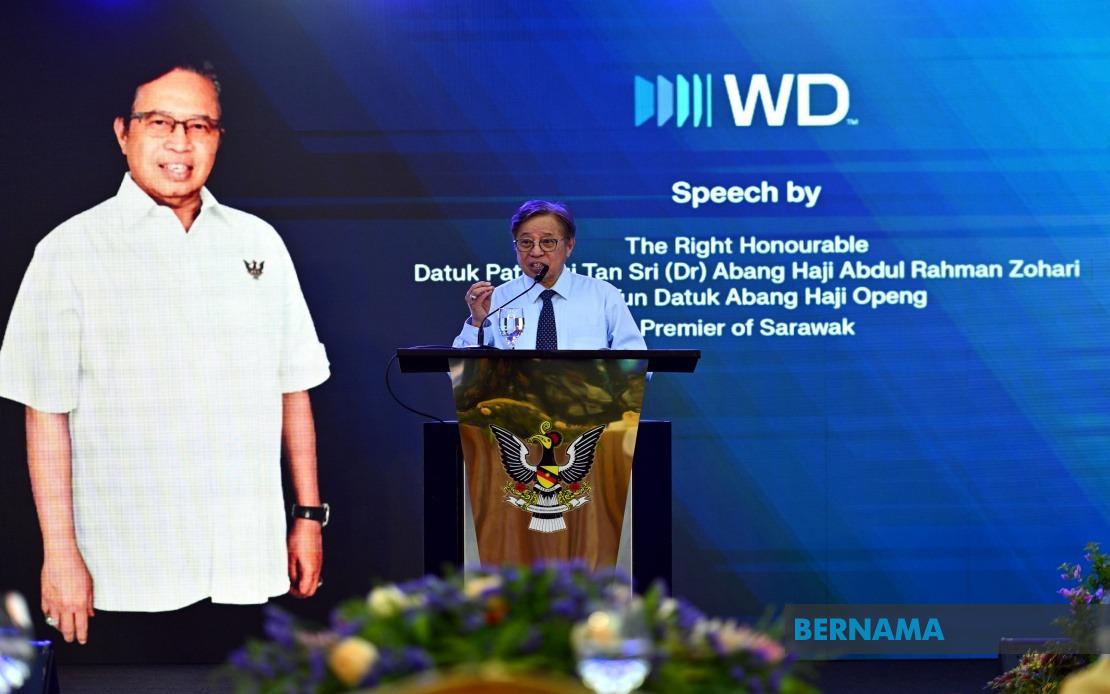
Sarawak's political leadership has adopted a pragmatic stance on the prospect of increasing the state's constitutional special grant, signalling willingness to accept a boost while acknowledging federal fiscal constraints. Premier Tan Sri Abang Johari Tun Openg made the remarks in Kuching on July 2, framing any potential increase to allocations under Article 112D as contingent upon Putrajaya's budgetary capacity rather than a firm demand. This measured approach reflects the delicate balance required in negotiations between resource-rich states and the federal centre over revenue-sharing arrangements that date back to Malaysia's founding architecture.
Abang Johari's comments came after attending the New Horizon for Western Digital (WD) Sarawak programme, and he explicitly noted that substantive discussions have not yet materialised. While the matter had been broached during his recent engagement with Prime Minister Datuk Seri Anwar Ibrahim in Bintulu, Abang Johari emphasised that no detailed negotiations have proceeded from that preliminary exchange. The Premier's measured language suggests Sarawak is neither pressing aggressively for an increase nor dismissing the possibility outright, instead positioning the state as a reasonable interlocutor willing to factor federal constraints into any settlement.
The special grant mechanism under Article 112D forms part of the constitutional framework governing Sarawak's fiscal relationship with the federation. Prime Minister Anwar had separately informed Parliament on June 30 that ongoing negotiations concerning Sarawak's special grant alignment reflected commitment to honouring the Malaysia Agreement 1963 (MA63), the foundational compact that brought Sarawak into the Malaysian federation. This framing ties discussions to historical constitutional obligations rather than ad hoc political favour, lending them greater weight and suggesting they represent a principled recalibration rather than mere budgetary discretion.
For Malaysian observers, the exchange underscores the persistent tension between constitutional guarantees to resource-rich states and the federal government's competing financial obligations. Sarawak, along with Sabah, enjoys special status within Malaysia's federal arrangements stemming from MA63, which granted these states greater autonomy and fiscal protections than other provinces. Periodic renegotiations of grant allocations have therefore become a standard feature of centre-state relations, with each side attempting to balance historical commitments against contemporary resource constraints.
Abang Johari's comments must be understood within the context of the current federal government's overall fiscal position. Malaysia continues to grapple with substantial debt obligations and competing demands on the budget, from servicing existing commitments to funding development initiatives and managing inflation pressures. In this environment, any increase to Sarawak's special grant would represent a material redirection of federal resources, making the Premier's conditional acceptance politically astute. By explicitly acknowledging federal fiscal challenges, Abang Johari avoids positioning Sarawak as an unreasonable claimant while preserving the state's position in future bargaining rounds.
Parallel to these constitutional discussions, Sarawak is pursuing an ambitious economic diversification strategy that positions the state as a technology and data hub. Abang Johari highlighted during the same engagement that Sarawak's three-decade partnership with Western Digital continues deepening, particularly around glass substrate-based data storage technology. This advanced recording medium enables substantially higher data storage capacity and supports the infrastructure demands of artificial intelligence systems—technologies likely to define economic value in coming decades. The partnership represents a substantial commitment of international capital to Sarawak's economy.
The state's natural endowments increasingly drive its appeal to high-technology investors seeking operational advantages. Sarawak's abundant renewable energy resources, particularly hydroelectric capacity, and plentiful freshwater reserves provide significant cost benefits for data centre operations and semiconductor manufacturing. These factors have attracted major technology firms seeking locations that combine economic stability, energy security, and technological capability. Abang Johari's framing of data storage as a future value driver surpassing traditional sectors like petroleum reflects a forward-looking policy orientation aimed at reducing Sarawak's economic vulnerability to commodity price volatility.
Western Digital's emphasis on glass substrate technology underscores the sophistication of contemporary data storage requirements. Traditional magnetic recording technology has approached physical limits, making advanced alternatives essential for supporting exponential growth in data generation and processing. Glass substrate offers significantly higher areal density—the amount of data storable per unit area—while providing improved durability and performance characteristics. Supporting such research and manufacturing in Sarawak positions the state at the frontier of a critical technology sector anticipated to experience substantial growth as artificial intelligence deployment accelerates globally.
For the broader Southeast Asian context, Sarawak's positioning as a technology manufacturing destination reflects regional competition for high-value-added industries. Countries and states across the region are seeking to move beyond labour-intensive manufacturing toward capital-intensive, knowledge-based production. Sarawak's combination of stable governance, energy availability, and existing foreign direct investment relationships from established technology partnerships creates advantages in this competitive landscape. Success in attracting and deepening technology manufacturing would generate employment in skilled technical roles while building expertise that supports broader economic development.
The intersection of Sarawak's constitutional fiscal negotiations with its technology industry development strategy reveals a sophisticated approach to contemporary state governance. Rather than frame special grant discussions purely in terms of historical entitlements or demands for redistribution, Abang Johari's positioning emphasises Sarawak's trajectory toward higher-value economic participation. This framing may implicitly suggest that federal support for Sarawak's development translates into technology sector growth benefiting the national economy, not merely local interests. Such reasoning could strengthen Sarawak's negotiating position by presenting grant increases as investments in national technological capacity rather than transfers to a single state.
Looking forward, the outcome of these negotiations will carry implications beyond Sarawak itself. Other states and the federal government will monitor how Article 112D discussions conclude, as the precedent established could influence future fiscal arrangements and centre-state relations more broadly. Should negotiations successfully resolve around MA63's foundational principles and contemporary development imperatives, it could establish a template for balancing historical constitutional commitments with modern economic realities. Alternatively, protracted negotiations could signal the challenges inherent in maintaining federal frameworks designed for mid-twentieth century contexts in twenty-first century circumstances.
Abang Johari's diplomatic formulation of Sarawak's position—welcoming but not demanding a grant increase while acknowledging federal constraints—reflects maturity in federal negotiations. By avoiding public pressure tactics or confrontational posturing, the Premier creates space for productive dialogue with Putrajaya while preserving Sarawak's long-term negotiating interests. Simultaneously, his emphasis on technology partnership and economic diversification demonstrates that Sarawak is not merely a supplicant seeking redistributed revenue, but an active economic participant whose development benefits the broader federation. This approach may ultimately prove more effective in securing fiscal outcomes favourable to Sarawak than more aggressive negotiating strategies.

