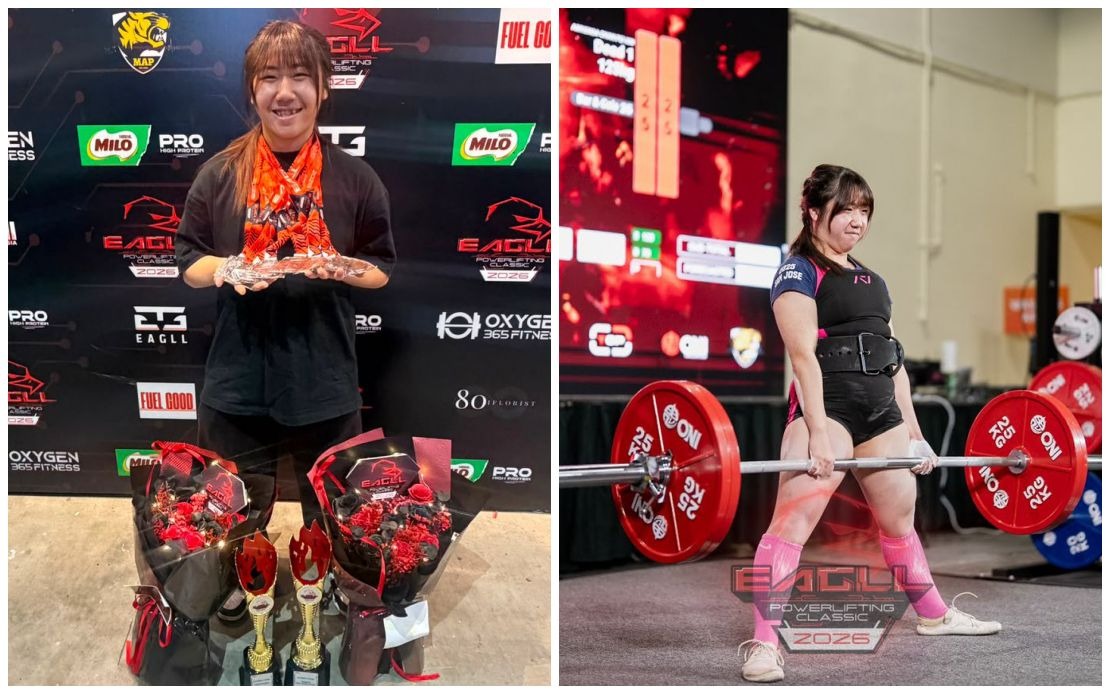
Twenty-year-old Malaysian powerlifter Abrienda Chan has delivered a breakthrough performance at the Eagll Powerlifting Classic 2026 in Kuala Lumpur, shattering five national records in the Under-57 kilogramme category and capturing seven gold medals alongside one silver medal across junior and open divisions. The Sarawakian athlete's remarkable achievement represents a decisive milestone in her trajectory towards international prominence, following through on ambitions she had outlined weeks earlier to systematically rewrite Malaysia's powerlifting record books as part of her strategic preparation for two major world championships scheduled for 2027.
Competing in the U57 division, Chan established new national benchmarks across multiple disciplines. Her open squat record now stands at 128 kilograms, while she claimed both junior and open bench press records at 70 kilograms. Most impressively, her combined total in both junior and open categories reached 343 kilograms, underscoring her dominance across the full range of powerlifting movements. These achievements reflect not merely isolated moments of athletic excellence but rather the culmination of meticulous preparation and progressive strength development in a sport typically dominated by larger competitors.
Despite her comprehensive success, Chan revealed that circumstances during the competition prevented her from attempting additional records. Technical difficulties during her final squat attempt cost her the opportunity to establish the junior squat record, whilst her coaching team opted for a conservative approach in the deadlift phase to secure the gold medal positions and overall titles. This strategic decision-making illustrates the sophisticated planning that underpins elite powerlifting competition, where the cumulative pursuit of records must sometimes yield to the primary objective of winning overall championships.
At just 151 centimetres tall, Chan's achievements carry particular significance within a sport where physical stature conventionally influences competitive outcomes. Her capacity to generate the strength required to lift substantially more than her own body weight, whilst remaining among the competition's smallest participants, distinguishes her as an exceptional talent. Beyond her current accomplishments at the U57 level, Chan previously dominated the Under-52 kilogramme sub-junior category, where she continues to hold national records across all three individual lifts and the combined total—a distinction that speaks to her consistency and progressive development.
Chan's performance at the EPC 2026 delivered an unexpected personal milestone: finishing as the runner-up in the open category overall standings, a result that surprised even the athlete herself given her relative youth compared to other open division competitors. Emerging as the Junior and Sub-Junior Overall Champion while simultaneously placing second in the open standings, she demonstrated the capacity to compete effectively across age categories, a versatility that bodes well for her future progression into senior international competition where she will eventually face fully mature athletes.
The significance of Chan's open category placing merits careful consideration for Malaysian readers interested in sports development. Her competitive positioning against substantially older and more experienced lifters indicates that the pipeline of elite powerlifting talent in Malaysia extends beyond isolated performers; rather, there exists a development pathway capable of producing athletes who can bridge junior and senior levels. This structural strength becomes increasingly important as Southeast Asian nations compete for recognition in international powerlifting federations.
Reflecting on her competition experience, Chan articulated that her preparation had deepened her self-knowledge as an athlete. She credited the competition with strengthening her psychological readiness for the larger international challenges ahead, while acknowledging the critical support network that enables her pursuit. Her comments regarding family backing, coaching guidance, and institutional assistance from Turbo Fitness underscore a reality often overlooked in discussions of individual athletic achievement: elite performance emerges from integrated ecosystems combining personal discipline, expert guidance, financial support, and institutional infrastructure.
The financial and logistical dimensions of Chan's career deserve particular attention for Malaysian audiences evaluating sports development priorities. Her explicit mention of Turbo Fitness's assistance with competition travel expenses and training facilities highlights how commercial sponsors and private institutions currently fill gaps that government sports funding might otherwise address. This pattern, whilst enabling individual success, raises questions about equitable access to elite development pathways and whether Malaysia's emerging powerlifting talent pool receives proportionate investment relative to other combat sports or traditionally popular disciplines.
Looking forward, Chan has calibrated her focus towards two specific international campaigns. She will compete in the 2027 World Classic and Equipped Bench Press Championships in Istanbul, Turkey, alongside the 2027 World Classic Sub-Junior and Junior Powerlifting Championships in Haining, China. Within the U57 junior category, she has explicitly targeted placement within the world's top three, a metric-driven objective that provides measurable benchmarks for her progression. These competitions will position her against the strongest junior powerlifters internationally, substantially elevating the competitive calibre she confronts.
Chan's emergence as a world-class prospect carries implications extending beyond individual sporting achievement. Malaysia's representation in technical strength sports like powerlifting remains modest compared to regional competitors, and the development of athletes capable of contending for medals at world championships contributes to the nation's broader sports portfolio and international standing. Her success demonstrates that with appropriate support structures and individual dedication, Malaysian athletes can achieve world-competitive levels across diverse sporting disciplines beyond the traditional focal points of badminton, table tennis, and combat sports.
The trajectory Chan has established through the EPC 2026 competition suggests she possesses both the physical attributes and psychological fortitude required for sustained development at elite international levels. Her progression from the U52 sub-junior records to U57 achievements, combined with her competitive positioning in the open category, indicates an athlete still ascending her development curve with significant growth potential remaining. The next two years, culminating in the 2027 world championships, will prove decisive in determining whether she achieves her stated objective of establishing herself amongst powerlifting's global elite.
For Malaysian sports administrators and development officials, Chan's achievements warrant attention as a case study in identifying and nurturing emerging talent. Her success, whilst personally driven and supported through private channels, demonstrates the commercial viability of strength sports in Malaysia's sporting ecosystem. As she prepares for international competition, the visibility and funding she attracts may catalyse broader interest in powerlifting development within Malaysia, potentially identifying additional athletes whose talents might otherwise remain underdeveloped through lack of exposure or institutional support.

