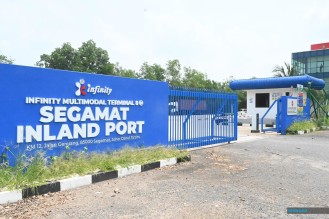
Segamat Inland Port has set an ambitious throughput target of over 6,000 twenty-foot equivalent units (TEUs) by the close of 2026, marking a significant milestone for the facility following its operational restart in late June. The inland port, now managed by Infinity Logistics & Transport, handled approximately 1,000 TEUs during its inaugural month of operations through July, demonstrating steady momentum as it rebuilds after more than a decade of relative dormancy.
The facility's geographical positioning makes it a vital logistics hub for a sprawling industrial corridor spanning northern Johor, southern Pahang, southern Negeri Sembilan, and Melaka. Samuel Ho, the port's manager, emphasised that the reactivation directly aligns with the government's broader Road to Rail initiative, executed in collaboration with Keretapi Tanah Melayu Bhd. This partnership represents a strategic shift in Malaysia's transport philosophy, prioritising rail infrastructure as a backbone for cargo movement rather than relying predominantly on road networks.
The safety argument underlying this transition carries particular weight for policymakers and logistics operators. Rail transport eliminates exposure to accident risks and road congestion delays that plague truck-dependent supply chains, while delivering substantial environmental and operational efficiencies. A single freight train can replace approximately 80 container trucks, translating into significantly reduced diesel consumption and lower carbon emissions per unit of cargo moved. For operators managing supply chains across the peninsula, these advantages compound across repeated journeys and extended timeframes.
Historically, the original port facility established in 1997 struggled to gain traction, partly because single-track rail operations forced freight schedules to yield priority to passenger services. This constraint severely limited commercial viability; under the previous operational regime, the facility could accommodate only about one cargo trip weekly. The completion of the double-tracking project extending to Johor transformed this calculus fundamentally. Modern scheduling now permits up to four cargo receiving and dispatch operations each week, a quadrupling of throughput capacity that makes rail logistics commercially rational for shippers and forwarders.
The infrastructure upgrade unlocked connectivity to major regional ports including Port Klang, the Port of Tanjung Pelepas, and Johor Port in Pasir Gudang. This multi-port integration creates genuine flexibility for cargo routing, allowing shippers to optimise their choices based on vessel schedules, port congestion levels, and final destination requirements. For businesses throughout the served hinterland, this represents access to a genuinely competitive logistics option with meaningful cost and reliability advantages over all-road alternatives.
Segamat Inland Port currently operates across 20.23 hectares in its inaugural development phase, positioned adjacent to Segamat Railway Station. The broader masterplan encompasses three phases of expansion, though Ho did not specify timelines or the ultimate footprint. Already, the first phase has generated employment for over 200 local residents, a figure that will expand substantially as subsequent phases come online. For communities across the Batu Pahat, Kluang, and surrounding districts, job creation in logistics and security represents genuine economic diversification from traditional sectors.
The facility's emergence as a developed economic node carries implications extending well beyond container throughput statistics. Ho articulated an explicit vision of the inland port functioning as an economic catalyst, potentially attracting manufacturing plants and distribution warehouses to surrounding industrial estates. When firms evaluate location decisions, reliable, cost-effective cargo access ranks prominently in site selection criteria. A revitalised inland port fundamentally alters the competitive positioning of northern Johor and adjacent areas relative to other regional industrial clusters, potentially redirecting investment flows.
Collaboration with Universiti Tun Hussein Onn Malaysia adds an educational dimension to the project. Through fieldwork exposure and applied research programmes, the partnership builds technical expertise in rail-based port operations, positioning graduates for careers in this emerging sector while generating knowledge contributions to port management practices. This university engagement suggests the government views the inland port not merely as a logistics facility but as an institution capable of anchoring regional development through knowledge creation and workforce development.
Transport Minister Anthony Loke Siew Fook, who officiated the June 25 reactivation ceremony, articulated ambitious expectations for the facility's regional economic impact. The ministry's projections encompass substantial traffic diversification benefits: the inland port is forecast to eliminate approximately 18,000 lorry movements monthly from Malaysian roads, encompassing both container trucks and laden trailers. This reduction translates directly into measurable improvements in road safety, reduced congestion on major corridors, and optimised utilisation of existing rail infrastructure. For highway safety outcomes, removing 18,000 monthly truck movements represents a material reduction in collision and fatality risks.
The supply chain efficiency gains ripple across the broader economy. Shippers gain access to transport modes with superior reliability and lower per-unit costs once volumes reach operational scale. Regional manufacturers can better compete in price-sensitive markets when logistics costs decline. Consumers benefit indirectly through lower production costs incorporated into retail prices. These broad-based advantages explain why inland port development features prominently in logistics modernisation strategies across Southeast Asia, where congested road networks and limited rail alternatives have historically constrained economic productivity.
For Malaysian readers, particularly those in affected regions, the Segamat Inland Port represents a tangible expression of infrastructure modernisation with immediate employment and supply chain implications. The facility demonstrates that even long-dormant infrastructure assets can become economically vital when underlying conditions—rail capacity, port connectivity, regional demand—align appropriately. Success at Segamat will likely inform decisions about reactivating or developing similar inland port facilities elsewhere, particularly in states where geographic positioning and industrial density support rail-based logistics models. The port's trajectory through 2026 will constitute essential evidence regarding whether Malaysia's Road to Rail strategy can deliver on its efficiency and safety promises.

