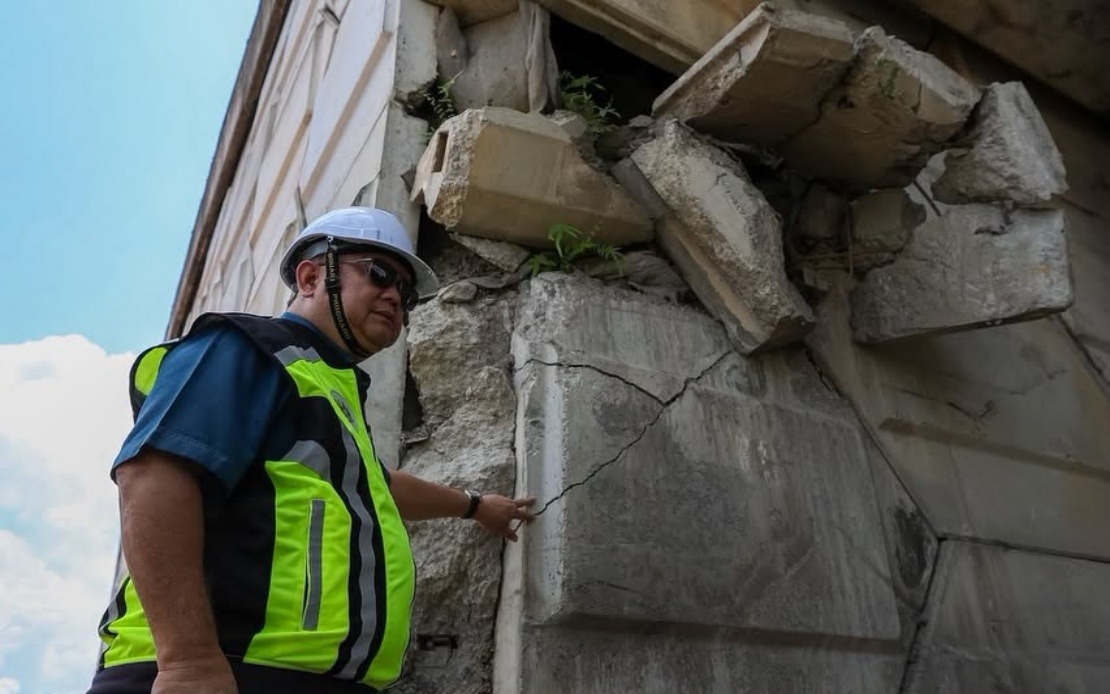
Works Minister Datuk Seri Alexander Nanta Linggi has committed to a staged reopening of the Selangau-Mukah Interchange Flyover along the Pan Borneo Highway, contingent on rigorous safety inspections and the completion of structural repairs. The assurance came after Nanta visited the site in Sibu on July 6, where he assessed damage sustained when a palm oil tanker struck Ramp 1 of the elevated interchange, prompting authorities to shut down the facility to prevent further incidents or potential collapse.
The decision to close the thoroughfare reflects the seriousness of the structural compromise. Engineers determined that the collision had inflicted significant harm to the retaining wall system supporting the ramp, creating an immediate safety risk for the thousands of daily commuters who depend on this critical section of the Pan Borneo Highway. Rather than attempting quick repairs that could prove inadequate, the Ministry of Works opted for a precautionary approach, prioritising protection over convenience.
Nanta outlined a systematic repair strategy designed to restore structural stability whilst minimising prolonged disruption. Under the phased reopening plan, sections of the interchange deemed safe following technical evaluation will resume operations progressively. However, portions still presenting structural concerns will remain sealed off until reconstruction reaches completion and undergoes final certification. This measured approach acknowledges both the immediate need to restore connectivity and the irreplaceable importance of ensuring user safety.
The minister addressed widespread community anxiety about the closure, particularly among residents and regular users of the Bintulu-Mukah-Sibu corridor who now face significant detours and extended travel times. Nanta recognised the genuine inconvenience caused to commuters, acknowledging that the stoppage disrupts economic activity, daily travel patterns, and commercial transport operations throughout the region. Nonetheless, he remained firm that premature reopening without certified repairs would be indefensible, given the potential catastrophic consequences of structural failure.
Recognising the power of public discourse in modern governance, Nanta emphasised the government's commitment to monitoring community feedback through both conventional media channels and social media platforms. This openness signals an appreciation that residents, businesses, and frequent users possess valuable insights about the conditions and impacts of the closure. By pledging to factor such input into decision-making processes, the Works Minister acknowledged that infrastructure decisions cannot operate in isolation from public concern and lived experience.
Three core operational priorities now guide the reconstruction efforts. Foremost is maintaining absolute safety standards for all road users—a principle that cannot be compromised regardless of time or financial pressures. Second is rigorous oversight of the repair timeline to prevent unnecessary delays or work stoppages that would extend the closure indefinitely. Third is ensuring transparent public communication regarding alternative routes, specific closure areas, and the progress of ongoing construction. This commitment to transparency helps minimise confusion and allows commuters and businesses to plan accordingly.
The Pan Borneo Highway represents a significant infrastructure investment designed to improve connectivity across Sarawak and enhance economic development prospects for communities along its route. The Selangau-Mukah Interchange constitutes a vital node in this network, serving not merely as a transport link but as an economic artery facilitating trade and movement of goods. The collision and subsequent closure underscore how vulnerable such infrastructure can be to unforeseen incidents, and highlight the necessity of robust maintenance protocols and rapid response mechanisms for structural emergencies.
For residents of Mukah, Bintulu, and surrounding areas, the closure represents more than mere inconvenience. Delivery services face route complications and increased operational costs; commercial drivers must spend additional hours on the road; and emergency services encounter delays reaching distant areas. The broader economic implications extend to reduced accessibility for tourism, manufacturing, and agricultural sectors reliant on efficient transport networks. These cumulative impacts underscore why balancing safety with operational necessity remains challenging for infrastructure managers.
Nanta's personal commitment to monitoring reconstruction progress carries significance beyond procedural reassurance. It signals ministerial-level accountability and suggests that higher-level political pressure will be applied to contractors to maintain schedule discipline whilst adhering to safety standards. Such oversight can prove instrumental in preventing the delays and cost overruns that frequently plague major infrastructure projects across the region. The minister's visible engagement also provides residents and businesses with a clear escalation pathway should concerns arise during the repair phase.
The technical assessment that informed the closure decision remains central to determining the reopening timeline. Engineers must evaluate each structural element, verify repair quality, and conduct load testing before sections can be certified for resumed traffic. This scientific approach, whilst time-consuming, provides the only reliable basis for confirming that repaired infrastructure will safely accommodate design loads. Rushing this process to satisfy impatient commuters would represent an unconscionable trade-off between short-term convenience and medium-term catastrophic risk.
Moving forward, this incident offers broader lessons for infrastructure management across Southeast Asia, where rapid development has sometimes prioritised speed of construction over long-term robustness. The Selangau-Mukah situation demonstrates that even well-designed infrastructure requires regular assessment, that unexpected incidents can occur despite best practices, and that transparent communication becomes essential when public infrastructure fails to function. These lessons will likely inform subsequent maintenance protocols for the Pan Borneo Highway and comparable projects throughout the region.

