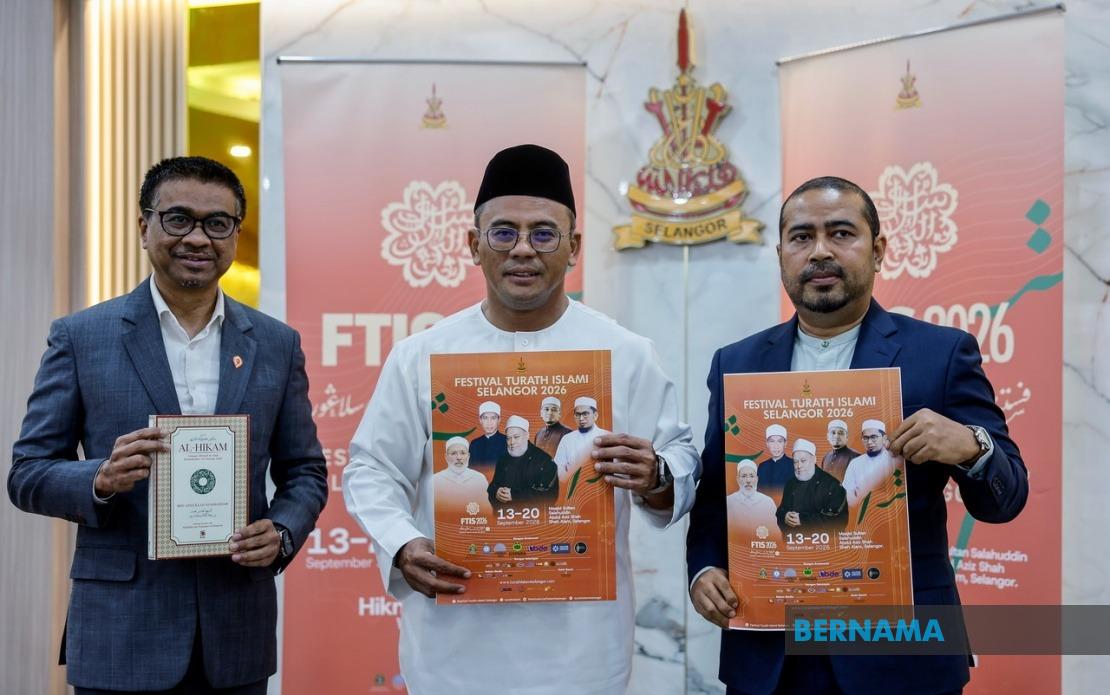
The Selangor state government is preparing to host the fourth edition of the Turath Islami Festival in September 2026, a signature event designed to elevate Islamic scholarship and cultural preservation across Malaysia. Menteri Besar Datuk Seri Amirudin Shari announced that the festival will assemble 23 prominent Islamic scholars from multiple nations, creating a rare gathering of intellectual figures committed to advancing Islamic knowledge and addressing contemporary challenges facing Muslim communities throughout Southeast Asia and beyond.
The festival's roster includes internationally recognized figures such as former Grand Mufti of Egypt Sheikh Professor Dr Ali Jum'ah, whose participation underscores the event's ambition to attract heavyweight Islamic intellectuals. Scholars will travel from Malaysia, Indonesia, Morocco, and Thailand to participate in what organisers characterize not merely as a religious gathering but as a serious academic undertaking centered on reviving the classical Islamic learning tradition known as talaqqi—a pedagogical approach emphasizing direct transmission of knowledge between established teachers and students. This methodology reflects an effort to reconnect contemporary Muslims with historical scholarly traditions while adapting them to modern educational frameworks.
Running for eight consecutive days from September 13 to 20, 2026, the festival will transform Masjid Sultan Salahuddin Abdul Aziz Shah in Shah Alam into its primary hub, with additional venues distributed throughout the city to accommodate the anticipated influx of participants. The event's architectural footprint will allow organisers to distribute programming across multiple sites, reducing logistical congestion while creating opportunities for participants to explore Shah Alam's Islamic institutions and cultural spaces. This dispersed venue strategy represents a deliberate choice to embed the festival within the city's broader institutional landscape rather than concentrating activities in a single location.
The festival programme will feature more than 42 learning sessions spanning various formats and scholarly disciplines. Sessions will include pre-dawn lectures—a traditional Islamic educational practice—and intensive study circles examining classical and contemporary Islamic texts. This diversity of formats reflects recognition that different participants engage with learning through distinct modalities, from structured lectures to small-group seminars to individual consultations with scholars. The breadth of programming indicates organisers' determination to make the festival accessible to participants with varying levels of Islamic education and scholarly background.
A novel feature for 2026 is the inaugural National Turath Scholars Dialogue, a convening designed to create space for Malaysia-based and visiting scholars to deliberate on pressing issues confronting Muslim-majority societies. Rather than focusing exclusively on historical Islamic knowledge, this dialogue will pivot toward contemporary application and problem-solving. Organisers envision these discussions producing insights relevant to Malaysia's role as a Muslim-majority nation navigating globalization, technological disruption, and plural societies. The dialogue format signals recognition that Islamic scholarship must remain intellectually engaged with current affairs to maintain relevance and credibility among younger generations.
The Selangor government explicitly positions this festival as instrumental to its broader vision of constructing a knowledge-based and ethically grounded society. By investing in such a flagship cultural event, state leadership seeks to demonstrate commitment to Islamic education as foundational to national development rather than peripheral to it. This framing carries particular significance in Malaysia's political context, where Islamic credentials frequently influence electoral legitimacy and policy formation. The festival becomes a vehicle for the state government to articulate its understanding of Islam's role in contemporary governance and social progress.
Prime Minister Datuk Seri Anwar Ibrahim is expected to formally launch the 2026 festival, a symbolic gesture confirming federal government alignment with Selangor's Islamic cultural programming. Such high-level political participation elevates the festival's perceived importance while potentially broadening its audience beyond traditional Islamic education circles to include government officials, civil society actors, and media representatives seeking to understand evolving approaches to Islamic knowledge within Malaysian governance frameworks.
Organisers project at least 50,000 visitors for the 2026 edition, matching attendance figures from the previous iteration and indicating plateauing demand at current capacity. This relatively stable attendance suggests the festival has established itself as a fixed point in Malaysia's Islamic cultural calendar, attracting a committed constituency of scholars, students, and religious intellectuals. However, the projection also raises questions about growth trajectories and whether organisers intend to expand beyond this visitor threshold in future years through enhanced programming, celebrity scholars, or diversified activities.
A critical enabler for expanding accessibility is the recently inaugurated Shah Alam Line of the Light Rail Transit 3 (LRT3), which has substantially reduced travel friction for visitors arriving from Kuala Lumpur and surrounding regions. The new transit connection transforms Shah Alam from a peripheral location requiring dedicated transportation arrangements into an accessible destination integrated within the Klang Valley's public transport network. Selangor authorities are exploring complementary transport solutions, including shuttle buses and van services connecting LRT3 stations to festival venues, a recognition that the final-mile problem remains a constraint even with improved trunk-line connectivity.
The strategic timing of the festival's growth phase coinciding with LRT3's operational launch suggests deliberate coordination between transport infrastructure investment and cultural programming expansion. This integration exemplifies how Southeast Asian governments increasingly leverage transportation modernization to concentrate and promote cultural activities, creating synergies between infrastructure and soft power objectives. For Malaysian policymakers, the festival illustrates how Islamic heritage positioning can function as an urban development catalyst, justifying infrastructure investment while simultaneously projecting the state as custodian of Islamic civilization within a competitive regional landscape where multiple nations contend for Islamic intellectual leadership.
The festival's regional composition—featuring scholars from Indonesia, Morocco, and Thailand alongside Malaysian and Egyptian participants—positions it as a genuinely transnational intellectual gathering rather than a parochial Malaysian event. This international character enhances the festival's credibility within global Islamic intellectual networks while creating networking opportunities that extend beyond the festival dates themselves. Participants from different Islamic scholarly traditions will expose each other to varied jurisprudential approaches, interpretive methodologies, and contextual understandings of Islamic principles, enriching all participants' intellectual frameworks.
Looking beyond the immediate 2026 edition, the festival's institutionalization raises broader questions about Southeast Asia's role in contemporary Islamic intellectual production. Malaysia's investment in hosting such gatherings reflects ambitions to establish Kuala Lumpur and its satellite cities as destinations for serious Islamic scholarship, competing with traditional centers in the Middle East and South Asia. As regional Muslim-majority nations increasingly assert cultural autonomy from Arab intellectual hegemony, events like the Turath Islami Festival become vehicles for articulating distinctly Southeast Asian Muslim perspectives on classical Islamic knowledge and contemporary application. The festival thus operates simultaneously as a religious educational event, a nationalist cultural project, and a geopolitical intervention within global Islamic intellectual hierarchies.

