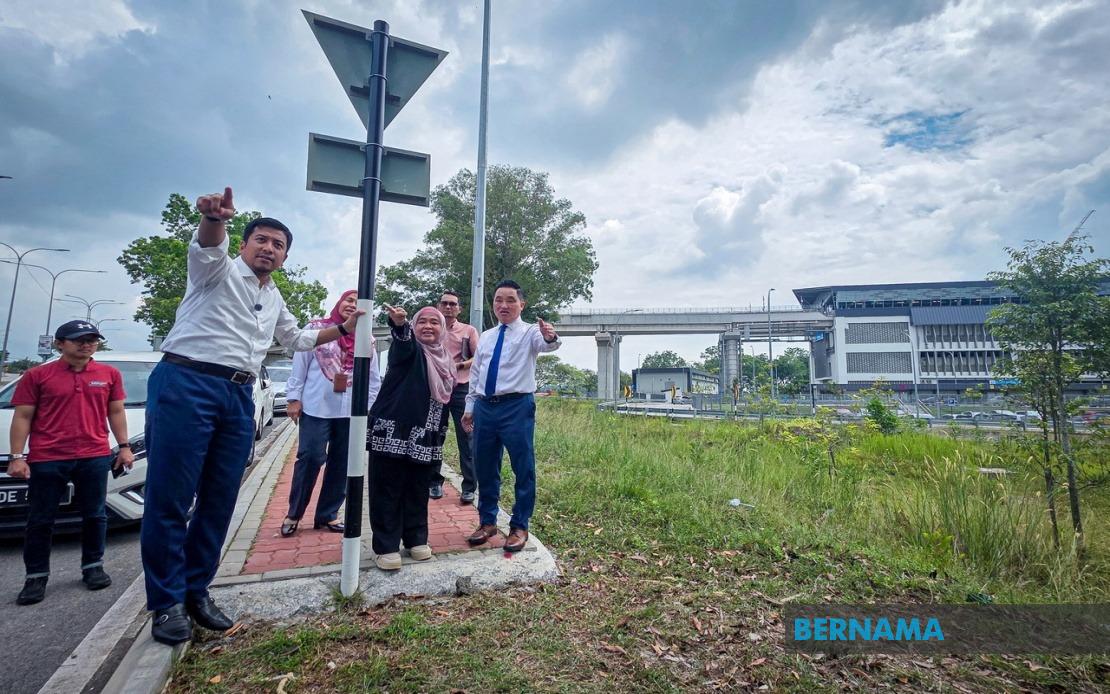
The Selangor State Government is moving decisively to remedy infrastructure gaps at its Shah Alam Line LRT3 stations, acknowledging that post-launch deficiencies require immediate remedial action. State Local Government and Tourism Exco Datuk Ng Suee Lim announced the acceleration drive following an inspection of public accessibility facilities, signalling that authorities are treating the matter as a priority that demands coordinated inter-agency response.
Two stations are receiving particular focus: Dato' Menteri Station and Shah Alam Stadium Station, both of which lack adequate pedestrian connectivity infrastructure including walkways and zebra crossings. These gaps represent a broader challenge facing Malaysia's rapidly expanding rapid transit network, where the rush to deliver headline-grabbing rail projects sometimes outpaces the unglamorous but essential work of creating safe, accessible last-mile connections. For commuters in the Klang Valley, such shortcomings translate into real inconvenience and potential safety risks, particularly during peak travel periods when pedestrian volumes surge.
For Dato' Menteri Station, the delays stem from administrative and permitting processes. Datuk Ng confirmed that Prasarana, the state-owned operator managing the LRT network, has been instructed to complete all required facilities within two months. This relatively tight timeline suggests that much of the groundwork may already be underway, with bureaucratic hurdles rather than construction capacity serving as the primary constraint. The emphasis on regulatory compliance reflects a recognition that projects of this scale require proper documentation and approvals, even when political will exists to expedite matters.
Shah Alam Stadium Station presents a more complex challenge, as its remedial works depend on actions by nearby private developers rather than direct government control. The station requires improvements that fall partially outside government jurisdiction, necessitating coordination between the state administration and commercial entities whose primary interests may diverge from public infrastructure priorities. Datuk Ng acknowledged that this tender-dependent process will require extended timeframes, though he pledged sustained monitoring to prevent indefinite delays. This dynamic illustrates the complications that arise when rapid transit infrastructure interfaces with surrounding private development, a scenario increasingly common as cities expand vertically and horizontally.
The Selangor government's acknowledgment that completed projects inevitably contain initial weaknesses represents a candid assessment of real-world execution challenges. Rather than defending the status quo, state officials are adopting a pragmatic framework that treats post-launch feedback as actionable intelligence. This stance contrasts with dismissive approaches sometimes encountered in government, where public complaints about infrastructure shortcomings are treated as criticism to be defended against rather than information to guide improvement.
Coordination mechanisms are being strengthened to prevent future recurrence of such gaps. The Shah Alam City Council (MBSA) will assume monitoring responsibilities, while coordination meetings with developers have been scheduled to synchronise improvement timelines. Additionally, all Local Authorities (PBT) operating stations within their jurisdictions have been instructed to conduct systematic reviews identifying connectivity deficiencies. This distributed accountability model distributes oversight responsibility across multiple administrative layers, reducing the likelihood that problems slip through bureaucratic cracks.
The involvement of the Royal Klang City Council (MBDK) and other local authorities signals recognition that transport infrastructure does not function in isolation. Surrounding land use patterns, existing pedestrian networks, and municipal services all influence the practical utility of rapid transit stations. By requiring councillors and assemblymen to gather and report feedback, the state government is attempting to create feedback loops that capture on-the-ground reality more effectively than top-down inspections alone.
For the broader Malaysian context, this initiative demonstrates both progress and persistent vulnerability in infrastructure delivery. The willingness to publicly acknowledge and systematically address post-launch shortcomings represents maturation in approach compared to earlier projects. However, the very existence of such significant gaps at newly-opened stations highlights the continued tension between political imperatives to declare projects complete and the far longer timescale required for full functionality. The two-month deadline for Dato' Menteri Station and the indeterminate timeline for Shah Alam Stadium Station suggest that even accelerated efforts may not fully resolve outstanding issues immediately.
These connectivity challenges carry particular weight in the Klang Valley context, where the LRT3 serves economically significant areas with substantial daily commuter volumes. Incomplete pedestrian infrastructure can undermine the viability of transit-oriented development plans and discourage public transport usage among those with alternative mobility options. For lower-income commuters without private vehicles, adequate walking infrastructure is not a convenience but a necessity determining whether rapid transit is genuinely accessible.
The government's approach also reflects evolving expectations among Malaysian citizens who increasingly demand accountability for infrastructure outcomes. Rather than passive acceptance of incomplete projects, public pressure and media attention have created political incentives for visible remedial action. Whether these commitments translate into sustained follow-through remains to be seen, but the public declaration of specific timelines and responsible agencies establishes benchmarks against which performance can be measured.
Moving forward, the Selangor administration's experience with LRT3 infrastructure gaps should inform planning for future transit expansions. Building in adequate time for connectivity infrastructure completion, clarifying jurisdictional responsibilities before project launch, and establishing monitoring frameworks before operational commencement could all prevent recurrence of similar issues. For passengers and potential passengers in the Klang Valley, the coming weeks will demonstrate whether stated commitments convert into tangible improvements that enhance their daily commuting experience.

