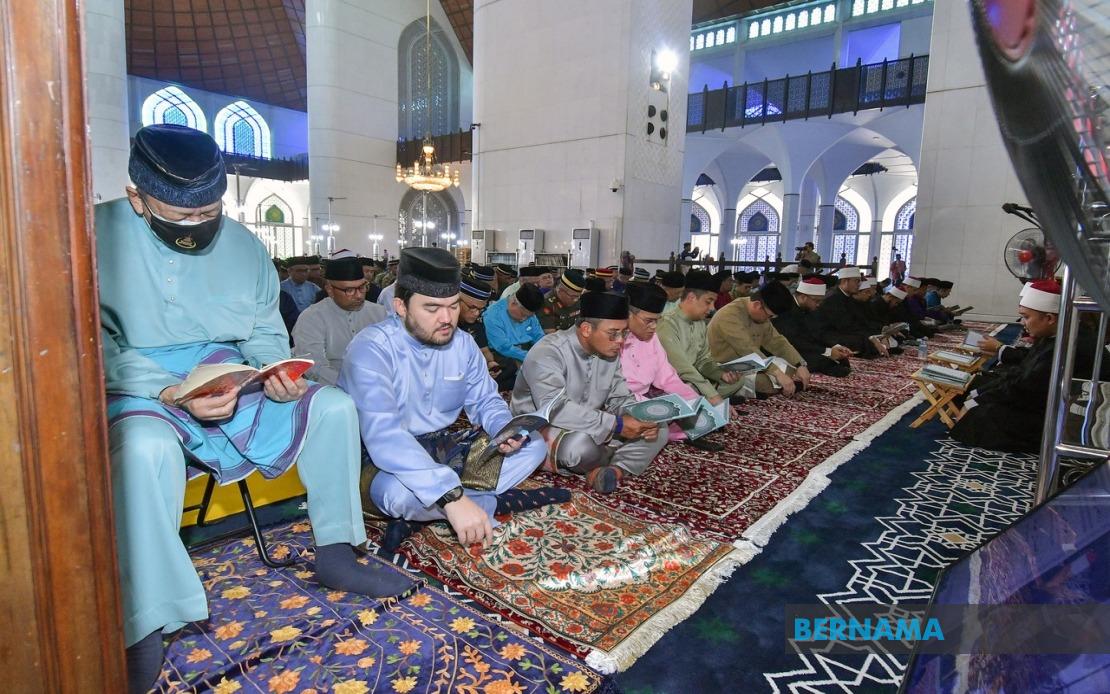
Sultan Sharafuddin Idris Shah, the reigning monarch of Selangor, participated in a Surah Yassin recitation and Friday prayers at Masjid Sultan Salahuddin Abdul Aziz Shah in Shah Alam on Wednesday, underscoring the state's commitment to spiritual preparation ahead of the nation's independence commemoration. The attendance of the Sultan alongside his heir, Raja Muda Tengku Amir Shah, reflected the royal household's active engagement with religious observances in the state's calendar, reinforcing the symbolic connection between the monarchy and the Islamic faith in Selangor's institutional framework.
The gathering drew approximately 1,000 worshippers representing a cross-section of Selangor's religious community, notably including members of the security forces stationed throughout the state. This inclusive participation highlighted how national religious observances serve as platforms for bringing together civilian and military personnel under shared spiritual values. The representation of armed forces personnel underscored the broader national theme of unity that typically characterizes the lead-up to Merdeka Day commemorations across Malaysia.
Selangor Menteri Besar Datuk Seri Amirudin Shari was present to receive the Sultan upon his arrival at the mosque, along with Dr Mohammad Fahmi Ngah, who chairs the State Islamic Affairs and Innovation Culture Committee. This administrative presence reflected the coordination between the state government and royal institution in orchestrating significant religious events. The attendance of senior figures from the Selangor Islamic Religious Department (JAIS) and the Selangor Islamic Religious Council (MAIS), represented by director Datuk Mohd Shahzihan Ahmad and chairman Datuk Salehuddin Saidin respectively, demonstrated the multi-layered institutional involvement in state-level religious programming.
The sermon delivered during Friday prayers carried thematic weight beyond routine spiritual guidance. Titled "Merdeka Daripada Belenggu Kerakusan" (Freedom from the Shackles of Greed), the message presented by Grand Imam Muhammad Farhan Wijaya aligned the occasion with the broader ethical and moral dimensions of national independence. This framing suggested that Malaysia's annual commemoration of independence encompasses not merely political sovereignty but also aspirations toward spiritual and moral liberation from material excess, a perspective that resonates with ongoing national conversations about sustainable development and ethical governance.
For Malaysian observers, the timing and composition of this event carries significance in the context of Selangor's role as the nation's most developed state and a major economic powerhouse. The sultan's participation in pre-Merdeka religious observances signals to citizens that national pride and spiritual values remain intertwined in the state's institutional messaging. In a multicultural democracy like Malaysia, such occasions also serve as reminders of the constitutional position of Islam and the monarchy within the federation's fabric.
The forthcoming state-level National Day celebrations will be held at Kajang Stadium on August 30, beginning at 8 pm, operating under the theme "Malaysia MADANI: Kesejahteraan Dinikmati" (Malaysia MADANI: Prosperity Enjoyed). This theme directly aligns with the federal government's broader Malaysia MADANI policy framework, which emphasizes inclusive prosperity, sustainability, and social well-being. By anchoring Selangor's celebrations to this national narrative, state authorities are positioning the state as a committed partner in executing the government's longer-term developmental vision.
The Malaysia MADANI initiative itself has become the overarching framework for how Malaysia's leadership envisions the nation's trajectory in the current political era. The integration of this theme into Selangor's Merdeka observances indicates that regional administrations are actively translating federal policy directives into localized celebrations and public messaging. For state governments, the National Day period provides an important opportunity to demonstrate alignment with national priorities while also articulating specific achievements and commitments at the regional level.
Selangor's prominence in these national commemorations reflects the state's demographic and economic weight within Malaysia. As the most populous state outside of Kuala Lumpur and the country's industrial heartland, Selangor's celebration patterns often set benchmarks for how other states approach similar occasions. The decision to hold festivities at Kajang Stadium, a venue with considerable capacity, anticipates significant public attendance and suggests the state's expectation of robust community engagement with Merdeka Day activities.
The presence of religious leaders and officials at the mosque recitation also underscores the ongoing role of Islam as a unifying institutional force within Selangor's state identity. Malaysia's constitutional arrangement reserves Islam as the federation's official religion while protecting the rights of other faiths, and state governments regularly utilize religious observances as vehicles for demonstrating responsible governance and spiritual leadership. The participation of security forces alongside civilian worshippers further illustrates how national identity formation in Malaysia encompasses both secular and religious dimensions within unified public spaces.
Looking forward to August 30, Selangor's National Day celebrations will likely feature the ceremonial elements typical of such occasions—flag-raising ceremonies, patriotic speeches, cultural performances, and community engagement activities—all organized around the prosperity and well-being messaging of Malaysia MADANI. The groundwork laid through the pre-Merdeka religious observance suggests that state authorities are attempting to frame the national celebrations as extensions of broader spiritual and moral commitments to the nation's development.
For observers across Southeast Asia, Malaysia's integration of religious practice with national commemoration demonstrates how contemporary Islamic-majority democracies navigate the relationship between state, faith, and national identity. The formula employed in Selangor—combining royal participation, institutional coordination, and inclusive religious observance—provides a model for how pluralistic societies can honor their constitutional and spiritual foundations simultaneously without compromising either dimension.

