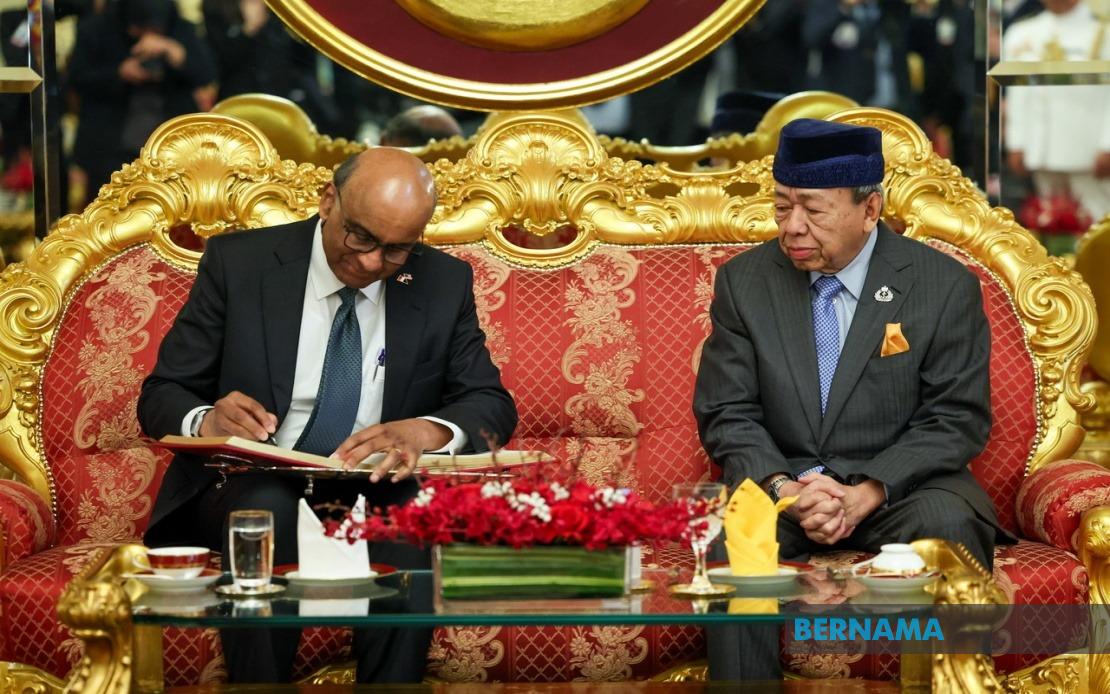
Singapore President Tharman Shanmugaratnam received an audience with the Sultan of Selangor, Sultan Sharafuddin Idris Shah, on July 14 at Istana Alam Shah in Klang, marking a significant moment in Malaysia-Singapore bilateral relations during the president's official state visit to the country. The 90-minute meeting underscored the importance both nations place on maintaining strong institutional and diplomatic ties at the highest levels of leadership.
The president arrived at the palace at 11 am and was formally received by the Raja Muda of Selangor, Tengku Amir Shah, reflecting the ceremonial significance of the engagement. The audience concluded at 12.40 pm, providing ample time for substantive discussions between the two senior officials. Entrepreneur Development and Cooperatives Minister Steven Sim attended the meeting in his capacity as minister-in-attendance, a role that typically ensures government coordination and follow-up on matters discussed during such high-level visits.
Tharman's presence in Selangor, Malaysia's most economically developed state, carries particular weight given the state's role as a commercial and industrial hub. Selangor hosts significant portions of Malaysia's manufacturing base, financial services, and technology sectors—areas where bilateral cooperation between Malaysia and Singapore has historically been most active. The choice to hold the audience at Istana Alam Shah rather than limiting engagements to federal level meetings demonstrates the recognition of state-level importance in the bilateral relationship.
The three-day state visit, running from July 13 to 15, was conducted at the invitation of His Majesty Sultan Ibrahim, King of Malaysia, and represents a continuation of high-level exchanges between the two nations. This visit serves as reciprocal acknowledgment of the Malaysian king's state visit to Singapore on May 6 and 7, 2024, indicating a pattern of regular engagement at the apex of both governments. Such exchanges help reinforce personal relationships between leaders and create opportunities to address bilateral concerns in a candid setting.
Economically, Singapore's significance to Malaysia extends well beyond ceremonial visits. As Malaysia's second-largest trading partner globally and its largest trading partner within ASEAN, Singapore occupies a unique position in the Malaysian economic landscape. The bilateral trade relationship encompasses diverse sectors including energy, petrochemicals, finance, and technology, making regular high-level engagement essential for ensuring smooth commercial operations and resolving any trade-related friction that might emerge.
The presence of the Raja Muda alongside the Sultan during the audience reflects the importance placed on involving Selangor's leadership succession in diplomatic functions. The Raja Muda's participation ensures continuity in relationships and allows the crown prince to build his own rapport with visiting leaders, a practice that strengthens institutional memory and maintains diplomatic continuity across generational transitions.
For Malaysia-Singapore relations, such formal meetings serve multiple purposes beyond ceremonial requirements. They provide opportunities to discuss transnational issues including water agreements, maritime boundaries, transportation links, and increasingly, digital economy cooperation and climate change mitigation. The substantial duration of this particular audience—lasting ninety minutes rather than a brief courtesy visit—suggests that substantive matters were likely on the agenda.
The involvement of Minister Steven Sim, who oversees entrepreneurship and cooperative development, hints at possible discussions regarding business facilitation, startup ecosystems, and small and medium enterprise cooperation between the two nations. These areas have grown in importance as both economies focus on innovation-driven growth beyond traditional sectors.
From a regional perspective, Malaysia-Singapore engagement carries implications for broader ASEAN dynamics. As two founding members of ASEAN and major economic powers within the association, their bilateral relationship influences regional trade flows, investment patterns, and collective ASEAN positions on various international matters. The smooth functioning of this relationship is particularly important given the geographic overlap and economic interdependence that characterizes the region.
The timing of Tharman's visit also occurred against the backdrop of evolving economic conditions in Southeast Asia, where both nations face similar pressures regarding digital transformation, workforce reskilling, and transition to green energy. High-level visits provide platforms for discussing shared challenges and exploring collaborative solutions that benefit both economies and the broader region.
For Malaysian observers, particularly those in Selangor where the meeting occurred, such diplomatic engagements reinforce the state's position as a key player in Malaysia's international relations. The presence of a foreign head of state at Istana Alam Shah elevates Selangor's profile and underscores its importance in Malaysia's economic and political architecture.
Looking forward, such regular exchanges between Malaysian and Singaporean leaders are likely to continue, given the structural importance of bilateral ties and the track record of maintaining cordial relations despite occasional differences. These meetings typically result in working group discussions at technical levels that address specific issues and chart pathways for deeper cooperation in emerging areas of mutual interest.

