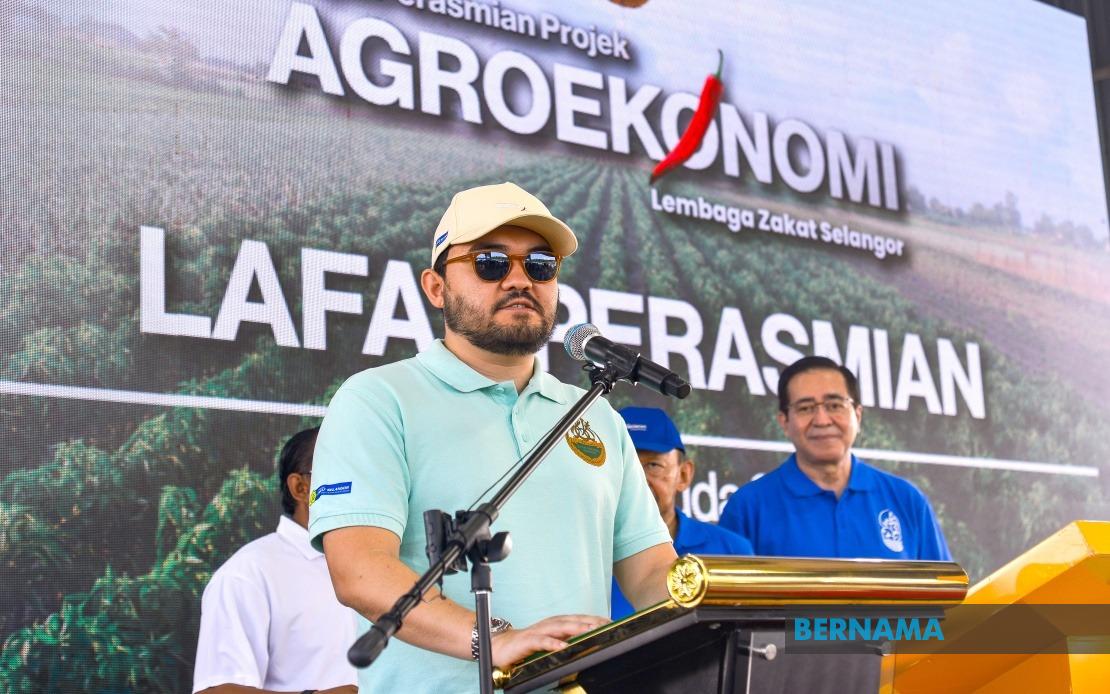
The Selangor Zakat Board has taken a significant step toward transforming social welfare by shifting its focus from temporary financial assistance to generating permanent economic opportunities for disadvantaged communities. On July 1, the organisation unveiled its Agroeconomic Project at Laman Agro Ehsan in Bukit Beruntung, representing a RM26 million investment that signals a fundamental change in how zakat funds can be deployed to achieve long-term poverty alleviation across Selangor.
The project occupies 110 acres of land, with 76 acres dedicated to agricultural production and development activities centred on fertigation chilli cultivation. This scale of operation demonstrates the ambition behind the initiative, which seeks to transform selected asnaf participants into self-sufficient agricultural entrepreneurs capable of generating stable monthly income. The launch was officiated by Tengku Amir Shah Sultan Sharafuddin Idris Shah, the Raja Muda of Selangor, reflecting the importance placed on this venture by the state's leadership.
Forty-eight carefully selected asnaf participants will form the cohort of this inaugural programme, each assigned a 0.5-acre plot containing approximately 2,000 chilli plant bags. This structure creates a total cultivation area of 24 acres producing 96,000 planting bags per cycle, establishing a substantial commercial operation that transcends typical household-based agricultural activities. Zakat Selangor chairman Tan Sri Syed Anwar Jamalulail and his team have designed the programme to be comprehensive, recognising that land and seeds alone cannot guarantee success.
The economic potential outlined for participants is compelling. According to project leadership, once crop management and production systems stabilise, participants could generate monthly incomes reaching RM4,000—a figure that would place many asnaf households above poverty thresholds and enable them to meet basic family needs while building savings. For context, this income level represents a substantial improvement over conventional zakat distribution, which typically provides temporary relief rather than revenue-generating capacity.
The three-year development programme encompasses far more than agricultural logistics. Participants receive intensive technical training in modern farming methods, regular crop monitoring with expert guidance, and hands-on mentorship to ensure their operations run efficiently and productively. The Kuala Langat Area Farmers' Organisation collaborated in selecting suitable candidates, applying a rigorous screening process that identifies individuals capable of committing to and benefiting from the structured programme.
Beyond the farm itself, participants enjoy substantial support that removes barriers to programme participation. Zakat Selangor covers all housing costs at the Prima Beruntung residential area throughout the programme duration, ensuring participants can focus entirely on agricultural development without worrying about accommodation expenses. This holistic approach recognises that poverty alleviation requires addressing multiple dimensions of disadvantage simultaneously.
The project's financing structure demonstrates collaborative thinking within Malaysia's Islamic financial ecosystem. Strategic partners including the Pilgrims Fund Board, RHB Islamic Bank Berhad, and Cagamas Berhad contributed wakalah funds totalling RM2.07 million, indicating that this initiative resonates with broader institutional commitments to sustainable development. Such partnerships suggest potential scalability and the possibility of replicating this model across other states.
Participants themselves have articulated the programme's transformative potential. Norfhadilah Mohd Shafiin, a 45-year-old mother of five, described how joining in 2025 opened pathways to strengthen her family's financial stability while building her confidence and self-reliance through acquired agricultural knowledge. Similarly, Raimi Rusydi Rodi, a father of two, highlighted the value of learning crop management alongside peer support from fellow participants, suggesting that the programme creates social networks alongside economic benefits.
For Malaysian policymakers and Islamic finance practitioners, this initiative offers instructive lessons about modernising zakat distribution. Rather than restricting zakat to consumption-focused assistance, Selangor demonstrates how strategic agricultural investment can transform recipients into productive economic participants. This approach aligns with Islamic principles emphasising human dignity and economic independence while addressing Malaysia's broader rural development challenges.
The project also carries implications for agricultural modernisation in Selangor and potentially beyond. By introducing asnaf communities to commercial-scale fertigation chilli farming—a relatively advanced technique—the initiative raises skills and productivity levels across participating farms. Success here could catalyse interest in similar structured agricultural projects targeting other vulnerable populations.
Looking forward, the three-year programme timeline provides an opportunity for rigorous evaluation of outcomes, participant experiences, and sustainability mechanisms. If the projected RM4,000 monthly incomes materialise and participants successfully transition to independent operations beyond the programme, this could establish a replicable model for asnaf economic empowerment that other zakat institutions and regional governments might adopt and adapt.
The Selangor Zakat Board's investment signals confidence that disadvantaged communities, when provided with appropriate land, training, infrastructure, and sustained guidance, can generate their own prosperity. This represents a philosophical and practical shift from traditional welfare towards productive inclusion—potentially reshaping how Malaysian institutions approach long-term poverty reduction and economic justice across the region.

