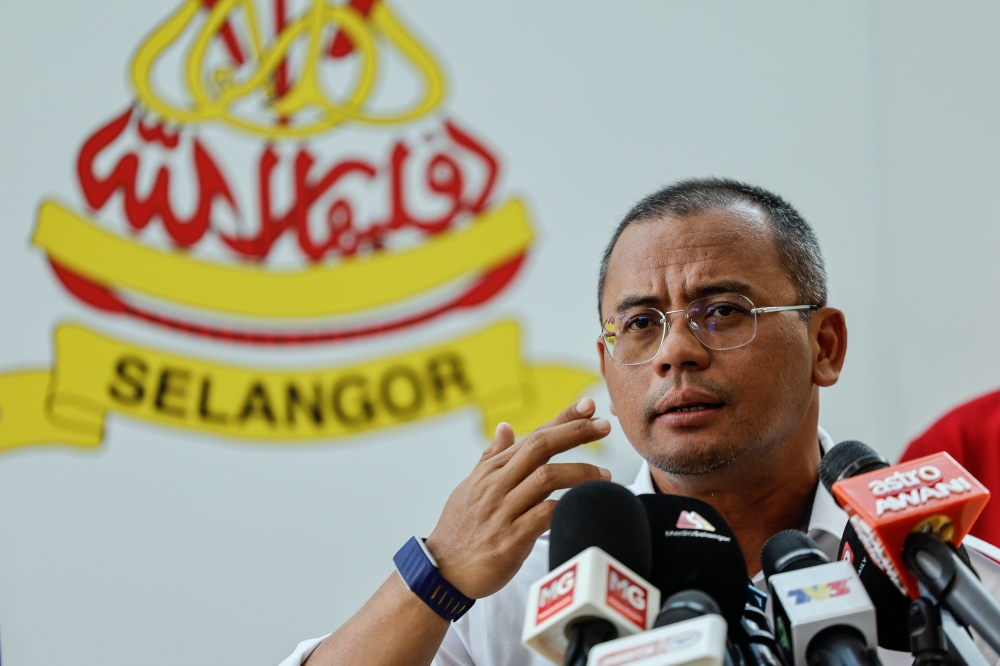
Selangor Menteri Besar Datuk Seri Amirudin Shari has drawn attention to a growing challenge confronting authorities in the state: sections of the local population are reportedly harbouring Rohingya refugees, creating significant impediments to enforcement operations. The revelation underscores the complex humanitarian and administrative tensions that have emerged as Malaysia grapples with one of the world's largest stateless refugee populations, estimated at over 180,000 individuals within the country.
The Menteri Besar's acknowledgement represents a candid assessment of how community-level activism and humanitarian concerns have begun to complicate state-level compliance efforts. Rather than portraying this simply as a law enforcement challenge, Amirudin Shari's comments suggest a deeper friction between top-down policy implementation and ground-level social responses. This friction reflects broader societal divisions over how Malaysia should respond to the Rohingya crisis, a question that has proven particularly contentious in states with significant refugee concentrations.
For Malaysia, the Rohingya situation carries considerable weight across multiple policy domains. The country hosts one of the largest populations of Rohingya outside Myanmar and Bangladesh, yet operates without signing the 1951 UN Refugee Convention. This legal position places Malaysia in a precarious middle ground: it provides de facto protection through a registration system managed by the United Nations High Commissioner for Refugees (UNHCR), yet maintains that Rohingya are technically not recognized refugees under Malaysian law. This ambiguity has created conditions where both protection and enforcement operate simultaneously, often at cross-purposes.
The involvement of local residents in sheltering Rohingya refugees points to the humanitarian impulse that has taken root across Malaysian communities, particularly among faith-based organizations and civil society groups. Many Malaysians have responded to the plight of the stateless population with direct assistance, viewing such actions through a moral lens rather than a legal one. However, this grassroots protection network operates in direct tension with state policies emphasizing immigration control and deportation, creating a conflict that Amirudin Shari's statement brings into sharp relief.
From an enforcement perspective, the Menteri Besar's warnings highlight the practical difficulties that arise when regulatory objectives encounter strong community resistance. Immigration authorities face considerable obstacles when attempting to conduct operations against individuals who may be hidden by sympathetic neighbours, sheltered in private homes, or protected by informal networks. These barriers significantly complicate registration and documentation processes, as well as efforts to track undocumented individuals within the state's jurisdiction. The lack of cooperation from segments of the population effectively reduces the state's enforcement capacity.
The disclosure also carries implications for federal-state relations and coordination. Selangor, as Malaysia's most economically developed state and home to the capital region, houses a substantial portion of the country's refugee population. The state government's frustration with community-level obstruction suggests gaps in how federal immigration policy translates into state-level implementation. Questions arise about resource allocation, interagency coordination, and whether current approaches balance humanitarian considerations with administrative feasibility.
Beyond Selangor's immediate context, this issue reverberates across Southeast Asia, where multiple nations face similar pressures. The region hosts millions of displaced persons and migrants, yet most countries lack robust legal frameworks for refugee protection. Malaysia's experience—where humanitarian impulses clash with enforcement capacity—offers cautionary lessons for neighbouring states managing their own refugee populations. The phenomenon of locals protecting vulnerable populations suggests that civil society responses may increasingly outpace formal governmental mechanisms.
The international dimension adds another layer of complexity. Myanmar's military junta continues to face allegations of genocide and crimes against humanity against the Rohingya, making repatriation an ethically fraught proposition. Malaysia has resisted pressure from Myanmar to accept forced returns, yet maintains public deportation policies. This contradiction creates conditions where both Rohingya and their Malaysian supporters operate in legal grey areas, with locals viewing sheltering as a humanitarian necessity rather than a violation of law.
Amirudin Shari's statement also raises questions about how the state might recalibrate its approach. Heavy-handed enforcement against community members harbouring refugees could generate further social friction and public backlash, particularly among Malaysia's Muslim majority who often view the Rohingya's plight through religious and ethical frameworks. Conversely, tolerating widespread non-compliance with immigration laws undermines state authority and creates parallel governance structures where informal networks supersede official channels.
Looking ahead, Selangor's situation suggests that sustainable solutions require more than enforcement alone. The revelation that locals are actively protecting Rohingya indicates that significant portions of Malaysian society have made a values-based decision to prioritize humanitarian concerns over immigration compliance. Addressing this requires policymakers to engage with the ethical questions underpinning community responses, rather than treating such behaviour merely as an enforcement problem to be overcome through stronger measures or increased surveillance.
The tension Amirudin Shari identifies ultimately reflects Malaysia's broader struggle to reconcile its status as a stable, developed nation committed to rule of law with its informal role as a protector of last resort for one of the world's most vulnerable populations. Until Malaysia develops a comprehensive policy framework that acknowledges both realities—legal and humanitarian—these enforcement challenges are likely to persist, complicating the state's ability to manage its growing refugee population effectively.

