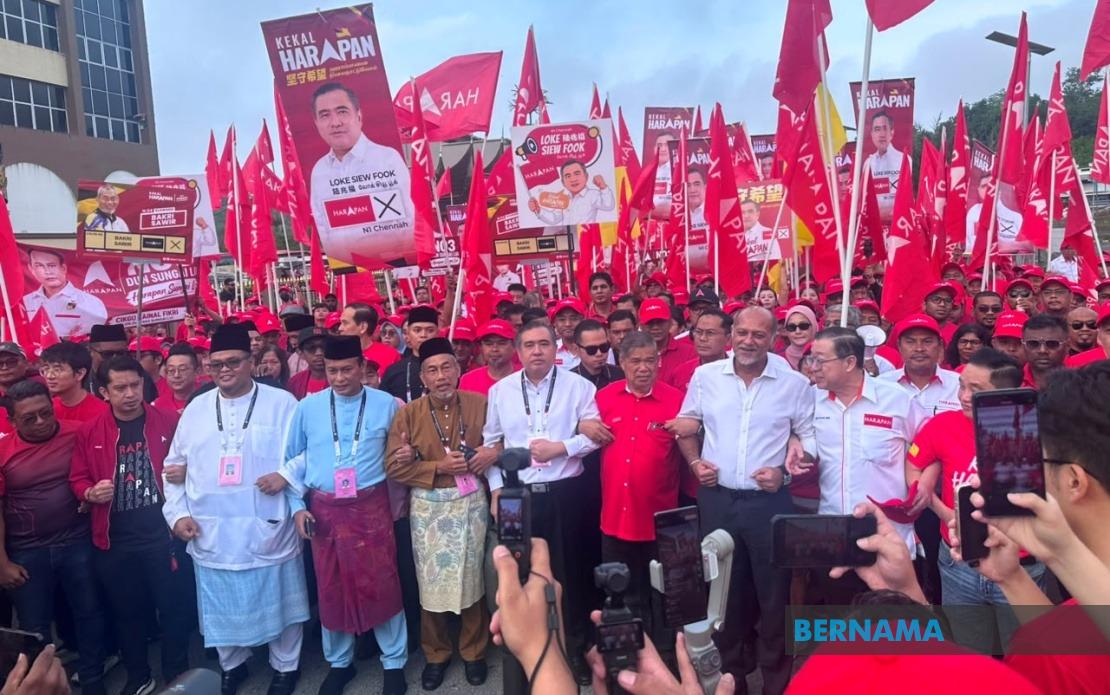
Senior figures from the Pakatan Harapan coalition descended on multiple nomination centres across Negeri Sembilan on July 18, underscoring the coalition's organisational push as candidates formally entered the race for the 16th state election. The show of unified leadership highlighted PH's strategy to project momentum following its relatively strong performance in the previous state election and ahead of the August 1 polling date, with early voting scheduled for July 28.
In Jelebu, Transport Minister Anthony Loke, who holds the position of DAP secretary-general, filed nomination papers for the Chennah state seat at Dewan Besar Kuala Klawang. His appearance at the nomination centre was deliberately high-profile, drawing alongside fellow party heavyweights including DAP chairman Gobind Singh Deo, DAP adviser Lim Guan Eng and Amanah president Datuk Seri Mohamad Sabu. The concentration of senior figures at a single nomination site reflected the symbolic importance PH attaches to securing representation in key constituencies, particularly those traditionally contested between the major coalitions.
Meanwhile, in Jempol, Deputy Communications Minister Teo Nie Ching, who also leads the DAP's women's wing, personally escorted PH candidate Teo Kok Seong as he submitted nomination papers for the Bahau state seat. Communications Minister Datuk Seri Fahmi Fadzil arrived shortly after to oversee a broader slate of candidates, shepherding four PH nominees contesting the Serting, Palong, Jeram Padang and Bahau constituencies. This distribution of ministerial presence across multiple locations demonstrated PH's attempt to maintain visible momentum in constituencies where it either held incumbent positions or sought to expand representation.
The candidate roster accompanying Fahmi Fadzil included a mix of political experience levels. Teo Kok Seong brings continuity as the incumbent representative from the previous election cycle, while Yaacob Mahmood, Muhammad Zahin Zinal Abidin and Manivanan Gowin represent fresh party choices in their respective seats. This combination of established figures and newcomers reflects the delicate balance major coalitions must strike between rewarding loyal grassroots organisers and introducing new political talent to broaden appeal among voters.
At Port Dickson, Negeri Sembilan Menteri Besar Datuk Seri Aminuddin Harun, who doubles as PH's state chairman, filed nomination papers for the Linggi seat. His nomination event drew attention from DAP deputy secretary-general Hannah Yeoh, PKR secretary-general Datuk Dr Fuziah Salleh and the Prime Minister's political secretary Datuk Farhan Fauzi, signalling alignment between state-level and federal PH structures. The presence of federal political operatives at state-level nomination events illustrates how contemporary Malaysian politics increasingly intertwines national and state governance dynamics, with decisions at one level influencing electoral calculations at another.
Alongside Aminuddin Harun's nomination, three incumbent candidates—Chuah Yew Boon Lye for Chuah, Choo Ken Hwa for Lukut and Dr G Rajassekaran for Sri Tanjung—also filed their papers, suggesting PH's confidence in retaining these seats despite inevitable electoral competition. The strategy of parading incumbents signals to voters that the coalition believes its record merits renewal, a particularly important message in states where anti-incumbency sentiment can shift voting patterns significantly.
At the Seremban nomination centre, Entrepreneur and Cooperatives Development Minister Steven Sim coordinated the filing of six PH candidates, accompanied by Selangor State Legislative Assembly Speaker Lau Weng San, Bukit Gelugor MP Ramkarpal Singh and PKR vice-president Datuk Seri R. Ramanan. The deployment of senior figures from neighbouring Selangor highlights how coalitions leverage cross-state political networks to amplify electoral campaigns, with prominent individuals from well-performing states lending credibility and campaign infrastructure to contests elsewhere in the region.
The electoral context makes these nomination-day mobilisations strategically significant. In the previous 15th state election in 2023, PH secured 17 of 36 available seats, establishing itself as the largest coalition bloc but falling short of the 19 seats required for outright control. Barisan Nasional won 14 seats while Perikatan Nasional captured five, creating a fragmented political landscape where coalition building post-election became necessary. Understanding this arithmetic shapes how PH deploys resources and messaging during nomination periods, as winning marginal seats could materially alter post-election negotiations over government formation.
The timing of the Negeri Sembilan election derives from the state legislative assembly's dissolution on June 5, following approval from Yang Dipertuan Besar Tuanku Muhriz Tuanku Munawir. This dissolution, though formally procedural, occurred within broader national political dynamics where coalition governments periodically test electoral mandates to strengthen their parliamentary positions. For PH, improved performance in Negeri Sembilan could strengthen its hand in federal coalition management and influence its ability to pursue policy initiatives within cabinet.
The organisational display on nomination day also carries implications for how voters perceive coalition strength and unity. In Malaysian electoral psychology, visible party discipline and leadership presence at ceremonial political moments—including nomination filings—function as signals of organisational competence and internal cohesion. Voters frequently interpret such demonstrations as indicators of whether a coalition possesses the institutional capacity to govern effectively, even if nomination-day pageantry does not directly address specific policy concerns affecting household finances or public services.
For Southeast Asian observers, the Negeri Sembilan election represents a microcosm of how Malaysian federalism creates multiple electoral contests with distinct dynamics yet interconnected consequences. State elections serve as intermediate testing grounds where national coalitions refine messaging, assess regional support and recalibrate political strategies before higher-stakes national contests. The demonstrable commitment of federal ministers and senior party figures to Negeri Sembilan's nomination processes reflects recognition that state electoral performance influences national political momentum and coalition resilience.
As Negeri Sembilan heads toward August 1 polling, the intensity of leadership mobilisation evident during nomination proceedings suggests an election viewed as consequential within PH's broader political strategy. The coalition's investment in visible high-level participation across multiple constituencies signals determination to consolidate recent gains and potentially improve upon its 2023 result, recognising that incremental state-level victories accumulate into material advantages in a federal system where aggregate coalition strength depends on performance across multiple jurisdictions.

