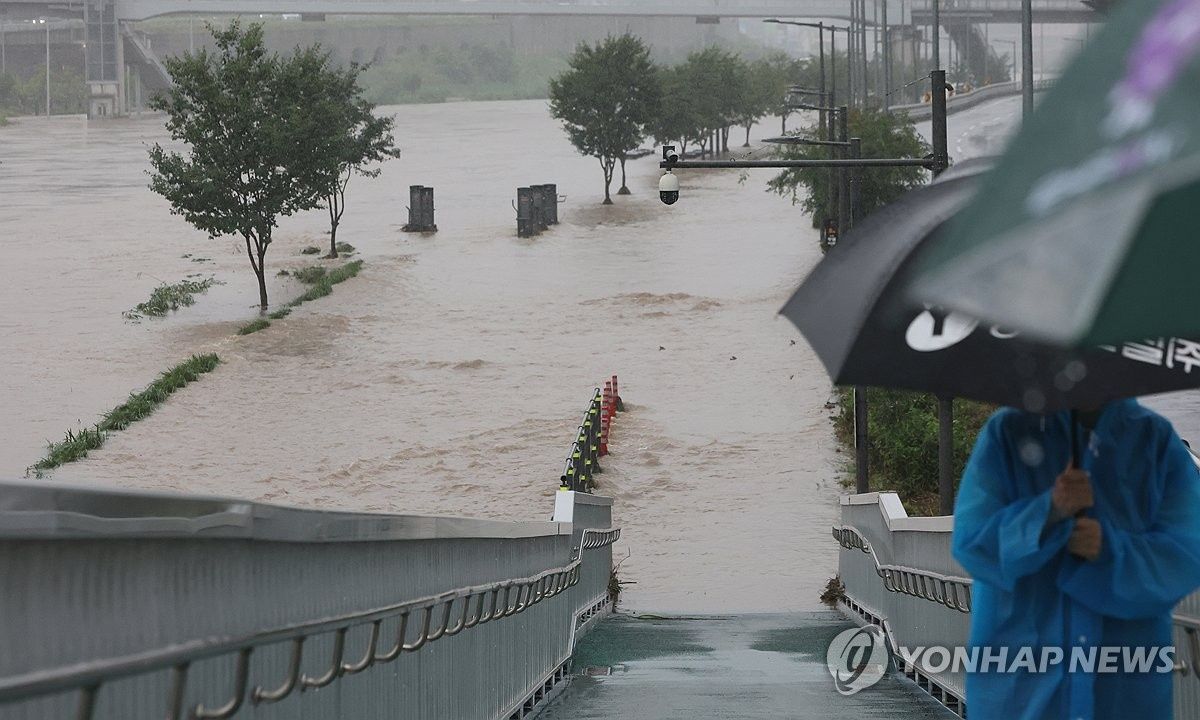
South Korea's capital region and surrounding areas endured a punishing deluge Saturday morning as near-record rainfall swept across the Seoul metropolitan zone and the mountainous Gangwon Province, triggering widespread flooding and infrastructural disruption. The overnight storm left approximately 540 instances of property damage in its wake, according to statements from the Central Disaster and Safety Countermeasure Headquarters, underscoring the scale of the meteorological event and its tangible impact on civilian populations and urban systems.
The rainfall intensity proved remarkable across multiple measurement points throughout the affected territories. Between midnight and 10 a.m. local time, precipitation levels hovered near or exceeded 190 millimetres in numerous districts: Paju recorded 192.5 mm, Dongducheon 189.5 mm, Pocheon 179 mm, Gimpo 166.5 mm, and Cheorwon 159.5 mm. These figures highlight the geographic breadth of the system and suggest the storm was not a localized phenomenon but rather a regional weather pattern affecting an expansive territory stretching from the northwestern Seoul suburbs to inland eastern regions.
The operational response from government agencies reflected the severity perceived by emergency management officials. By mid-morning Saturday, weather alerts remained active across 10 separate jurisdictions within Gangwon Province, while mudslide warnings specifically targeted Pocheon, a municipality where mountainous terrain compounds drainage challenges and increases geological instability. These precautionary measures indicated authorities' concern that saturated soil conditions could trigger secondary disasters even as rainfall continued.
Property-related incidents dominated official damage tallies. Authorities documented 148 discrete instances of residential and road flooding, while a separate category recorded 392 cases of downed trees and accumulated debris. The distinction between these figures reveals the storm's multifaceted destructive character—precipitation overloaded drainage infrastructure, but wind gusts or ground saturation also contributed to environmental damage. Notably, no fatalities emerged despite these considerable material losses, a result attributed partly to effective early warning systems and evacuation protocols.
Precautionary displacement affected a modest but significant population segment. Approximately 95 individuals from 44 households distributed across six municipalities were temporarily relocated to safer locations. This preventive approach, though inconvenient for affected families, likely prevented casualty figures from rising had residents remained in vulnerable zones during the height of rainfall intensity. The evacuation numbers suggest authorities successfully identified and acted upon high-risk areas before conditions deteriorated critically.
Recreational and transportation infrastructure absorbed substantial impacts from the flooding event. Ten national parks, including the prominent Mount Bukhan facility, shuttered their gates to visitors, effectively restricting access to 275 hiking trails and outdoor recreation sites. Simultaneously, maritime transport services deteriorated as operational authorities suspended seven ferry routes servicing western coastal regions. These closures, while temporary, demonstrate how weather events cascade through multiple economic sectors and disrupt daily routines far beyond those directly experiencing flooding.
Meteorological forecasts painted a worrying picture of conditions to come. Officials warned that heavy rainfall would persist through Sunday, with projections indicating localized rates potentially reaching 300 millimetres per hour in certain areas. This forecast suggested the overnight event might represent merely the opening chapter of a multi-day weather crisis, with particular emphasis on central and northeastern provinces expected to experience intensified precipitation during Sunday morning hours. Such projections necessitated sustained vigilance and preparation protocols extending well beyond the initial 24-hour response window.
Prime Minister Han Seong-sook convened emergency response leadership Saturday to coordinate governmental reaction to unfolding conditions. During the crisis meeting, she issued directives mandating rapid mobilization of equipment and personnel to affected zones, aiming to minimize ongoing disruption and expedite recovery operations. Her acknowledgment that residential properties and roadways had suffered inundation while residents sustained property losses reflected the administrative priority of validating public suffering and demonstrating governmental concern for civilian welfare during disaster response.
The prime minister's subsequent statements emphasized both the fortunate absence of human casualties and the sobering reality of material destruction. Her expression of condolences to affected parties signaled governmental recognition that property damage, while less catastrophic than loss of life, nonetheless imposed significant hardship upon individuals and families. This rhetorical balance—celebrating the absence of deaths while acknowledging economic harm—represented standard disaster-response communication designed to maintain public confidence in governmental competence.
Forward-looking concerns centered on secondary hazards potentially arising from the preceding night's saturation and continuing precipitation. Prime Minister Han specifically requested that officials maintain heightened readiness for potential landslides, particularly across Chungcheong Province and Gangwon Province where mountainous topography combined with water-logged soil creates conditions conducive to mass movement events. This emphasis on anticipatory risk management reflected lessons learned from previous weather disasters in South Korea and demonstrated administrative commitment to preventing cascading failures across sequential weather cycles.
For Malaysian observers, the Seoul situation illustrates vulnerabilities inherent in densely urbanized regions subjected to extreme precipitation—challenges directly relevant to Malaysian cities experiencing intensified monsoon rainfall and urban flooding. The Korean response protocols, particularly early warning systems and coordinated inter-agency mobilization, offer instructive examples of disaster management approaches applicable within Southeast Asian contexts. The distinction between casualties and property damage also underscores how effective preparedness and evacuation procedures can substantially reduce human costs even when material losses remain substantial.

