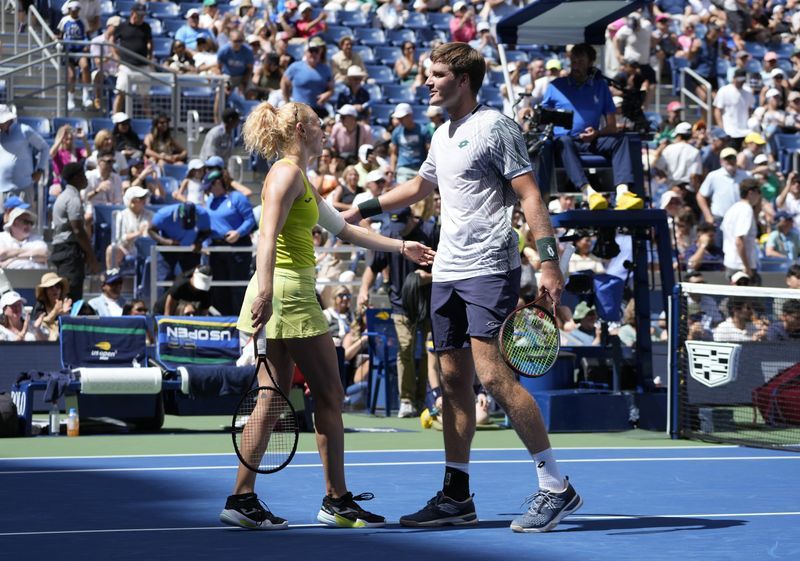
Serena Williams stepped back into the Arthur Ashe Stadium spotlight on Tuesday for her first competitive appearance there since bidding an emotional farewell in 2022, partnering with rising star Carlos Alcaraz to secure a commanding 5-3 4-1 victory over Erin Routliffe and Lloyd Glasspool in the mixed doubles opening round. The triumph electrified the venue, with thousands of spectators erupting in cheers as the 23-time Grand Slam champion returned to the court where she had captured so many of her greatest triumphs. Her comeback, announced just over two months earlier, marked an unexpected chapter in both her storied career and the broader narrative of professional tennis.
The pairing between the 44-year-old Williams and the 21-year-old Alcaraz created an intriguing cross-generational dynamic that proved far more than a mere marketing exercise. Williams demonstrated immediate comfort on court, striking a backhand winner on her opening touch and later unleashing a 120 mph ace that drew audible gasps from the crowd. For Alcaraz, competing for the first time since April following an injury layoff, the partnership offered both immediate competitive opportunity and invaluable mentorship from one of the sport's greatest practitioners. The young Spaniard, himself a seven-time major champion, appeared energized by the experience, executing cleanly through the second set as the pair advanced with apparent ease.
The chemistry between Williams and Alcaraz transcended mere tactical coordination. Both players displayed visible enjoyment throughout their encounter, with knowing grins and moments of levity that suggested Williams' presence had genuinely lifted her partner's mood and competitive spirit. Their matching royal purple outfits reinforced the sense of a unified team, while Alcaraz's subsequent remarks—crediting Williams with tactical guidance—underscored the educational dimension of their partnership. For Malaysian fans and Southeast Asian observers, the pairing represented a compelling demonstration of how tennis bridges generational and geographical divides, with two players from different continents and eras combining to create compelling entertainment.
The mixed doubles format itself has undergone significant transformation in recent years, particularly following the US Open's decision to elevate its status as a standalone event held the week before the singles draw. This structural change, now in its second year of implementation, deliberately repositioned mixed doubles from a sideshow into a marquee attraction capable of drawing marquee singles players. The commercial strategy proved remarkably successful during its inaugural year, generating sellout crowds and attracting major names despite vociferous objections from traditional doubles specialists who viewed the format as marginalizing their craft and established partnerships.
However, the format's expanded prominence did not shield the tournament's top-seeded partnership from early elimination. Novak Djokovic and Aryna Sabalenka, representing both the tournament's top ranking and considerable star power, suffered a stunning 1-4 4-2 10-2 defeat at the hands of experienced doubles professionals Henry Patten and Katerina Siniakova. The defeat exposed the inherent vulnerabilities of mixing elite singles players with limited doubles experience in a compressed format where individual service breaks prove immediately consequential. Siniakova, the victor, clinched the upset with an expertly placed ace on match point, sealing an accomplishment that demonstrated the persistent value of accumulated doubles expertise.
Patten's post-match analysis provided genuine insight into the format's strategic peculiarities. His observation that a single poor game could precipitate set loss captured the format's unforgiving mathematics, where players transitioning from singles-oriented rhythms found themselves exposed against opponents accustomed to the tactical nuances and positioning subtleties of doubles play. The tiebreaker victory Patten referenced underscored how matches in this format often hinged on brief, intense moments rather than the extended grinding points characteristic of traditional doubles.
The upset eliminated defending champions Sara Errani and Andrea Vavassori, the Italian pair who fell to the Russian combination of Mirra Andreeva and Andrey Rublev in a closely contested 1-4 4-1 11-9 result. The defending title holders' exit suggested that even established doubles credentials offered limited protection against determined opposition in a format that continued to showcase genuine unpredictability. Their conquerors advanced to face the winner of a forthcoming match between Casper Ruud, Diana Shnaider, Jessica Pegula, and Taylor Fritz, setting up intriguing combinations that would further test whether singles-oriented players could genuinely master doubles fundamentals under pressure.
Elsewhere in the draw, married couple Gaël Monfils and Elina Svitolina advanced to the semi-finals, as did the Czech-Slovak pairing of Karolina Muchova and Jakub Mensik. These progressions reflected a broader pattern emerging throughout the tournament: traditional doubles specialists and established partnerships often prevailed against combinations assembled primarily for commercial appeal or ranking points.
For Williams specifically, the US Open return carried profound significance beyond mere athletic competition. The moment represented closure of a chapter that many observers believed had definitively ended two years earlier. Her willingness to reenter professional competition, partnered with a player young enough to be her son, signaled personal resilience and genuine passion for competitive tennis. For the broader sport, her presence validated the mixed doubles format's capacity to generate authentic excitement and connect audiences to the human dimensions of athletic competition. The victory set up a quarter-final confrontation with Belinda Bencic and Flavio Cobolli later that same evening, offering further opportunity for Williams to demonstrate that her comeback possessed genuine substance rather than mere nostalgic appeal.

