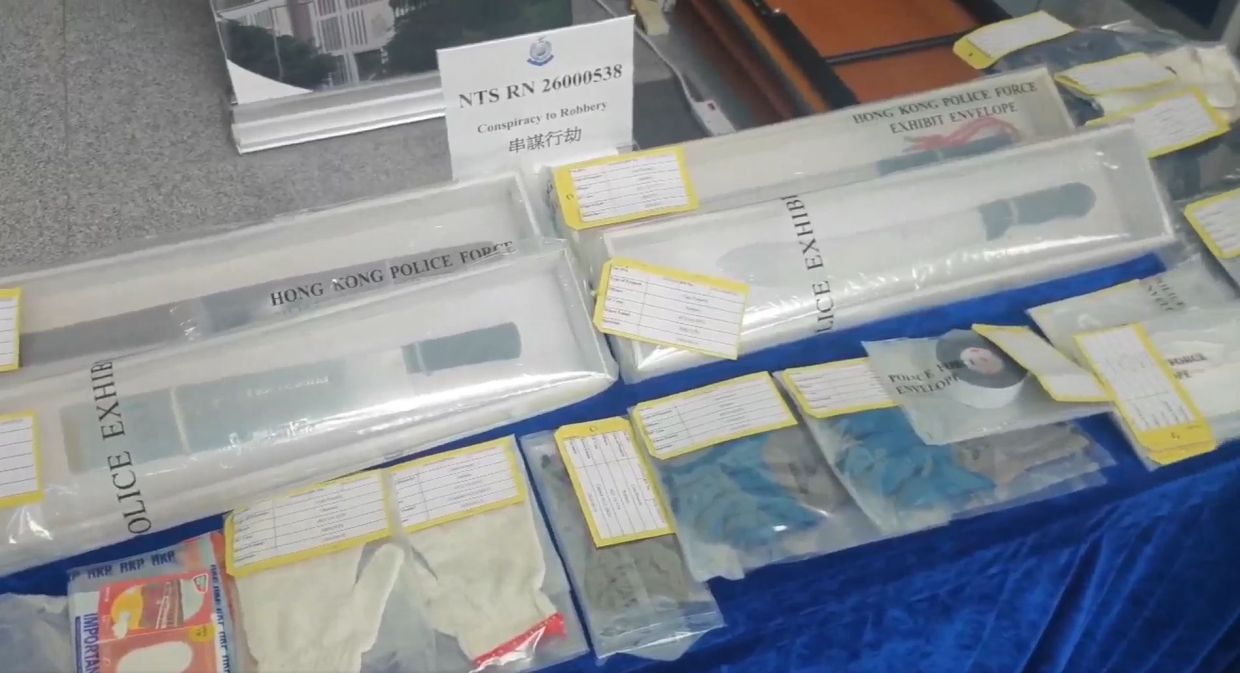
Hong Kong police have moved swiftly to dismantle a criminal gang responsible for a high-value gold theft that unfolded in broad daylight at Hong Kong International Airport. Within just 12 hours of the robbery being reported, law enforcement had taken seven individuals into custody on suspicion of orchestrating and abetting the heist that netted HK$7 million in precious metal. The rapid response demonstrates the efficiency of the territory's law enforcement apparatus when dealing with organised crime, though investigators acknowledge that some conspirators have already slipped away to safety across the border.
The incident occurred on Thursday, June 18, when a man arriving from Bali, Indonesia, became the unwitting target of a coordinated assault. The victim, who had just landed at the airport carrying six gold bars destined for a mainland businessman, was intercepted while making his way to retrieve his vehicle in car park 3. Three assailants wearing masks emerged to confront him, their intentions immediately evident as they brandished knives and set upon their target with calculated violence. The attackers inflicted stab wounds to the victim's left hand and foot before escaping with the backpack containing the precious cargo, which they loaded onto a seven-seater vehicle before disappearing into the sprawling metropolis.
The four men and three women detained by authorities range in age from 20 to 39 years old, representing a mixed crew of perpetrators and facilitators. Police investigations revealed that several of the arrested suspects maintained historical connections to triad societies, Hong Kong's notorious organised crime syndicates that have long engaged in robbery, extortion, and other serious offences. However, not all members of the criminal network fell into police hands during the initial sweep. Investigators believe that additional suspects involved in the conspiracy have managed to flee to mainland China, taking advantage of the porous border and the mainland's historical reluctance to extradite suspects to Hong Kong. Recognising the cross-border dimensions of the case, Hong Kong police have formally requested cooperation from mainland law enforcement authorities to apprehend the fugitives and recover the stolen property.
Among the most intriguing aspects of this case is the revelation that the robbery was far from a random act of street violence. Detectives have determined that the assailants possessed advance knowledge of the victim's arrival time and his intended parking location, a specificity that points toward involvement of an insider with access to operational information. Such inside knowledge typically emerges through relationships within airport security personnel, transportation logistics, or the criminal underworld's established intelligence networks. The precision with which the gang executed their strike—timing their assault to catch the victim at a vulnerable moment in an isolated section of the car park—suggests months of planning and coordination rather than opportunistic violence. This dimension elevates the investigation beyond a simple robbery inquiry into a more complex probe of potential corruption or collusion within airport operations.
Investigators have already achieved notable success in recovering evidence linked to the crime. Police located both the seven-seater vehicle used in the getaway and the knives wielded during the stabbing in the Tsuen Wan district, signifying a breakthrough in forensic analysis and reconstruction efforts. These recovered items will likely yield fingerprints, DNA evidence, and other trace materials that could strengthen the prosecution's case against the detained suspects and potentially identify additional perpetrators. The recovery of the vehicle and weapons also suggests that at least some gang members remained in Hong Kong after the heist rather than immediately fleeing to the mainland, possibly to dispose of evidence or collect payment from handlers.
The victim, who endured significant trauma both physical and psychological, was transported to Princess Margaret Hospital where medical staff stabilised his condition. Though wounded in both hand and foot, his injuries were assessed as non-life-threatening, and he was reported to be in stable condition. For a person who had merely arrived to conduct business on behalf of a mainland client, the experience represents a jarring introduction to Hong Kong's underbelly of organised crime and suggests that valuable cargo movements remain lucrative targets for sophisticated criminal enterprises operating in the territory.
This incident underscores persistent vulnerabilities in Hong Kong's airport security ecosystem despite decades of investment in counterterrorism and crime prevention measures. Car parks, with their labyrinthine structures and multiple exit points, remain attractive hunting grounds for organised robbery gangs seeking high-value targets. The targeting of someone arriving from an international flight carrying precious metals highlights the extent to which criminal networks monitor passenger movements and cargo patterns. For Malaysian travellers and business people who transit through Hong Kong International Airport or conduct commerce involving valuable goods, the case serves as a cautionary reminder about situational awareness and the importance of discretion when transporting high-value items in unfamiliar environments.
The swift police response and ongoing cross-border investigation reflect Hong Kong's commitment to tackling organised crime, yet the case also exposes the limitations of enforcement when perpetrators can exploit the Hong Kong-mainland border. As the investigation progresses and additional suspects are apprehended, authorities will likely focus on disrupting the supply chain that connects Hong Kong's criminal syndicates to mainland accomplices and determining what role corrupt insiders may have played in facilitating the heist.
%22%2F%3E%3C%2Fpattern%3E%3C%2Fdefs%3E%3Crect%20width%3D%22100%25%22%20height%3D%22100%25%22%20fill%3D%22url(%23ph2wu8ng)%22%2F%3E%3Crect%20width%3D%22100%25%22%20height%3D%22100%25%22%20fill%3D%22url(%23ph2wu8np)%22%2F%3E%3Ctext%20x%3D%2250%25%22%20y%3D%2250%25%22%20text-anchor%3D%22middle%22%20dominant-baseline%3D%22central%22%20fill%3D%22rgba(255%2C255%2C255%2C0.95)%22%20font-family%3D%22Georgia%2C%20'Times%20New%20Roman'%2C%20serif%22%20font-weight%3D%22700%22%20font-size%3D%22272%22%20letter-spacing%3D%22-0.02em%22%3EAnwar%3C%2Ftext%3E%3C%2Fsvg%3E)