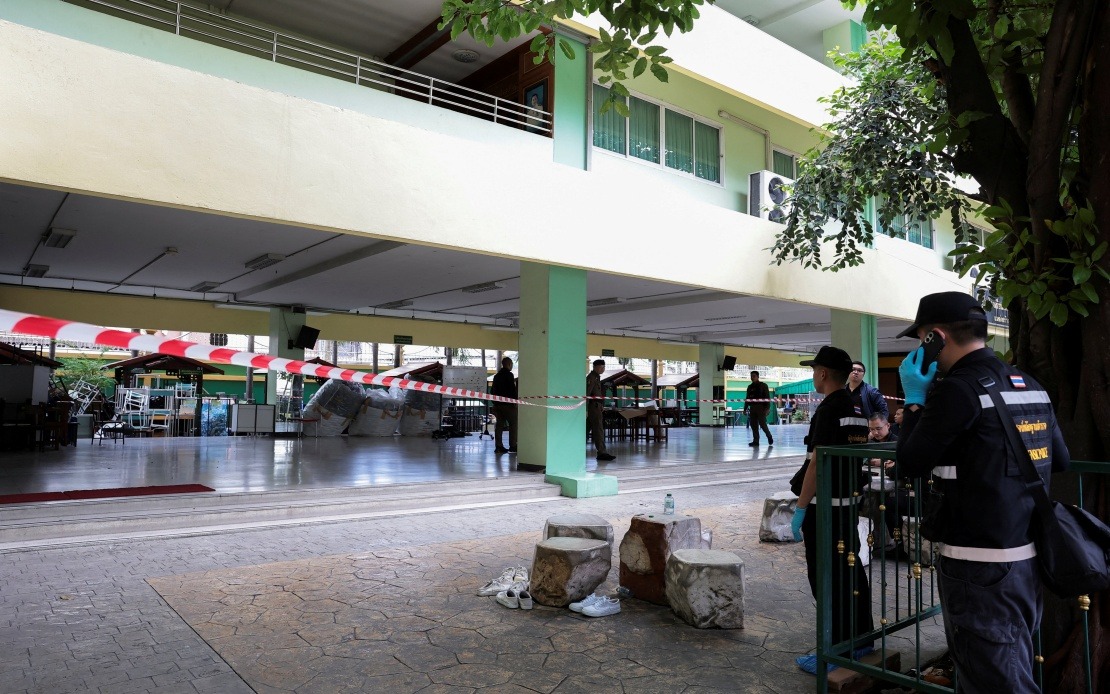
A shooting at Debsirin Nonthaburi School in Bang Kruai district on Friday morning left seven people dead and at least fifteen others wounded, marking another tragedy in Thailand's escalating pattern of armed violence at educational institutions. The incident occurred around 10 am when a student opened fire on the campus located in Nonthaburi province, northwest of the capital. According to the Royal Thai Police, the fatalities included three teachers, three students, and the shooter himself, who died at the scene. The casualty toll underscores the severity of the attack, which unfolded during school hours when the building was occupied by hundreds of pupils and staff.
Police Deputy Inspector-General Lieutenant General Trairong Piwpan disclosed that the weapon used in the attack was a 9mm handgun that belonged to the suspect's grandfather. Thirty-four rounds of ammunition were found outside the firearm's magazine, suggesting the gunman came to school with substantial firepower. The revelation that the weapon belonged to a family member has prompted renewed scrutiny of household gun storage practices and the responsibility of gun owners to secure firearms away from younger family members. Among the injured, two sustained serious wounds requiring urgent hospitalisation, while the remaining thirteen sustained injuries of varying severity. Medical staff across multiple hospitals in the region mobilised quickly to receive patients transferred from the scene.
School authorities implemented emergency evacuation procedures shortly after the shooting began. Teachers and students were moved to nearby Chanrat Wittaya School for safety and accountability purposes. Parents and guardians were instructed to collect their children as authorities worked to reunite families and assess the full extent of trauma across the school community. The evacuation process, while crucial for immediate safety, created confusion and distress among families desperate for information about their loved ones. Authorities also prioritised psychological support, with the national police chief directing Police General Hospital to urgently dispatch psychologists to provide counselling and mental health assistance to survivors, witnesses, and bereaved families.
Prime Minister Anutin Charnvirakul, who concurrently holds the interior ministry portfolio, responded to the tragedy by expressing profound sadness and pledging government support for the injured. He extended formal condolences to the families of those killed, acknowledging the gravity of the loss. Rather than treating the incident as an isolated event, Anutin contextualised it within his administration's firearm policy agenda. He stated that the shooting exemplified the rationale behind the government's decision to cease renewing permits for firearm carrying and possession, arguing that stricter regulations could prevent such tragedies. This policy stance reflects Thailand's ongoing tension between Second Amendment-style gun ownership traditions and public safety imperatives increasingly demanded by security concerns.
The Nonthaburi shooting represents the second school-based gun attack in Thailand within six months, a frequency that alarms policymakers and educators across Southeast Asia. In February of the same year, an eighteen-year-old man fired upon a school in Hat Yai, located in Songkhla province, killing the school director and injuring additional victims before being apprehended by authorities. That incident similarly raised questions about youth access to firearms and the adequacy of mental health screening systems for troubled young individuals. The recurrence of school shootings within such a compressed timeframe suggests systemic vulnerabilities in Thailand's approach to firearm regulation, youth mental health services, and early intervention programmes designed to identify and assist at-risk students.
For Malaysian observers, the Thai situation carries particular relevance given shared regional dynamics around gun ownership, urbanisation pressures, and youth mental health challenges. While Malaysia maintains comparatively strict firearms licensing regulations compared to Thailand, school safety remains a concern for Southeast Asian educators. The frequency and lethality of these incidents underscore the importance of comprehensive approaches that integrate better firearm access controls, enhanced school security protocols, improved mental health services for young people, and teacher training in recognising warning signs of potential violence. Educational institutions across the region increasingly recognise that safety requires multifaceted strategies rather than reliance on any single intervention.
The investigation into the Nonthaburi shooting will likely scrutinise how the suspect obtained access to his grandfather's firearm and what warning signs, if any, preceded the violence. Thai authorities will examine school records, medical histories, and communications to understand whether the student exhibited behavioural changes or made threats that might have triggered intervention. Such investigations typically reveal that mass shooters communicate intent through various channels before acting, suggesting opportunities for prevention if detection systems function effectively. Understanding the perpetrator's motivations—whether rooted in personal grievances, mental health crises, or other factors—will inform policy responses and preventive strategies.
Thailand's broader gun ownership culture differs substantially from Malaysia's highly regulated regime, where firearm possession requires stringent licensing through the police. However, the proliferation of weapons in civilian hands throughout Thailand, often justified for self-defence in rural areas or business protection in urban centres, creates risks of misuse and access by unauthorised individuals, particularly minors. The Nonthaburi incident powerfully demonstrates how firearms stored inadequately within homes become available to impulsive or troubled young people with potentially catastrophic consequences. Policymakers must balance legitimate self-defence needs with public safety imperatives, a challenge Thailand continues to navigate.
The government's stated commitment to tightening firearm regulations signals recognition that current systems have failed to prevent tragedies. Implementation of these policies will require cooperation from gun owners, improved compliance mechanisms, and effective enforcement to succeed. The decision to cease renewal of firearm permits may gradually reduce the number of weapons in civilian circulation, though enforcement challenges will persist given Thailand's substantial existing gun base. Additionally, authorities must invest substantially in mental health services, particularly school-based counselling and crisis intervention programmes capable of identifying and supporting troubled youth before incidents occur.
The Debsirin Nonthaburi School shooting will likely accelerate policy discussions within Thailand regarding comprehensive school safety measures. Discussions may encompass controlled access protocols, staff training in threat recognition, coordination with law enforcement, and emotional support infrastructure for students. Regional observers from Malaysia and other Southeast Asian nations will monitor Thailand's policy responses, potentially adapting successful elements within their own institutional frameworks. The tragedy serves as a stark reminder that educational spaces require protection and that access to firearms must be carefully controlled to prevent misuse by those, particularly young people, lacking sufficient emotional regulation or mental stability to handle weapons responsibly.

