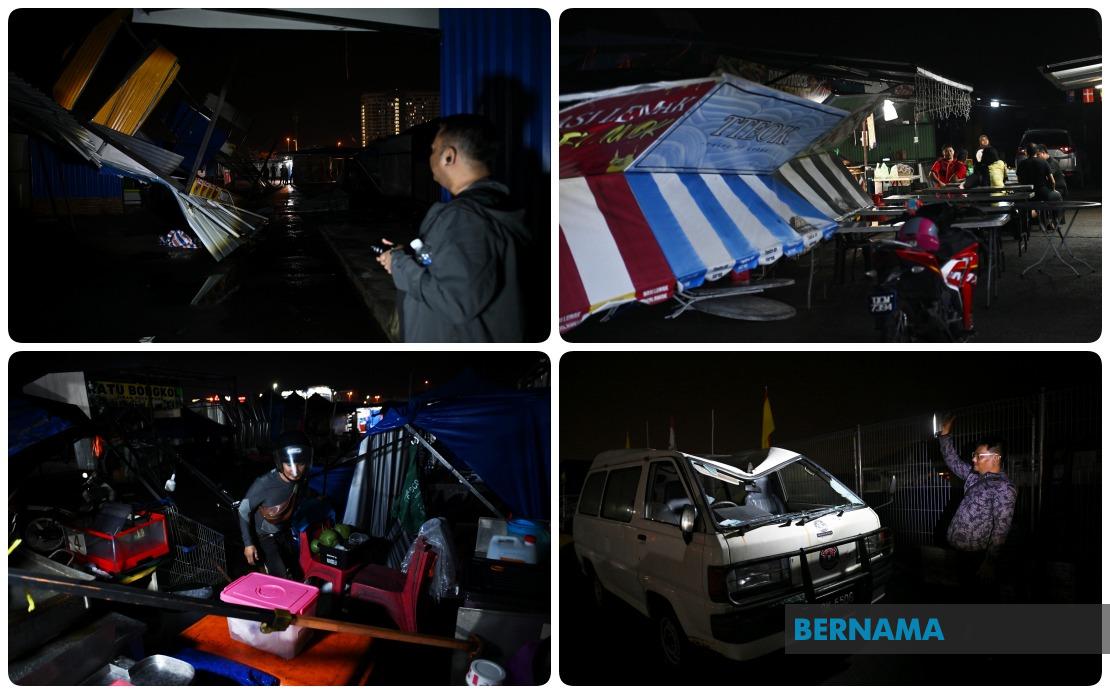
A severe weather system that swept through Kuching on the weekend brought exceptional destruction to the N6 Metrocity 2 Youth Night Market, forcing its immediate closure and leaving the hawking community grappling with significant financial losses. The unexpected storm, which struck during peak trading hours when the market typically attracts large crowds, caused widespread structural damage across the sprawling commercial site and created dangerous conditions that forced vendors to evacuate.
Mohamad Faisal, a 42-year-old vendor who has operated at the market, described the harrowing moments as strong winds tore through the venue with little warning. The sudden atmospheric disturbance transformed the normally bustling commercial space into a hazardous environment where canopy structures became airborne projectiles. He recounted how traders immediately abandoned their posts and merchandise, prioritising personal safety as the wind-swept framework whipped around the marketplace. The sheer velocity of the winds created multiple flying hazards simultaneously, with some canopies becoming airborne while others collapsed entirely, forcing nearby merchants to flee in different directions to avoid potential injury.
The scale of infrastructure damage proved extensive and multifaceted. Hamzah Hassan, deputy chairman of the night market management association, confirmed that the incident represents one of the most destructive weather events to affect the site since operations began a decade ago. From the approximately 300 individual trader lots operating at the venue, more than 40 experienced severe damage across their trading infrastructure. Beyond the vendor stalls, critical shared facilities also suffered significant harm, including the main performance stage, the management office, and the electrical supply network that powers the entire operation.
Financially, the impact on individual traders has been substantial and varied. While vendors who have operated at the market for the past ten years estimated collective losses of approximately RM2,000 per person, the deputy chairman's assessment reveals a more complex picture. Depending on canopy dimensions and structural specifications, individual traders face replacement costs ranging from RM2,000 to RM5,000 for the framework alone. These figures do not account for secondary damage to essential business equipment including cooking apparatus, water containers, and merchandise inventory. For many small-scale operators with limited financial reserves, such losses represent a significant setback to their livelihoods.
The night market occupies a crucial position within Kuching's informal economy, providing income opportunities for several hundred traders and serving as a regular shopping destination for local residents and tourists alike. Operating during evening hours when formal retail establishments have closed, the venue offers affordable dining and shopping options that depend entirely on predictable weather conditions and operational continuity. The forced closure disrupts not only vendor earnings but also community routines and the broader economic ecosystem surrounding the market.
The Malaysian Meteorological Department had issued an advance warning system for the region, posting a thunderstorm alert from 5 pm to 9 pm covering multiple Sarawak districts including Kuching, Serian, Siburan, Samarahan, Simunjan, Kapit and Song. This alert provided some advance notification of dangerous conditions, though the intensity and precise timing of the actual storm may have caught the market community somewhat unprepared. The meteorological agency's warning protocol demonstrates the technical capacity to anticipate severe weather, yet implementation of protective measures at commercial venues during peak hours remains a challenge that requires coordination between private operators and weather services.
Responding to the widespread damage, the market management has initiated outreach efforts seeking financial relief and material assistance. Hamzah Hassan indicated that the association welcomes contributions from relevant government ministries, local elected representatives, and cooperative organizations. Such requests reflect the vulnerability of informal sector participants who typically lack the insurance coverage or financial buffers available to larger commercial enterprises. The involvement of government agencies and elected officials could provide immediate relief mechanisms and potentially fund infrastructure reconstruction to restore the venue to full operational capacity.
This incident highlights the particular vulnerability of informal trading communities to environmental shocks and extreme weather events. Unlike permanent brick-and-mortar establishments with robust building codes and structural resilience standards, temporary market infrastructure relying on canvas canopies and lighter frameworks provides minimal protection against severe wind events. As climate patterns potentially shift toward more intense atmospheric disturbances, such markets face growing exposure to significant economic disruption. The incident raises questions about whether regulatory frameworks and building standards for informal commercial spaces adequately account for evolving weather risks.
For Malaysia's broader informal economy and the hundreds of thousands of small traders who depend on night markets for income, events such as this underscore the need for risk management frameworks and financial support mechanisms. The reconstruction of damaged infrastructure and the financial recovery of affected vendors will require coordinated action involving both private sector resources and government support programmes. Without intervention, individual traders may face extended income loss during recovery periods, potentially creating secondary economic hardship among the families depending on market earnings.
The closure of N6 Metrocity 2 Youth Night Market represents more than a temporary operational disruption; it demonstrates the intersection of environmental vulnerability, informal sector economics, and community resilience in Malaysian cities. As regulatory bodies and market operators reflect on this incident, questions about weather-resilient infrastructure design, emergency response protocols, and financial protection for informal sector workers will likely feature prominently in discussions about strengthening the economic security of Malaysia's night market communities.

