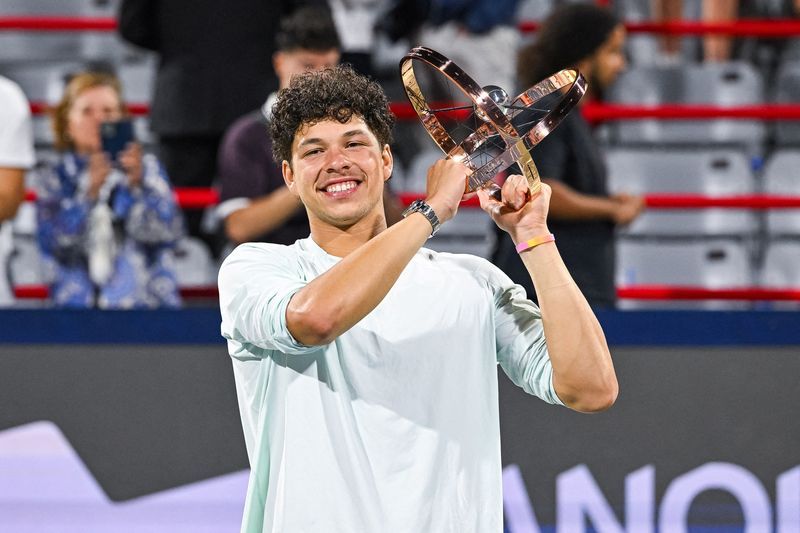
Ben Shelton arrives at the US Open with a pointed mission: to reverse the fortunes that have plagued his season at tennis's major tournaments. The 23-year-old American, ranked ninth globally, carries genuine momentum from his triumphant defence of the Canadian Open title in Montreal, where he navigated the entire draw without surrendering a single set. That breakthrough performance stands in sharp contrast to a campaign marked by inconsistency across the sport's marquee events, creating an unusual mixture of optimism and unfinished business as he prepares for the year's final Grand Slam.
Shelton's 2024 season has resembled precisely what he characterizes it as: a roller coaster, complete with exhilarating highs and unexpected lows. While he has accumulated four titles overall, his record at the Grand Slams tells a more sobering story. The Australian Open delivered a respectable quarter-final appearance, suggesting the American possesses the capacity to compete at the highest level. Yet subsequent major tournaments revealed significant gaps in his consistency. The French Open ended prematurely when he failed to advance beyond the second round, a disappointing exit on clay that raised questions about his versatility across surfaces. Wimbledon proved even more frustrating, with Shelton unable to clear the opening hurdle at the All England Club, a result that represented one of the season's more startling setbacks for a player of his ranking and potential.
However, the Canadian Open victory has fundamentally shifted Shelton's perspective entering New York. His performance in Montreal demonstrated marked improvement in the elements that separate elite competitors from those merely competing at a high level. Speaking to journalists after defeating Brandon Nakashima, Shelton identified specific improvements in his tactical execution and mental approach. He emphasized his enhanced clinical focus and occasional brilliance in return-of-serve situations, where he pressured opponents' delivery games with devastating effectiveness. Equally significant was his development of a more sophisticated defensive framework combined with aggressive shot-making, allowing him to dictate rallies rather than merely react to them. These elements collectively suggest a player entering the final stretch of the season with genuine progression rather than mere recovery.
Shelton's self-assessment carries particular weight given his explicit recognition of untapped potential. He believes additional layers of his game remain to be discovered and deployed, implying that even his impressive Canadian performance does not represent his ceiling. This psychological positioning matters enormously in tennis, where confidence and trajectory often determine outcomes as significantly as raw skill. On the hard courts that have dominated his recent schedule, Shelton reports incremental improvements across successive tournaments, a pattern suggesting he has identified the adjustments necessary to compete consistently against the sport's elite tier. His readiness to enter the US Open with renewed conviction, rather than residual disappointment from earlier disappointments, reflects the kind of mental resilience required to perform under the immense pressure surrounding a Grand Slam event.
The broader context surrounding Shelton's bid extends well beyond individual achievement. American tennis has endured a prolonged drought in men's singles Grand Slam titles, with Andy Roddick's 2003 US Open victory representing the last occasion an American male captured a major championship. That 21-year gap underscores how comprehensively the landscape has shifted toward European and now Australian dominance. Shelton has emerged as the most credible American candidate to reverse this trend, carrying the weight of national expectation that accompanies such a position. The sport-watching public in the United States has demonstrated genuine investment in his potential, understanding that another American Grand Slam champion would represent a significant restoration of American standing in a sport where the nation once reigned supreme.
Roddick himself, speaking during an August podcast before Jannik Sinner's withdrawal from the tournament, effectively endorsed Shelton as a legitimate contender. Roddick's assessment hinged on the absence of the tournament's most dominant players functioning at peak capacity. With question marks surrounding both the world number one and Carlos Alcaraz of Spain, Roddick identified a genuine opening for Shelton to claim the title. This analysis carries considerable credibility given Roddick's intimate familiarity with the pressures and mechanics of competing for a US Open crown. His willingness to position Shelton as a potential winner signals recognition that the American possesses not merely the ranking but the psychological and technical tools necessary for a deep run.
Shelton's 2023 US Open performance, when he reached the semi-finals, provides concrete evidence of his capacity to sustain excellence across multiple matches at this venue. That result demonstrated his ability to navigate varying opponents and playing styles while accumulating the kind of match fitness and confidence that Grand Slams demand. His semi-final appearance also revealed that he can handle the distinctive atmosphere of the US Open, where the intense spectator environment and extended match schedules present unique challenges. Returning to New York under improved circumstances—with a recent title and strengthened conviction—positions him advantageously compared to players arriving from disappointing major campaigns.
Shelton's philosophical approach to the demanding tennis calendar also merits consideration. He recognizes that the sport's extended season represents both blessing and burden, offering perpetual opportunities for redemption yet demanding sustained focus and physical recovery. This mature perspective reflects psychological development beyond the raw ambition of his early career. Each tournament presents a distinct opportunity to demonstrate progress or correct tactical approaches, creating a learning ecosystem where individual matches can precipitate significant shifts in trajectory. For a player of Shelton's ranking and potential, this outlook transforms Grand Slam events from make-or-break occasions into strategic waypoints within a larger developmental arc.
As Shelton settles into his US Open preparation, the convergence of factors—recent success, identified technical improvements, reasonable elimination of top threats, and prior semi-final experience—creates a plausible scenario for a breakthrough. The American enters not as an unlikely underdog but as a capable competitor whose recent form suggests matching credentials for challenging the tournament's favorites. His recognition that one significant match performance can alter everything reflects both the volatility and possibility inherent in tennis at the highest level.

