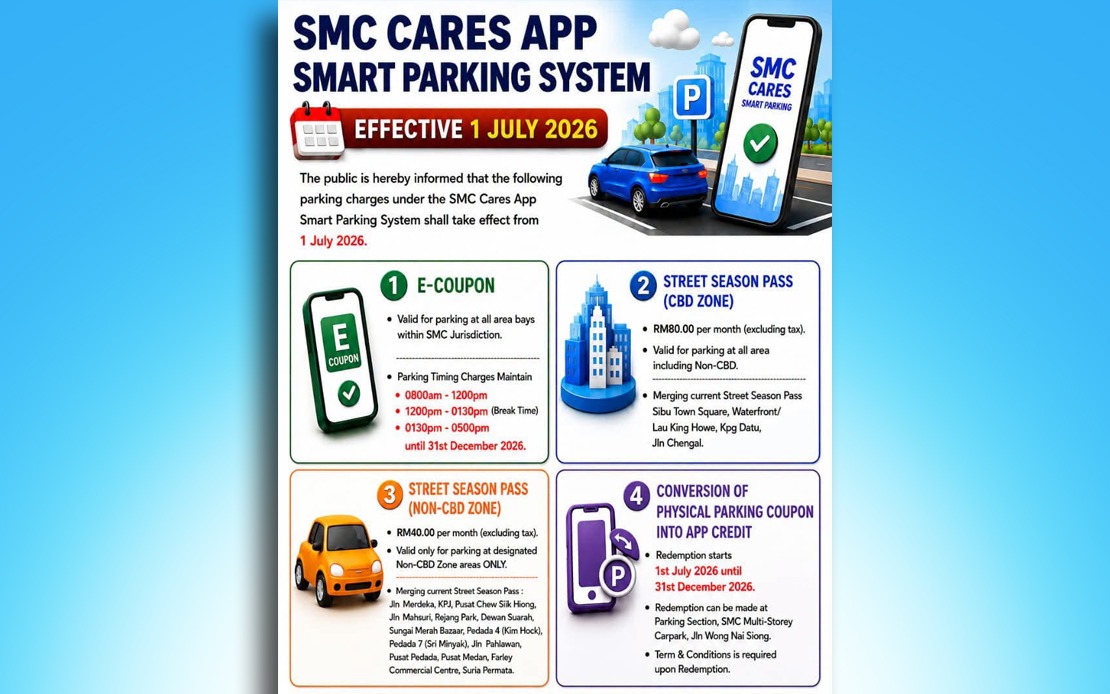
The Sibu Municipal Council has moved to soften its approach to smart parking enforcement after facing sustained public backlash over the rapid issuing of parking compounds, announcing a grace period and new concessions designed to make the system more accessible to its growing user base. The decision reflects mounting pressure from residents who have taken to social media to voice frustrations with the SMC Cares Smart Parking system since its full rollout earlier this month, with complaints ranging from technical glitches to what many perceive as overly aggressive penalty enforcement.
SMC Chairman Clarence Ting Ing Horh confirmed that the council has instructed system provider Primal Solution Sdn Bhd to implement a grace window of between five and ten minutes before an Over Parking Notice is issued, addressing one of the most contentious issues raised by users. This buffer period is intended to give motorists adequate time to physically park their vehicles, exit, and activate the payment through the mobile application—a sequence that many users have claimed is unrealistic under current system constraints. Ting emphasised that the council's intention is to facilitate use rather than penalise the public, signalling a shift in tone from the initial launch phase.
Beyond the grace period, SMC is introducing a Senior Citizen Parking Pass programme from August targeting drivers aged 60 and above, though full details remain to be disclosed. This initiative directly addresses complaints from older users who reported difficulty navigating the application's registration and payment processes. The concession acknowledges that digital adoption barriers are particularly acute for this demographic and that blanket enforcement without such provisions risks excluding vulnerable road users from accessing what is meant to be a convenient, modern parking solution.
Ting acknowledged the council's receptiveness to public feedback and encouraged users to escalate concerns through official SMC channels rather than relying on unverified claims spreading across social platforms. However, he also mounted a defence of the system itself, noting that motorists who believe notices have been wrongly issued can lodge appeals for council review, with every compound backed by photographic evidence stored within the system. This suggests that while the council is making operational adjustments, it maintains confidence in the enforcement mechanism's underlying accuracy.
The council has also clarified the scope of authority held by contract parking wardens, stipulating that they are authorised only to enforce parking-related violations such as unpaid or expired parking time and overparking. Separate enforcement of illegal parking and traffic obstruction remains the responsibility of SMC's own enforcement division and police—a distinction the council felt compelled to make after social media claims that wardens were overstepping their mandate. To improve public interactions, wardens have been instructed to be more approachable in assisting users unfamiliar with the application, and have been directed to avoid face coverings except for legitimate medical reasons, improving transparency and public confidence.
A dedicated support counter at Sibu Public Library now provides assistance for users requiring help with registration and application use, establishing an offline point of access for those uncomfortable with purely digital support. This represents an important concession to digital inclusion, particularly given the age range of Sibu's population and the concentration of complaints from senior citizens struggling with the technical interface.
Addressing allegations that Sibu's parking rates rank among the state's highest, Ting presented comparative data suggesting that SMC's charges remain competitive with rates set by other Sarawak local authorities. He further clarified that all parking revenue flows directly to SMC while the contractor receives separate compensation under a service agreement, a point designed to counter suspicions that aggressive enforcement might benefit the private operator. This transparency on financial flows is relevant for Malaysian readers accustomed to scrutiny over public-private partnerships in municipal services.
The system has already achieved over 93,000 registrations since launch and is on track to exceed the council's initial target of 100,000 by year-end, indicating substantial adoption despite the controversies. This figure demonstrates that despite implementation challenges, the smart parking infrastructure has attracted significant interest among Sibu motorists, suggesting demand for modernised parking management if technical and operational issues can be resolved.
The complaints that prompted this policy review paint a picture of a system that was ambitious in scope but inadequate in execution. Users reported complications with the registration process, unintuitive interface design, slow performance, involuntary log-outs, payment processing delays, and the issuance of compounds before payments could be fully processed. These are not merely inconveniences but represent a fundamental disconnect between system design and user capacity, particularly acute for older residents or those with limited smartphone literacy.
For Malaysian cities considering similar smart parking implementations, Sibu's experience offers cautionary lessons about the importance of phased rollouts with robust user testing before full enforcement. The necessity of introducing grace periods and age-specific exemptions suggests that the initial system was calibrated too aggressively for the prevailing level of digital adoption in the community. The council's responsiveness to criticism demonstrates that public pressure can drive municipal adjustments, though earlier consultation might have prevented the reputational damage incurred during the contentious launch phase.
The broader significance of Sibu's correction lies in its illustration of the tension between technological modernisation and social inclusion in urban Malaysia. Smart parking systems promise efficiency and revenue optimisation, but their successful implementation requires embedding them within institutional frameworks that account for varying user capabilities and ensure that no demographic is systematically disadvantaged. The introduction of concessions for senior citizens and grace periods for all users suggests SMC has recognised that technology must serve equity, not undermine it.
Moving forward, the council's willingness to iterate based on feedback may help restore public confidence in the system. However, the incident underscores the critical importance of extensive public engagement and user training before deploying enforcement-intensive digital services. As other Malaysian municipalities contemplate similar initiatives, Sibu's experience demonstrates that the success of smart parking hinges not merely on technological robustness but on the institutional commitment to ensuring the system remains accessible and fair across the entire user population.

